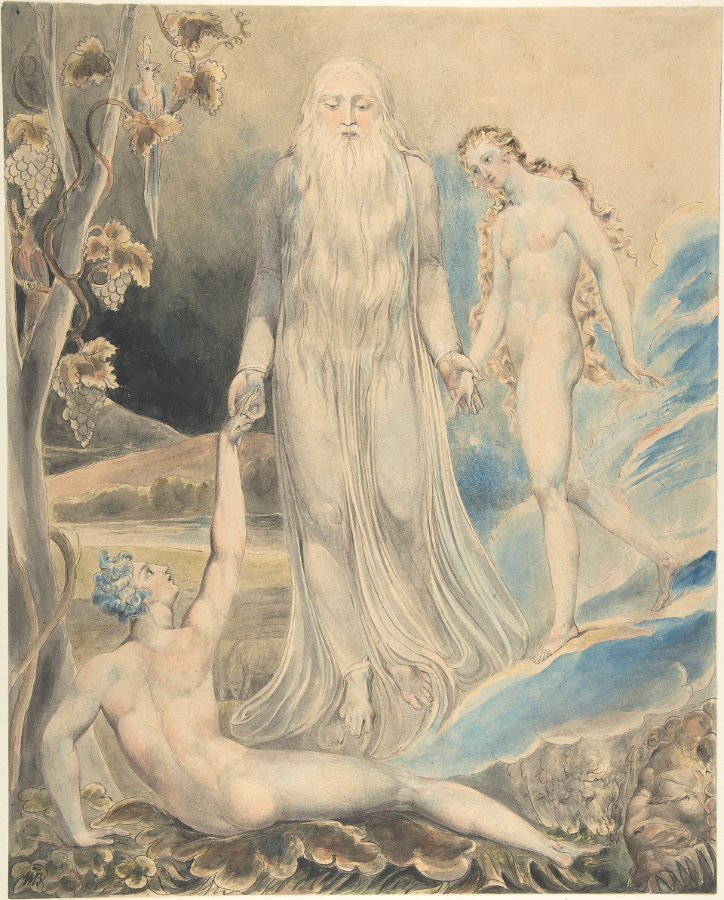
Adam is the name given in Genesis 1–5 to the first human. Adam is the first human being aware of God, and features as such in various belief systems (including Judaism, Christianity, Gnosticism, Islam, and the Baháʼí Faith). According to Christianity, Adam sinned in the Garden of Eden by eating from the tree of the knowledge of good and evil. This action introduced death and sin into the world. This sinful nature infected all his descendants, and led humanity to be expelled from the Garden. Only through the crucifixion of Jesus, humanity can be redeemed. In Islam, Adam is considered Khalifa (خليفة) (successor) on earth. This is understood to mean either that he is God’s deputy, the initiation of a new cycle of sentient life on earth, or both. Similar to the Biblical account, the Quran has Adam placed in a garden where he sins by taking from the Tree of Immortality, so loses his abode in the garden. When Adam repents from his sin, he is forgiven by God. This is seen as a guidance for human-life, who sin, become aware of their mistake, and repent. In Gnostic belief systems, the bodily creation of Adam is viewed in a negative light. Due to the underlying demonization of matter, Gnostic cosmologies depict the body as a form of prison of Adam’s soul. This soul would have been transferred by Sophia (wisdom) onto the creator (Demiurge) of the material world, who in turn is tricked into blowing the soul into a body.
Appearance List Book of Genesis (c. 6th–5th century BCE; earlier traditions) [Internet Archive]; Antiquities of the Jews (c. 93 CE) by Flavius Josephus [Internet Archive]; Paradise Lost (1667) by John Milton [Internet Archive]; Cain (1821) by Lord Byron [Internet Archive]; East of Eden (1952) by John Steinbeck (Cain and Abel retelling)
Sample Read The King James Version of the Bible [PG]
Description Adam is the name given in Genesis 1–5 to the first human. Adam is the first human being aware of God, and features as such in various belief systems (including Judaism, Christianity, Gnosticism, Islam, and the Baháʼí Faith). According to Christianity, Adam sinned in the Garden of Eden by eating from the tree of the knowledge of good and evil. This action introduced death and sin into the world. This sinful nature infected all his descendants, and led humanity to be expelled from the Garden. Only through the crucifixion of Jesus, humanity can be redeemed. In Islam, Adam is considered Khalifa (خليفة) (successor) on earth. This is understood to mean either that he is God’s deputy, the initiation of a new cycle of sentient life on earth, or both. Similar to the Biblical account, the Quran has Adam placed in a garden where he sins by taking from the Tree of Immortality, so loses his abode in the garden. When Adam repents from his sin, he is forgiven by God. This is seen as a guidance for human-life, who sin, become aware of their mistake, and repent. In Gnostic belief systems, the bodily creation of Adam is viewed in a negative light. Due to the underlying demonization of matter, Gnostic cosmologies depict the body as a form of prison of Adam’s soul. This soul would have been transferred by Sophia (wisdom) onto the creator (Demiurge) of the material world, who in turn is tricked into blowing the soul into a body.

 ,
,  ,
,