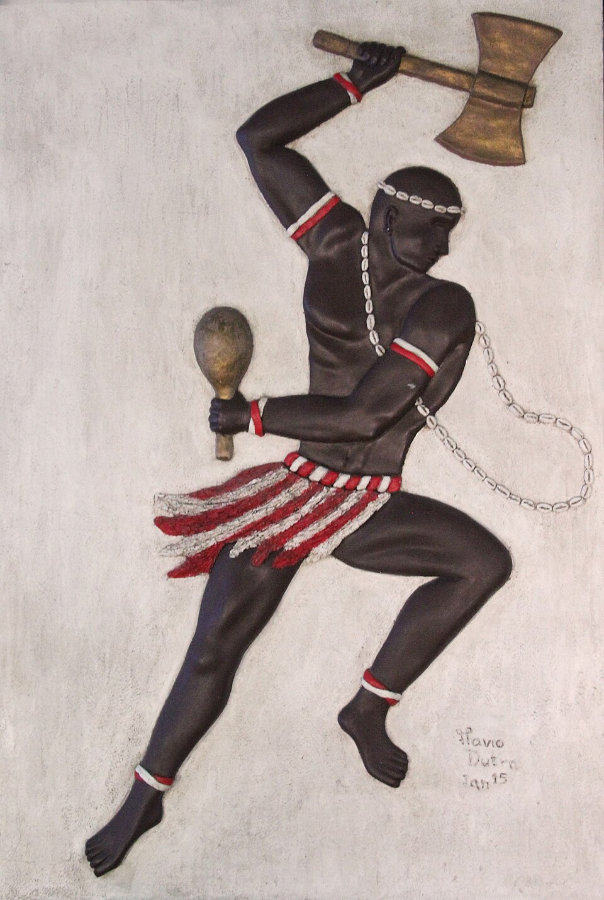
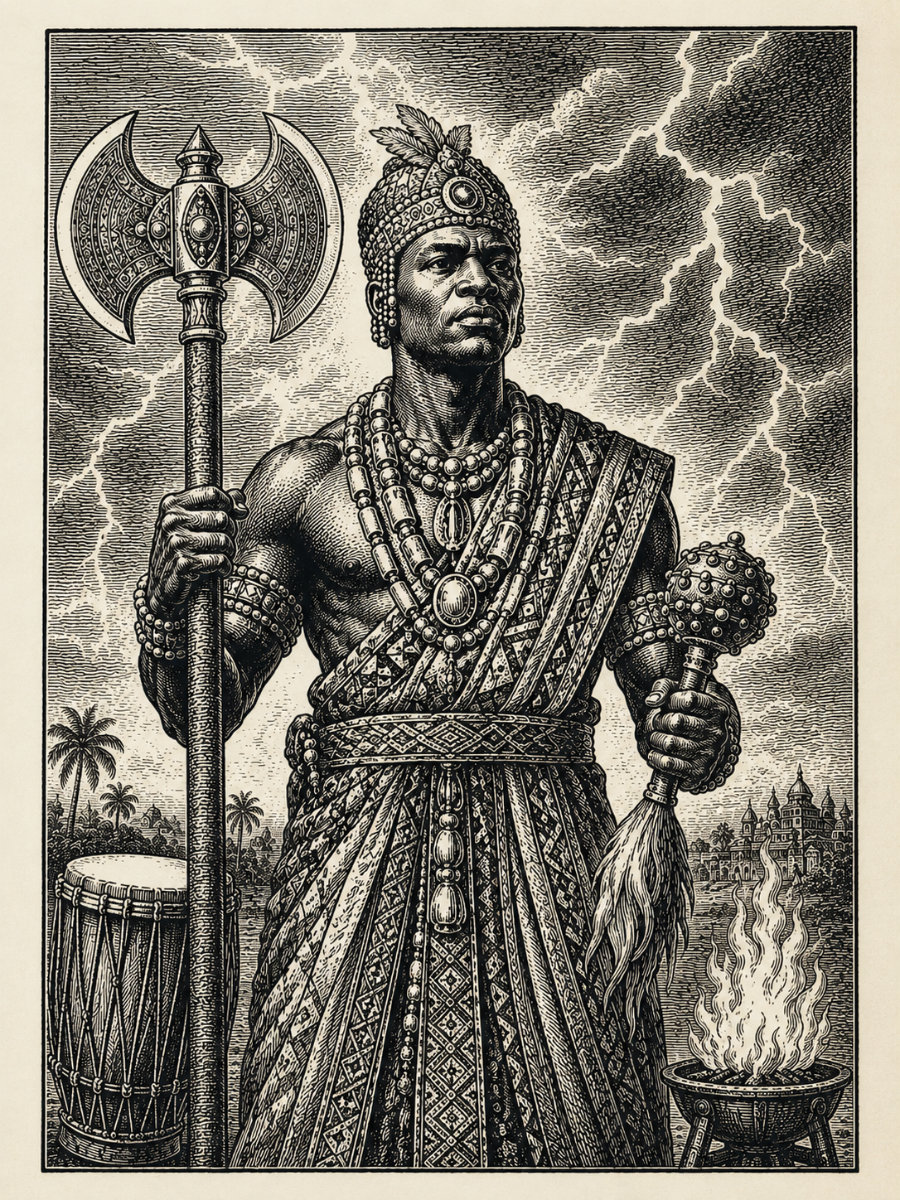
Shango is the Orisha (or deity) of fire, thunder, lightning, virility, dance, drumming, strength and justice in the Yoruba religion. Genealogically, Shango is a royal ancestor of the Yoruba as he was the third Alaafin of the Oyo Empire prior to his posthumous deification. Xangô, as he is called in Candomblé and various other Afro-Brazilian religions, is believed to have numerous manifestations as various historical and legendary figures, including Ayrá, Agodo, Afonja, Lubé, and Obomin… Shango is known for his double-headed battle-axe (Oṣé) and is considered to be one of the most powerful rulers in Yoruba history… Historically, Ṣàngó was the third Alaafin of Oyo, following Oranmiyan and Ajaka. He brought prosperity to the Oyo Empire. According to Professor Mason’s Mythological Account of Heroes and Kings, unlike his peaceful brother Ajaka, he was a powerful, bellicose and violent ruler. He reigned for seven years which were marked by his continuous campaigns and many battles. His reign ended due to the inadvertent destruction of his palace by lightning. He had three wives, namely Queen Oshun, Queen Ọba, and Queen Ọya.
Alias Shango
Real Names/Alt Names Shango, Ṣàngó, Changó (Santería), Xangô, Jakuta, Badé
Appearance List The voice of Africa v. 1 (1913) by Leo Frobenius — valued for early observations and visual documentation despite controversial diffusionist interpretations of African civilization [Smithsonian]; The history of the Yorubas : from the earliest times to the beginning of the British Protectorate (1921) by Rev. Samuel Johnson, Paster of Oyo; ed. Dr. O. (Obadiah) Johnson, Lagos [Internet Archive]; Os africanos no Brasil (1932) by Raymundo Nina Rodrigues; Xangôs do Nordeste: investigações sobre os cultos negro-fetichistas do Recife (1937) by Albino Gonçalves Fernandes; The Religion of the Yorùbá (1948) by J. Olumide Luca; Candomblés da Bahia (first ed. 1948; 2nd ed. 1954) by Edison Carneiro; West African Religion (1949) by Geoffrey Parrinder; Dieux d’Afrique (1954) by Pierre Verger (original edition; later reissued); Olódùmarè: God in Yoruba Belief (1962) by E. Bolaji Idowu; “The Symbolism and Ritual Context of the Yoruba ‘Laba Shango’” in Journal of the Royal Anthropological Institute (1962) by Janice Wescott & Peter Morton-Williams; Three Yoruba Plays (1964) by Duro Ladipo; The Shango Cult in Trinidad (1965) by George Eaton Simpson (monograph; first ed. 1965); African Religions in Brazil (French: Les religions africaines au Brésil, 1960) by Roger Bastide; Ifa Divination: Communication Between Gods and Men in West Africa (1969) by William Bascom; Yoruba Beliefs and Sacrificial Rites (1979) by J. Ọmọṣade Awolalu.
Sample Read Yoruba Beliefs and Sacrificial Rites (1979) [Internet Archive]
Description Shango is the Orisha (or deity) of fire, thunder, lightning, virility, dance, drumming, strength and justice in the Yoruba religion. Genealogically, Shango is a royal ancestor of the Yoruba as he was the third Alaafin of the Oyo Empire prior to his posthumous deification. Xangô, as he is called in Candomblé and various other Afro-Brazilian religions, is believed to have numerous manifestations as various historical and legendary figures, including Ayrá, Agodo, Afonja, Lubé, and Obomin… Shango is known for his double-headed battle-axe (Oṣé) and is considered to be one of the most powerful rulers in Yoruba history… Historically, Ṣàngó was the third Alaafin of Oyo, following Oranmiyan and Ajaka. He brought prosperity to the Oyo Empire. According to Professor Mason’s Mythological Account of Heroes and Kings, unlike his peaceful brother Ajaka, he was a powerful, bellicose and violent ruler. He reigned for seven years which were marked by his continuous campaigns and many battles. His reign ended due to the inadvertent destruction of his palace by lightning. He had three wives, namely Queen Oshun, Queen Ọba, and Queen Ọya.

 ,
,  ,
,  ,
,  ,
,