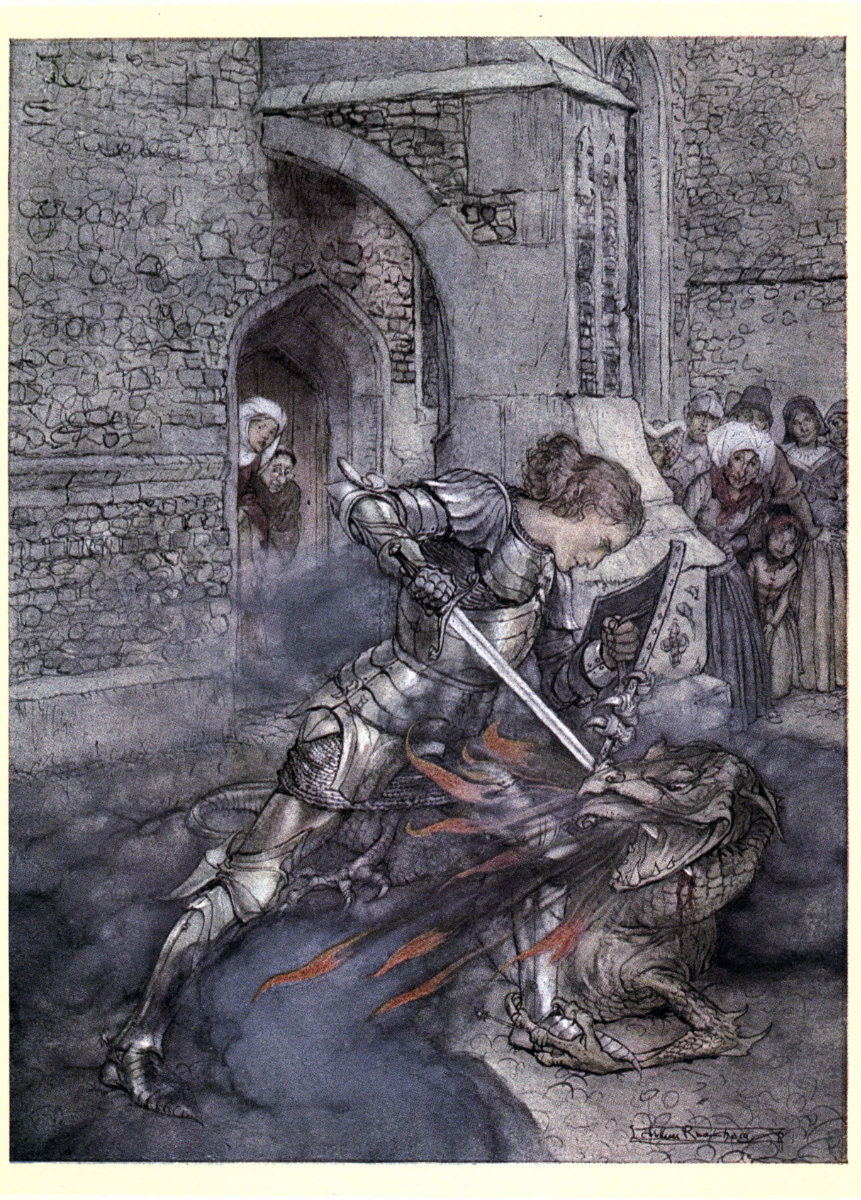
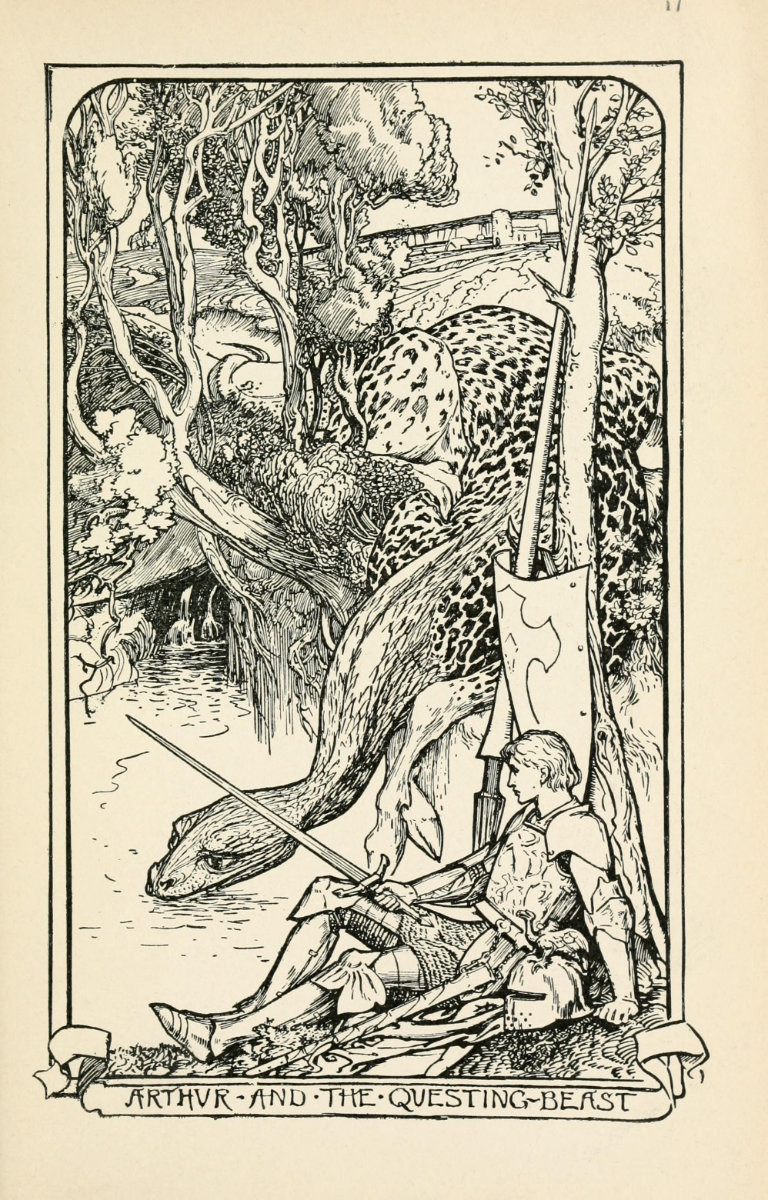
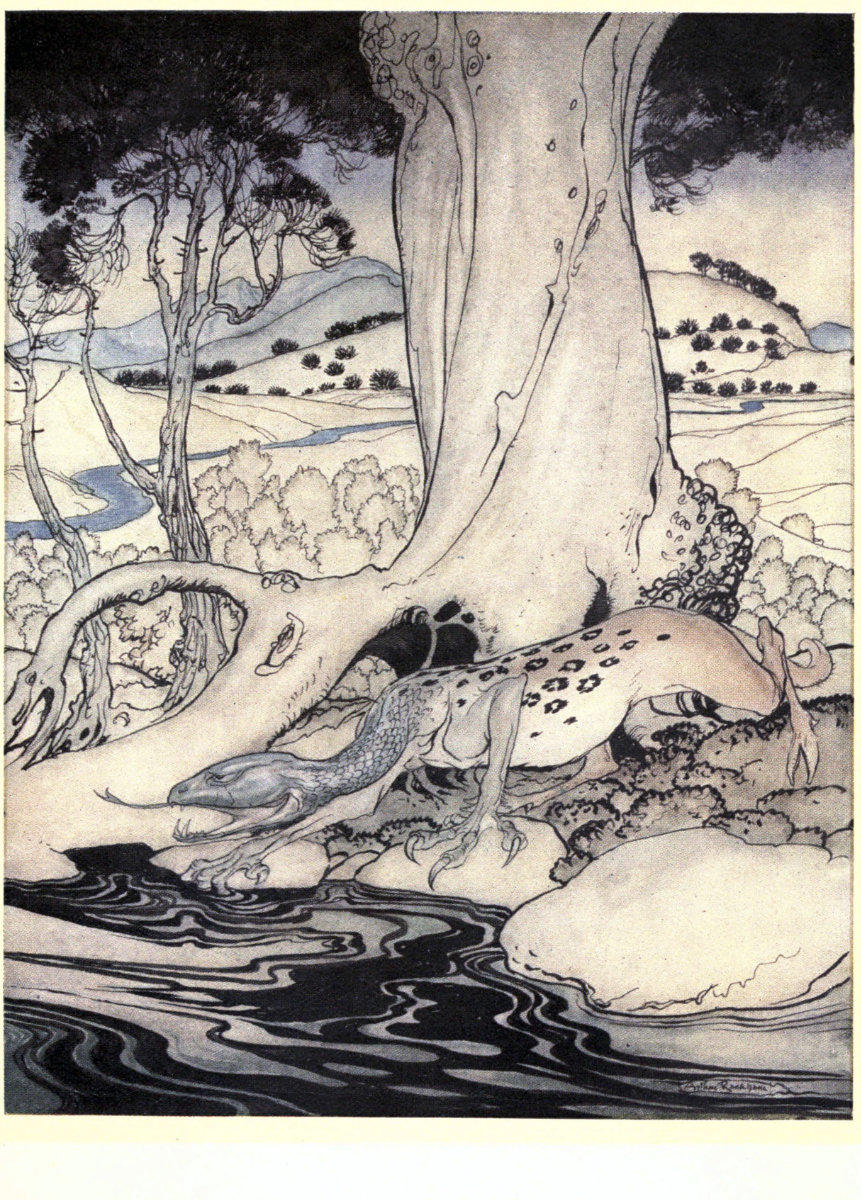
The Questing Beast, or the Beast Glatisant, is a cross-animal monster appearing in many medieval texts of the Arthurian legend and modern works inspired by them. In the French prose cycles, and consequently in the quasi-canon of Le Morte d’Arthur, the hunt for the Beast is the subject of quests futilely undertaken by King Pellinore and his family, and finally achieved by Sir Palamedes and his companions… Its name comes from the great noise that it emits from its belly… Glatisant is related to the French word glapissant, ‘yelping’ or ‘barking’, especially of small dogs or foxes… A Questing Beast-style, chimera-like creature first appears in the Arthurian legend in the prologue to the Vulgate Estoire del Saint Grail (History of the Holy Grail), where it is an unnamed and friendly animal that accompanies and guides the initial-narrator character in the 8th century into finding the book containing the main story… The actual Questing Beast story, originally from Post-Vulgate Suite du Merlin (Merlin Continuation), has the creature appear to the young King Arthur after he has had an affair with his half-sister Morgause and begotten Mordred (they did not know that they were related when the incestuous act occurred). Arthur sees it drinking from a pool just after he wakes from a disturbing dream that foretells Mordred’s destruction of the realm. He is then approached by King Pellinore, who confides that it is his family quest to hunt the Beast. Merlin reveals that the monster had been born of a human woman, a princess who lusted after her own brother. She slept with a devil who had promised to make the boy love her, but the devil manipulated her into accusing her brother of rape. Their father had the brother torn apart by dogs as punishment. Before he died, he prophesied that his sister would give birth to an abomination that would make the same sounds as the pack of dogs that were about to kill him… In the Post-Vulgate Merlin Continuation and Queste de Saint Grail (Quest for the Holy Grail), the Prose Tristan, and in Thomas Malory’s Le Morte d’Arthur, Saracen knight Palamedes hunts the Questing Beast. It is at first a futile venture, much like his love for Tristan’s paramour Iseult, offering him nothing but hardship. However, the conversion to Christianity allows Palamedes relief from his endless worldly pursuits, and he finally slays the Beast during the Grail Quest after he, Perceval, and Galahad have chased it into a lake. The Questing Beast story in the Post-Vulgate can be interpreted as a symbol of the incest, violence and chaos that eventually destroys Arthur’s kingdom…
Appearance List Perlesvaus / The High History of the Holy Grail (early 13th century) — Anonymous; Suite du Merlin / Post-Vulgate Merlin Continuation (13th century) — Anonymous; Prose Tristan (13th century) — Anonymous; Le Morte d’Arthur (1485) by Thomas Malory; The Boy’s King Arthur (1880) by Sidney Lanier; The Sword in the Stone (1938) by T. H. White; The Witch in the Wood (1939) by T. H. White; The Once and Future King (1958) by T. H. White. Film: The Sword in the Stone (1963, The Walt Disney Company). TV: Lost in Space — episode “The Questing Beast” (1967).
Description The Questing Beast, or the Beast Glatisant, is a cross-animal monster appearing in many medieval texts of the Arthurian legend and modern works inspired by them. In the French prose cycles, and consequently in the quasi-canon of Le Morte d’Arthur, the hunt for the Beast is the subject of quests futilely undertaken by King Pellinore and his family, and finally achieved by Sir Palamedes and his companions… Its name comes from the great noise that it emits from its belly… Glatisant is related to the French word glapissant, ‘yelping’ or ‘barking’, especially of small dogs or foxes… A Questing Beast-style, chimera-like creature first appears in the Arthurian legend in the prologue to the Vulgate Estoire del Saint Grail (History of the Holy Grail), where it is an unnamed and friendly animal that accompanies and guides the initial-narrator character in the 8th century into finding the book containing the main story… The actual Questing Beast story, originally from Post-Vulgate Suite du Merlin (Merlin Continuation), has the creature appear to the young King Arthur after he has had an affair with his half-sister Morgause and begotten Mordred (they did not know that they were related when the incestuous act occurred). Arthur sees it drinking from a pool just after he wakes from a disturbing dream that foretells Mordred’s destruction of the realm. He is then approached by King Pellinore, who confides that it is his family quest to hunt the Beast. Merlin reveals that the monster had been born of a human woman, a princess who lusted after her own brother. She slept with a devil who had promised to make the boy love her, but the devil manipulated her into accusing her brother of rape. Their father had the brother torn apart by dogs as punishment. Before he died, he prophesied that his sister would give birth to an abomination that would make the same sounds as the pack of dogs that were about to kill him… In the Post-Vulgate Merlin Continuation and Queste de Saint Grail (Quest for the Holy Grail), the Prose Tristan, and in Thomas Malory’s Le Morte d’Arthur, Saracen knight Palamedes hunts the Questing Beast. It is at first a futile venture, much like his love for Tristan’s paramour Iseult, offering him nothing but hardship. However, the conversion to Christianity allows Palamedes relief from his endless worldly pursuits, and he finally slays the Beast during the Grail Quest after he, Perceval, and Galahad have chased it into a lake. The Questing Beast story in the Post-Vulgate can be interpreted as a symbol of the incest, violence and chaos that eventually destroys Arthur’s kingdom…

 ,
,  ,
,