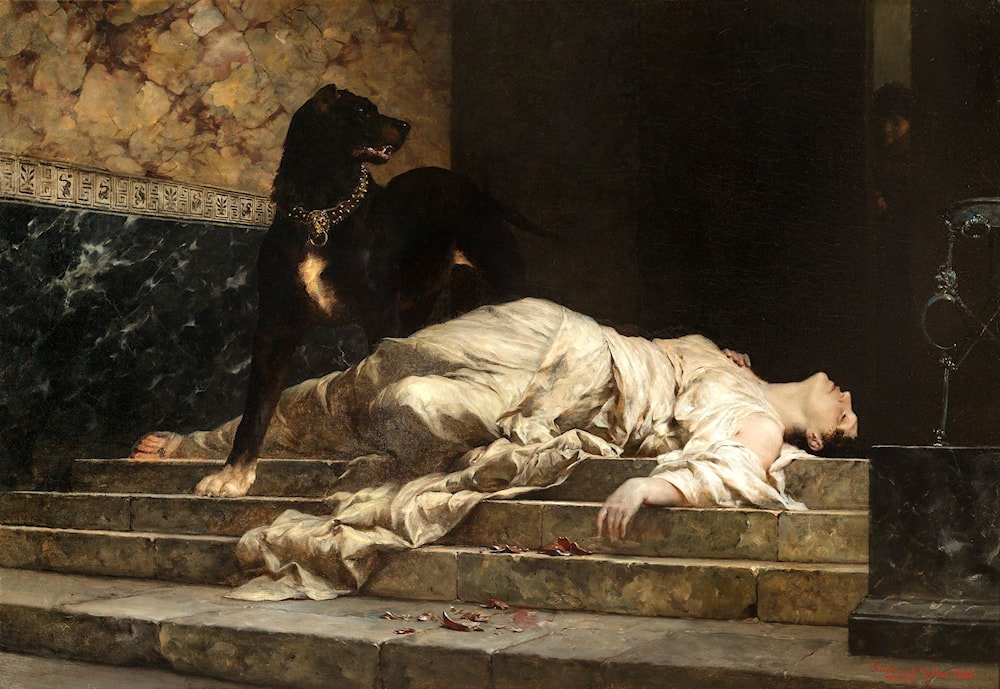
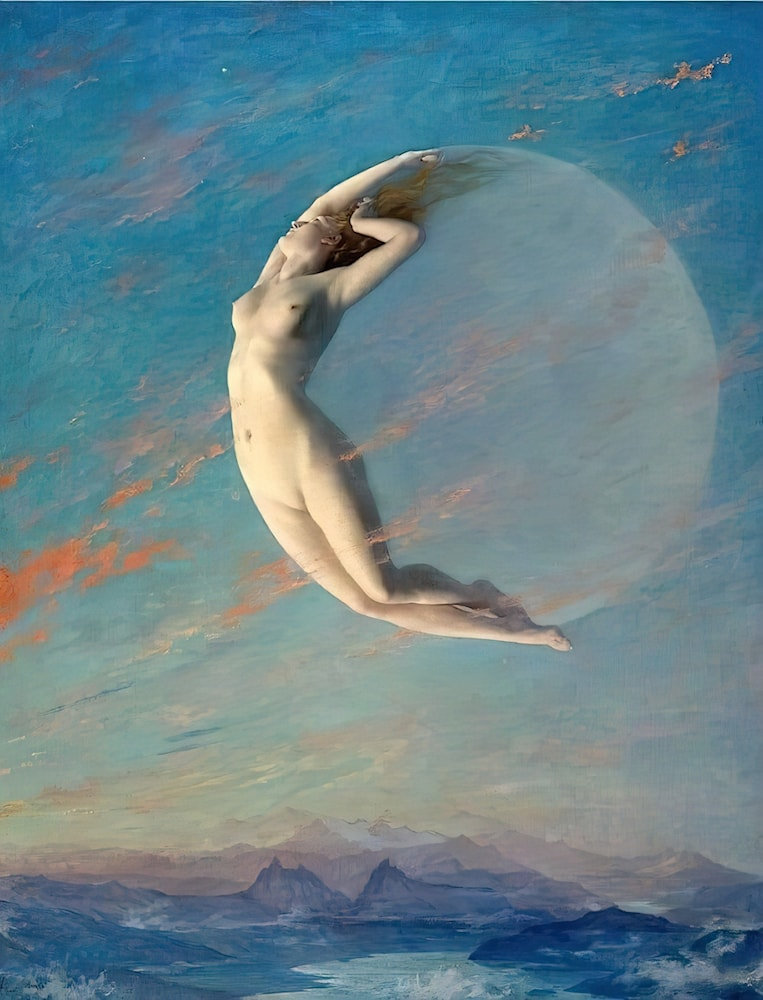
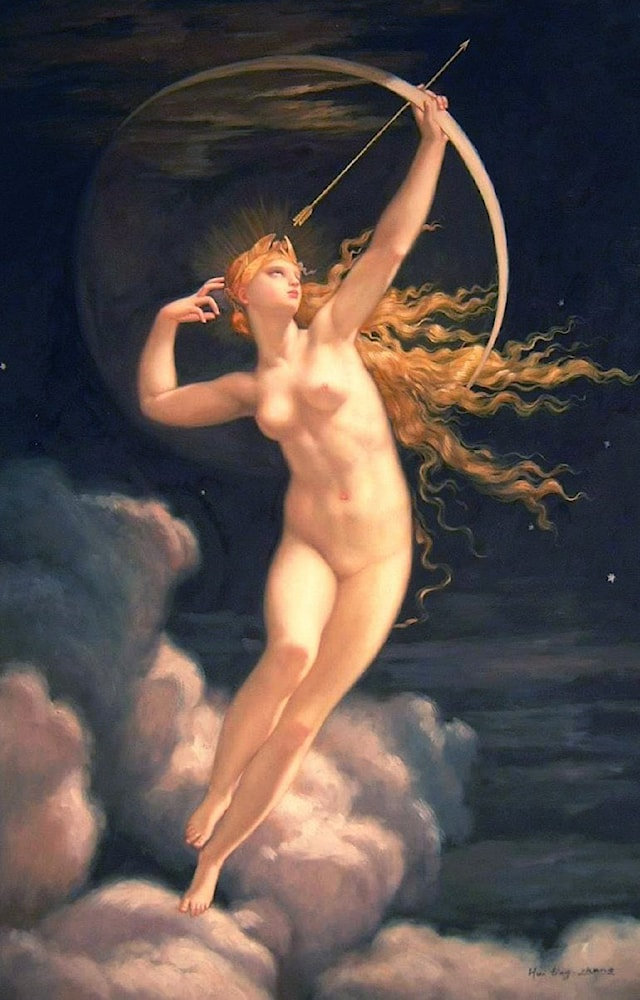
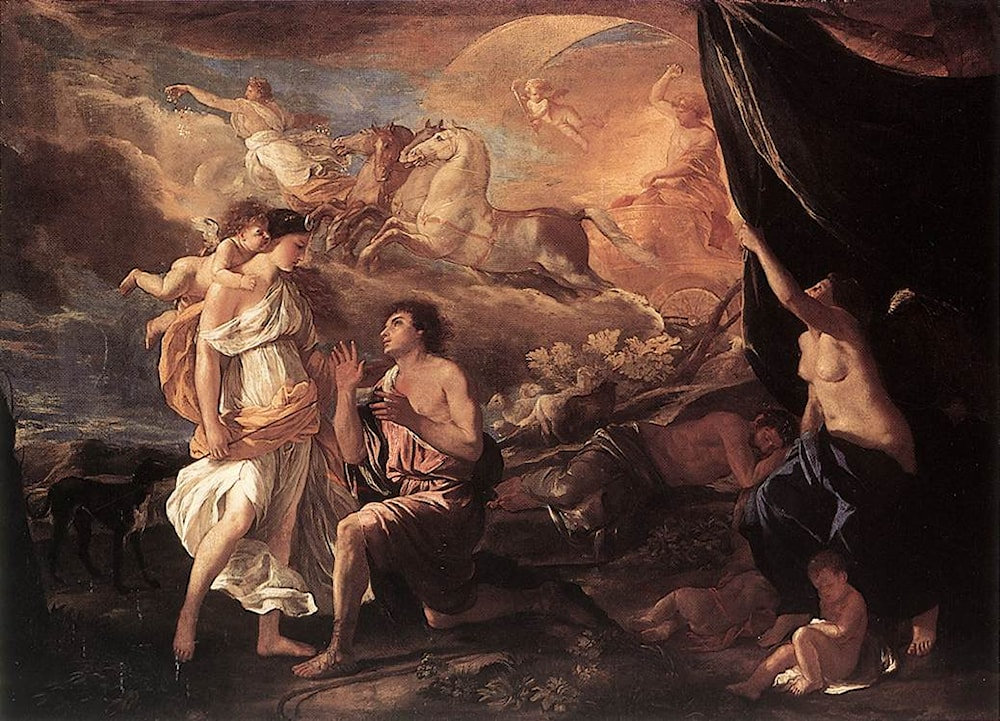
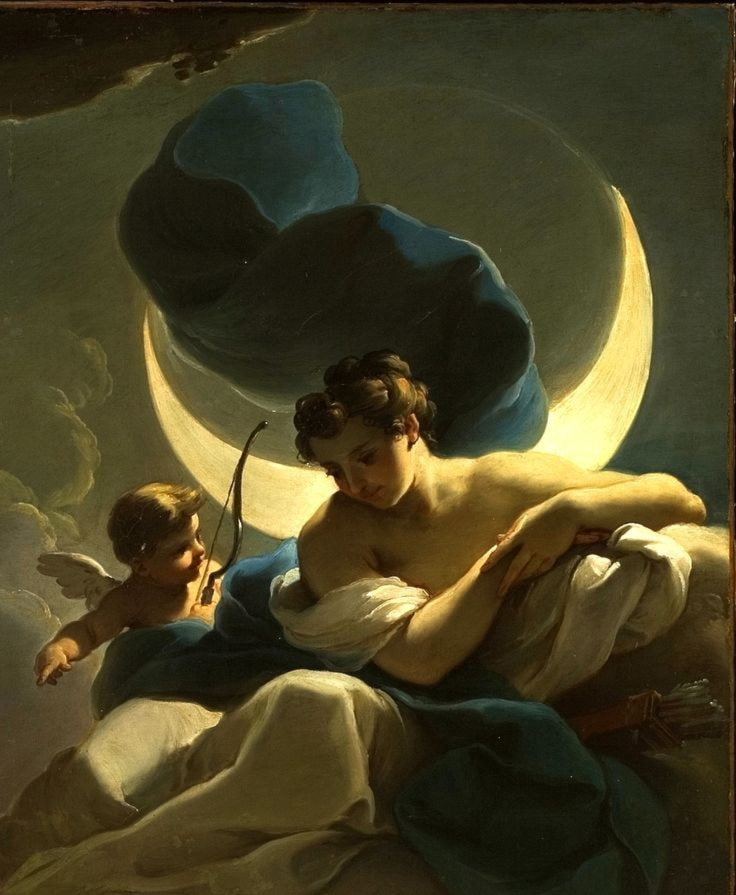
In ancient Greek mythology and religion, Selene is the goddess and personification of the Moon. Also known as Mene, she is traditionally the daughter of the Titans Hyperion and Theia, and sister of the sun god Helios and the dawn goddess Eos. She drives her moon chariot across the heavens. Several lovers are attributed to her in various myths, including Zeus, Pan, her brother Helios and the mortal Endymion. In post-classical times, Selene was often identified with Artemis, much as her brother, Helios, was identified with Apollo. Selene and Artemis were also associated with Hecate and all three were regarded as moon and lunar goddesses, but only Selene was regarded as the personification of the Moon itself. Her equivalent in Roman religion and mythology is the goddess Luna… Surviving descriptions of Selene’s physical appearance and character, apart from those which would apply to the Moon itself, are scant. There is no mention of Selene as a goddess in either the Iliad or the Odyssey of Homer, while her only mention in Hesiod’s Theogony is as the daughter of Hyperion and Theia, and sister of Helios and Eos. She was, however, the subject of one of the thirty-three Homeric Hymns, which gives the following description: “And next, sweet voiced Muses, daughters of Zeus, well-skilled in song, tell of the long-winged Moon. From her immortal head a radiance is shown from heaven and embraces earth; and great is the beauty that ariseth from her shining light. The air, unlit before, glows with the light of her golden crown, and her rays beam clear, whensoever bright Selene having bathed her lovely body in the waters of Ocean, and donned her far-gleaming raiment, and yoked her strong-necked, shining team, drives on her long-maned horses at full speed, at eventime in the mid-month: then her great orbit is full and then her beams shine brightest as she increases. So she is a sure token and a sign to mortal men.” Selene is best known for her affair with the beautiful mortal Endymion. The late 7th-century – early 6th-century BC poet Sappho apparently mentioned Selene and Endymion. However, the first account of the story comes from the third-century BC Argonautica of Apollonius of Rhodes, which tells of Selene’s “mad passion” and her visiting the “fair Endymion” in a cave on Mount Latmus…
First Appearance Catalogue of Women / Ehoiai (archaic Greek; fragmentary) by Pseudo-Hesiod
First Publisher ○
Appearance List Catalogue of Women / Ehoiai (archaic Greek; fragmentary) by Pseudo-Hesiod / Hesiodic tradition — early genealogical source for Endymion; Idylls (3rd century BCE) by Theocritus — early poetic allusion to Endymion as the beloved of Selene/the Moon; Argonautica (3rd century BCE) by Apollonius Rhodius; Bibliotheca / The Library (1st–2nd century CE) by Pseudo-Apollodorus; Dialogues of the Gods (2nd century CE) by Lucian of Samosata; Description of Greece (2nd century CE) by Pausanias; Endimion and Phoebe (1595) by Michael Drayton — Elizabethan poetic retelling of Endymion and the moon goddess; Endymion, the Man in the Moon (1591) by John Lyly — Elizabethan dramatic adaptation using Endymion, Cynthia, sleep, and lunar allegory; Endymion: A Poetic Romance (1818) by John Keats; A Dictionary of Greek and Roman Biography and Mythology (1844–1849; widely used into late 19th c.) by William Smith; The Age of Fable (1855; many later eds.) by Thomas Bulfinch; Myths of the Greeks and Romans (1893) by H. A. Guerber; The Myths of Greece and Rome (1942) by Edith Hamilton; The Greek Myths (1955) by Robert Graves.
Sample Read Bulfinch’s Mythology by Thomas Bulfinch [Internet Archive]
Description In ancient Greek mythology and religion, Selene is the goddess and personification of the Moon. Also known as Mene, she is traditionally the daughter of the Titans Hyperion and Theia, and sister of the sun god Helios and the dawn goddess Eos. She drives her moon chariot across the heavens. Several lovers are attributed to her in various myths, including Zeus, Pan, her brother Helios and the mortal Endymion. In post-classical times, Selene was often identified with Artemis, much as her brother, Helios, was identified with Apollo. Selene and Artemis were also associated with Hecate and all three were regarded as moon and lunar goddesses, but only Selene was regarded as the personification of the Moon itself. Her equivalent in Roman religion and mythology is the goddess Luna… Surviving descriptions of Selene’s physical appearance and character, apart from those which would apply to the Moon itself, are scant. There is no mention of Selene as a goddess in either the Iliad or the Odyssey of Homer, while her only mention in Hesiod’s Theogony is as the daughter of Hyperion and Theia, and sister of Helios and Eos. She was, however, the subject of one of the thirty-three Homeric Hymns, which gives the following description: “And next, sweet voiced Muses, daughters of Zeus, well-skilled in song, tell of the long-winged Moon. From her immortal head a radiance is shown from heaven and embraces earth; and great is the beauty that ariseth from her shining light. The air, unlit before, glows with the light of her golden crown, and her rays beam clear, whensoever bright Selene having bathed her lovely body in the waters of Ocean, and donned her far-gleaming raiment, and yoked her strong-necked, shining team, drives on her long-maned horses at full speed, at eventime in the mid-month: then her great orbit is full and then her beams shine brightest as she increases. So she is a sure token and a sign to mortal men.” Selene is best known for her affair with the beautiful mortal Endymion. The late 7th-century – early 6th-century BC poet Sappho apparently mentioned Selene and Endymion. However, the first account of the story comes from the third-century BC Argonautica of Apollonius of Rhodes, which tells of Selene’s “mad passion” and her visiting the “fair Endymion” in a cave on Mount Latmus…

 ,
,  ,
,  ,
,