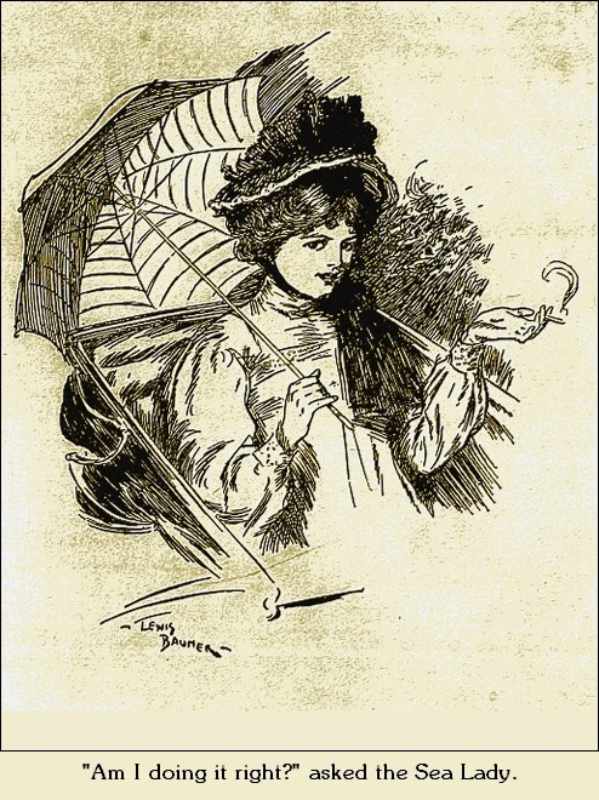
The main character of H. G. Wells’ novel The Sea Lady is a mermaid who came to the surface world and briefly lived among humans between the years 1898 and 1899, pretending to be an invalid bound to a wheelchair. Her real name, assuming she had one, is not revealed, but she goes by Miss Doris Thalassia Waters, and is generally referred to as the Sea Lady by the narrator. As a mermaid, she is an “elemental”, never-aging, immortal. She claims that her life has no clear beginning or ending. She came to existence “in some miraculous way” countless centuries ago, somewhere near the island of Cyprus, in the Mediterranean Sea. It appears that she has traveled through the world’s oceans, as she first met Harry Chatteris in the South Seas, near Tonga. She later came to the shore of Folkestone, England, where she pretended to be a drowning bather suffering from a cramp, in order to get rescued by Randolph Bunting and his son Fred. The Buntings realized that they had rescued a mermaid, but she nevertheless convinced them to allow her to spend some time on the surface world, as she claimed to be curious about human habits. She became familiar with Mr. and Mrs. Buntings, Fred, the sisters Betty and Nettie Bunting, Fred’s fiancée Mabel Glendower, and Mabel’s half-sister Miss Adeline Glendower, who was engaged to a family friend, Harry Chatteris. Unbeknownst to them, Mr. Chatteris had been the real reason the Sea Lady came to them all along. Revealing her impressions of the human world to the narrator’s cousin Melville, the Sea Lady describes most things humans believe in as being merely impressions or dreams: “all the elements of your life, the life you imagine you are living, the little things you must do, the little cares, the extraordinary little duties, the day by day, the hypnotic limitations – all these things are a fancy that has taken hold of you too strongly for you to shake off. You daren’t, you mustn’t, you can’t”. Although she does admit that mermaids envy some aspects of human life — the pleasantries of the surface world, and, being mortal, they “look towards an end” — she still claims that humans waste the limited time they have. “You begin and you end, and all the time between it is as if you were enchanted; you are afraid to do this that would be delightful to do, you must do that, though you know all the time it is stupid and disagreeable. Just think of the things – even the little things – you mustn’t do. Up there on the Leas in this hot weather all the people are sitting in stuffy ugly clothes – ever so much too much clothes, hot tight boots, you know, when they have the most lovely pink feet, some of them – we see – and they are all with little to talk about and nothing to look at, and bound not to do all sorts of natural things and bound to do all sorts of preposterous things. Why are they bound? Why are they letting life slip by them?”. Eventually, the Sea Lady seduces Chatteris. Despite Melville’s attempts to get him to go back to Adeline, who is willing to accept his apologies, Chatteris is last seen disappearing beneath the waves with the Sea Lady. She is described as beautiful and charming, at least from the waist up, as her fish tail appears to exert some feeling of uneasiness on human commentators. She has long blonde hair often hidden by her Phrygian cap, and blue eyes. The tail is dark with “pointed corners”, and has been compared to that of a mackerel. The Sea Lady is familiar with human literature, as she claims mermaids have access to human books from sunken ships. She first claims to have come to the human world in order to get a soul, and Mrs. Buntings believes she got the idea from Friedrich de la Motte Fouqué’s Undine, in which the eponymous water spirit must marry a human being in order to get a soul. Coincidentally or not, this is also a plot point in Hans Christian Andersen’s The Little Mermaid.
Alias Sea Lady
Real Names/Alt Names “Miss Doris Thalassia Waters”
First Appearance “The Sea Lady” serialized in Pearson’s Magazine (UK), July 1901–January 1902
First Publisher ○
Appearance List The Sea Lady serialized in Pearson’s Magazine (UK) (July 1901–January 1902); The Sea Lady: A Tissue of Moonshine (1902); The Works of H. G. Wells (inc. “The Sea Lady”, Atlantic Edition, vol. 5) (1924); The Sea Lady (Methuen “Sixth Edition”) (1934), etc.
Description The main character of H. G. Wells’ novel The Sea Lady is a mermaid who came to the surface world and briefly lived among humans between the years 1898 and 1899, pretending to be an invalid bound to a wheelchair. Her real name, assuming she had one, is not revealed, but she goes by Miss Doris Thalassia Waters, and is generally referred to as the Sea Lady by the narrator. As a mermaid, she is an “elemental”, never-aging, immortal. She claims that her life has no clear beginning or ending. She came to existence “in some miraculous way” countless centuries ago, somewhere near the island of Cyprus, in the Mediterranean Sea. It appears that she has traveled through the world’s oceans, as she first met Harry Chatteris in the South Seas, near Tonga. She later came to the shore of Folkestone, England, where she pretended to be a drowning bather suffering from a cramp, in order to get rescued by Randolph Bunting and his son Fred. The Buntings realized that they had rescued a mermaid, but she nevertheless convinced them to allow her to spend some time on the surface world, as she claimed to be curious about human habits. She became familiar with Mr. and Mrs. Buntings, Fred, the sisters Betty and Nettie Bunting, Fred’s fiancée Mabel Glendower, and Mabel’s half-sister Miss Adeline Glendower, who was engaged to a family friend, Harry Chatteris. Unbeknownst to them, Mr. Chatteris had been the real reason the Sea Lady came to them all along. Revealing her impressions of the human world to the narrator’s cousin Melville, the Sea Lady describes most things humans believe in as being merely impressions or dreams: “all the elements of your life, the life you imagine you are living, the little things you must do, the little cares, the extraordinary little duties, the day by day, the hypnotic limitations – all these things are a fancy that has taken hold of you too strongly for you to shake off. You daren’t, you mustn’t, you can’t”. Although she does admit that mermaids envy some aspects of human life — the pleasantries of the surface world, and, being mortal, they “look towards an end” — she still claims that humans waste the limited time they have. “You begin and you end, and all the time between it is as if you were enchanted; you are afraid to do this that would be delightful to do, you must do that, though you know all the time it is stupid and disagreeable. Just think of the things – even the little things – you mustn’t do. Up there on the Leas in this hot weather all the people are sitting in stuffy ugly clothes – ever so much too much clothes, hot tight boots, you know, when they have the most lovely pink feet, some of them – we see – and they are all with little to talk about and nothing to look at, and bound not to do all sorts of natural things and bound to do all sorts of preposterous things. Why are they bound? Why are they letting life slip by them?”. Eventually, the Sea Lady seduces Chatteris. Despite Melville’s attempts to get him to go back to Adeline, who is willing to accept his apologies, Chatteris is last seen disappearing beneath the waves with the Sea Lady. She is described as beautiful and charming, at least from the waist up, as her fish tail appears to exert some feeling of uneasiness on human commentators. She has long blonde hair often hidden by her Phrygian cap, and blue eyes. The tail is dark with “pointed corners”, and has been compared to that of a mackerel. The Sea Lady is familiar with human literature, as she claims mermaids have access to human books from sunken ships. She first claims to have come to the human world in order to get a soul, and Mrs. Buntings believes she got the idea from Friedrich de la Motte Fouqué’s Undine, in which the eponymous water spirit must marry a human being in order to get a soul. Coincidentally or not, this is also a plot point in Hans Christian Andersen’s The Little Mermaid.