“Le singe” (1924), or “The Monkey”, involves the police investigation of several corpses that all appear to be the same man, a certain Richard Cirugue. After many twists and turns, the mystery is finally solved: Richard is in reality still alive. Using his recent discovery of a “radiogenesis” process capable of duplicating (but not animating) human and animal tissues, he made lifeless clones of himself and scattered them across Paris as a shock advertisement to attract investors to his research. In an even stranger twist, Richard ends up dying (for good), but his spirit remains and manages to take possession of his brother’s clone, whose wife he covets. It goes without saying that, apart from the somewhat Frankenstein-style theme of creating artificial bodies in a chemical tank, The Monkey is less a science fiction novel than, as Bleiler says, a “comedy of morals, sex, [and] mystery à la Gaston Leroux” (Bleiler, 1990, p. 620).
First Appearance “Le singe” by Albert Jean and Maurice Renard serialized in 62 episodes of L’Intransigeant (15 April to 19 June 1924)
First Publisher L’Intransigeant
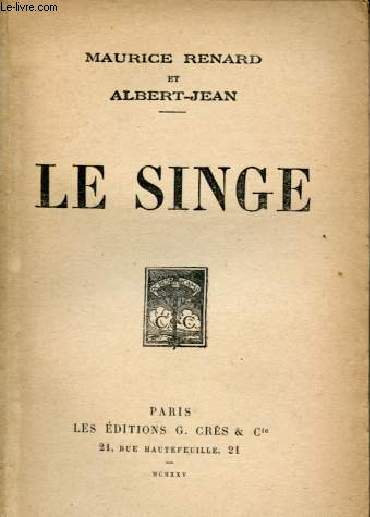
Appearance List “Le singe” by Albert Jean and Maurice Renard serialized in 62 episodes of L’Intransigeant (15 April to 19 June 1924); Le singe (1925, first book edition, Paris: Georges Crès); Człowiek, który chciał być Bogiem (1927, Polish translation); Blind Circle (1928) trans. Florence Crewe-Jones (1928, English, first edition, New York: E. P. Dutton & Co.).
Sample Read “Le singe” Part 1 in L’Intransigeant (15 April 1924) [Gallica (BNF)]
Description “Le singe” (1924), or “The Monkey”, involves the police investigation of several corpses that all appear to be the same man, a certain Richard Cirugue. After many twists and turns, the mystery is finally solved: Richard is in reality still alive. Using his recent discovery of a “radiogenesis” process capable of duplicating (but not animating) human and animal tissues, he made lifeless clones of himself and scattered them across Paris as a shock advertisement to attract investors to his research. In an even stranger twist, Richard ends up dying (for good), but his spirit remains and manages to take possession of his brother’s clone, whose wife he covets. It goes without saying that, apart from the somewhat Frankenstein-style theme of creating artificial bodies in a chemical tank, The Monkey is less a science fiction novel than, as Bleiler says, a “comedy of morals, sex, [and] mystery à la Gaston Leroux” (Bleiler, 1990, p. 620).

 ,
,