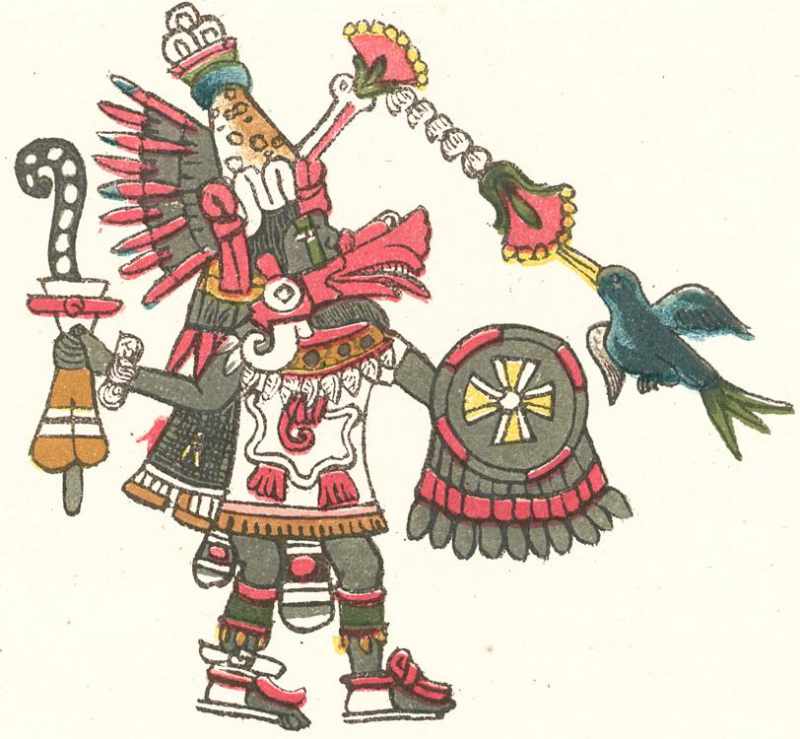
The Feathered Serpent was a prominent supernatural entity or deity, found in many Mesoamerican religions. It is still called Quetzalcoatl among the Aztecs, Kukulkan among the Yucatec Maya, and Q’uq’umatz and Tohil among the K’iche’ Maya. The double symbolism used by the Feathered Serpent is considered allegoric to the dual nature of the deity, where being feathered represents its divine nature or ability to fly to reach the skies and being a serpent represents its human nature or ability to creep on the ground among other animals of the Earth, a dualism very common in Mesoamerican deities. The earliest representations of feathered serpents appear in the Olmec culture (c. 1400–400 BC). Most surviving representations in Olmec art, such as Monument 19 at La Venta, and a painting in the Juxtlahuaca cave, show the Feathered Serpent as a crested rattlesnake, sometimes with feathers covering the body and legs, and often in close proximity to humans. The pantheon of the people of Teotihuacan (200 BC – 700 AD) also featured a feathered serpent, shown most prominently on the Temple of the Feathered Serpent (dated 150–200 AD). The pyramid was built southeast of the intersection of the avenue of the dead and the east-end avenue. Several feathered serpent representations appear on the building, many of them including full-body profiles and feathered serpent heads. The Aztec feathered serpent deity known as Quetzalcoatl is known from several Aztec codices, such as the Florentine codex, as well as from the records of the Spanish conquistadors. Quetzalcoatl was known as the deity of wind and rain, bringer of knowledge, the inventor of books, and associated with the planet Venus.
Alias Quetzalcoatl, White Tecatlipoca, Ce Acatl Topiltzin Quetzalcoatl, Feathered Serpent, Precious Twin, Tlahuizcalpantecuhtli
Appearance List Codex Magliabechiano (c. mid-16th century) – pictorial Aztec codex [Wikipedia]; Florentine Codex, Book 1: The Gods (1829 ed., later 20th-century full editions); Antiquities of Mexico (1831–1848) by Edward King; Historia de los Mexicanos por sus pinturas (1891 ed.) by Anónimo; Obras históricas de don Fernando de Alva Ixtlilxochitl (1891–1892) by Fernando de Alva Ixtlilxochitl; The Myths of Mexico & Peru (1913) by Lewis Spence; The Gods of Mexico (1917) by Lewis Spence; The Mythology of All Races, Vol. XI: Latin-American (1920) by Hartley Burr Alexander; El universo de Quetzalcóatl (1957) by Laurette Séjourné; Aztec Thought and Culture (1963) by Miguel León-Portilla; Burning Water: Thought and Religion in Ancient Mexico (1976) by Laurette Séjourné. Fiction: The Plumed Serpent (1926) by D. H. Lawrence.
Sample Read Book of the Gods and Rites and The Ancient Calendar (1971) [Internet Archive]
Description The Feathered Serpent was a prominent supernatural entity or deity, found in many Mesoamerican religions. It is still called Quetzalcoatl among the Aztecs, Kukulkan among the Yucatec Maya, and Q’uq’umatz and Tohil among the K’iche’ Maya. The double symbolism used by the Feathered Serpent is considered allegoric to the dual nature of the deity, where being feathered represents its divine nature or ability to fly to reach the skies and being a serpent represents its human nature or ability to creep on the ground among other animals of the Earth, a dualism very common in Mesoamerican deities. The earliest representations of feathered serpents appear in the Olmec culture (c. 1400–400 BC). Most surviving representations in Olmec art, such as Monument 19 at La Venta, and a painting in the Juxtlahuaca cave, show the Feathered Serpent as a crested rattlesnake, sometimes with feathers covering the body and legs, and often in close proximity to humans. The pantheon of the people of Teotihuacan (200 BC – 700 AD) also featured a feathered serpent, shown most prominently on the Temple of the Feathered Serpent (dated 150–200 AD). The pyramid was built southeast of the intersection of the avenue of the dead and the east-end avenue. Several feathered serpent representations appear on the building, many of them including full-body profiles and feathered serpent heads. The Aztec feathered serpent deity known as Quetzalcoatl is known from several Aztec codices, such as the Florentine codex, as well as from the records of the Spanish conquistadors. Quetzalcoatl was known as the deity of wind and rain, bringer of knowledge, the inventor of books, and associated with the planet Venus.