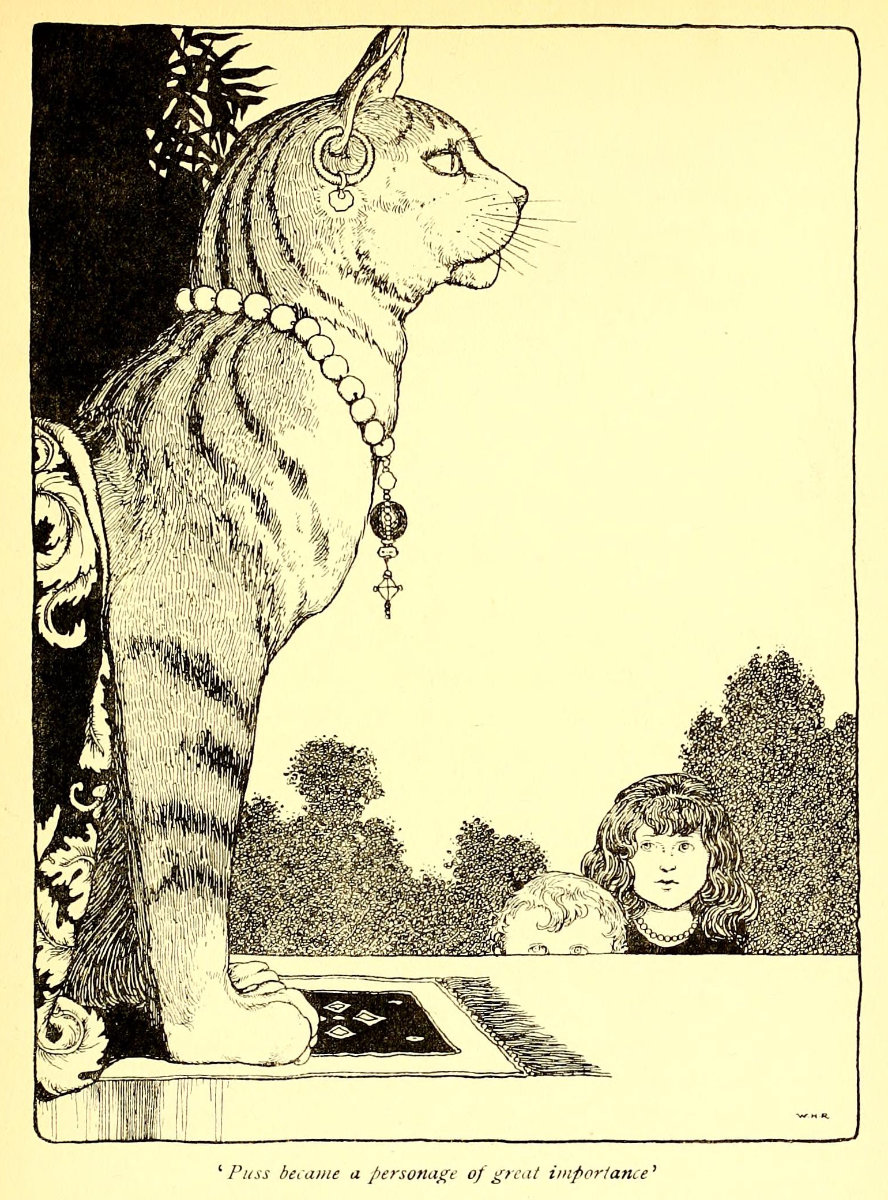
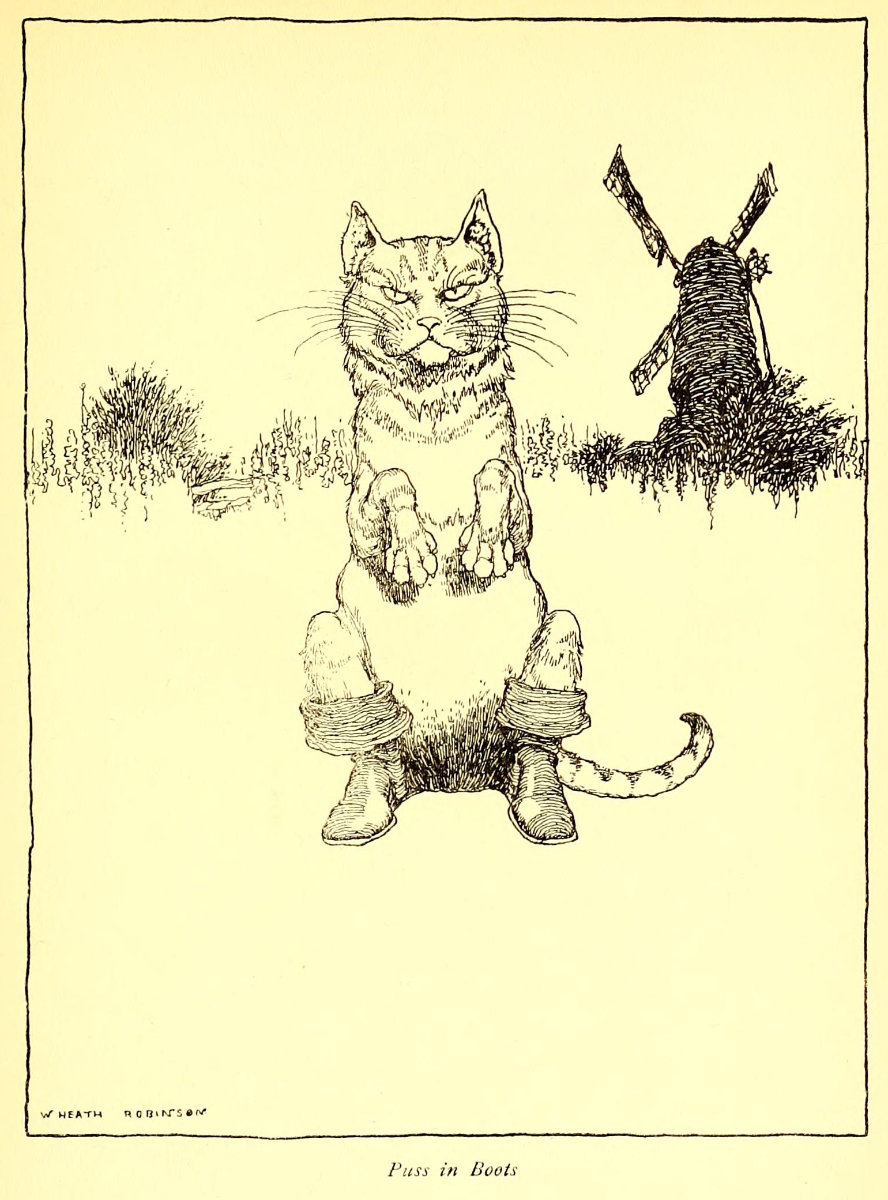
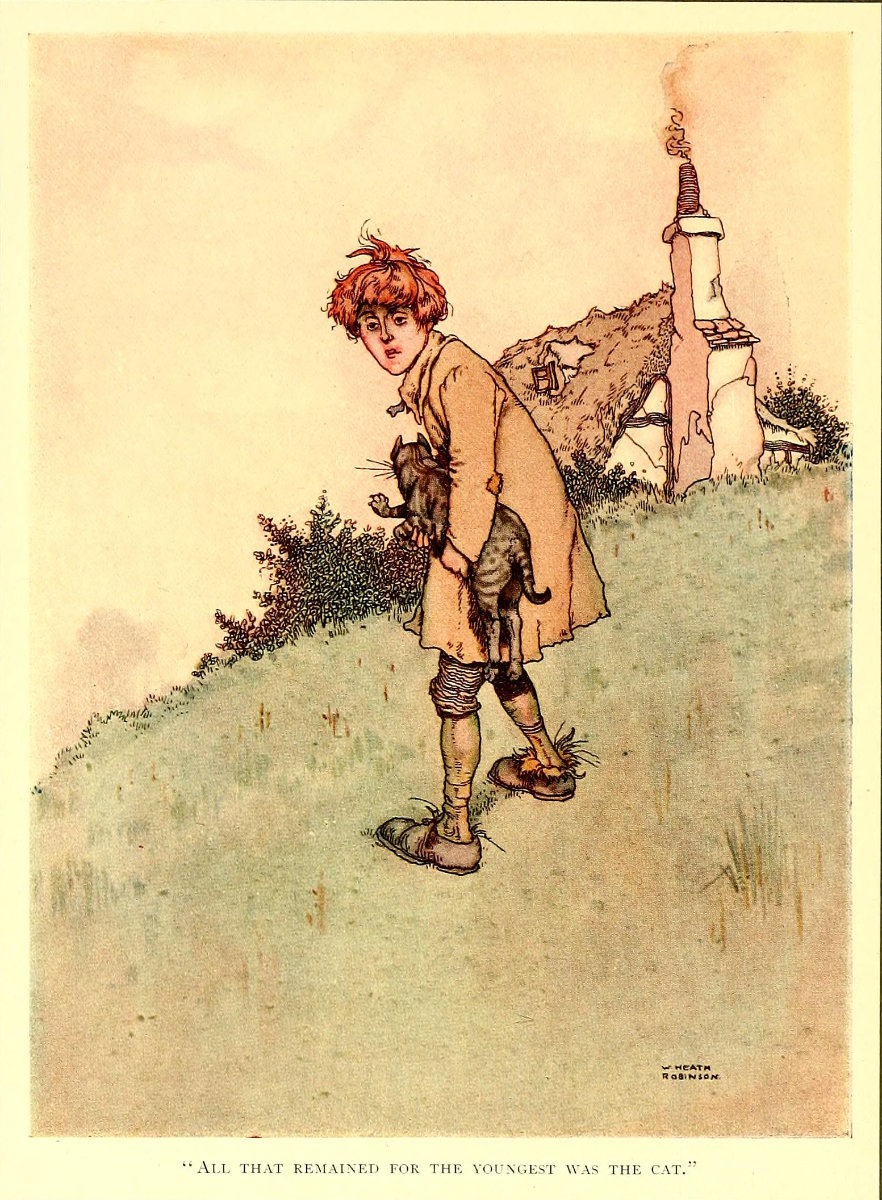
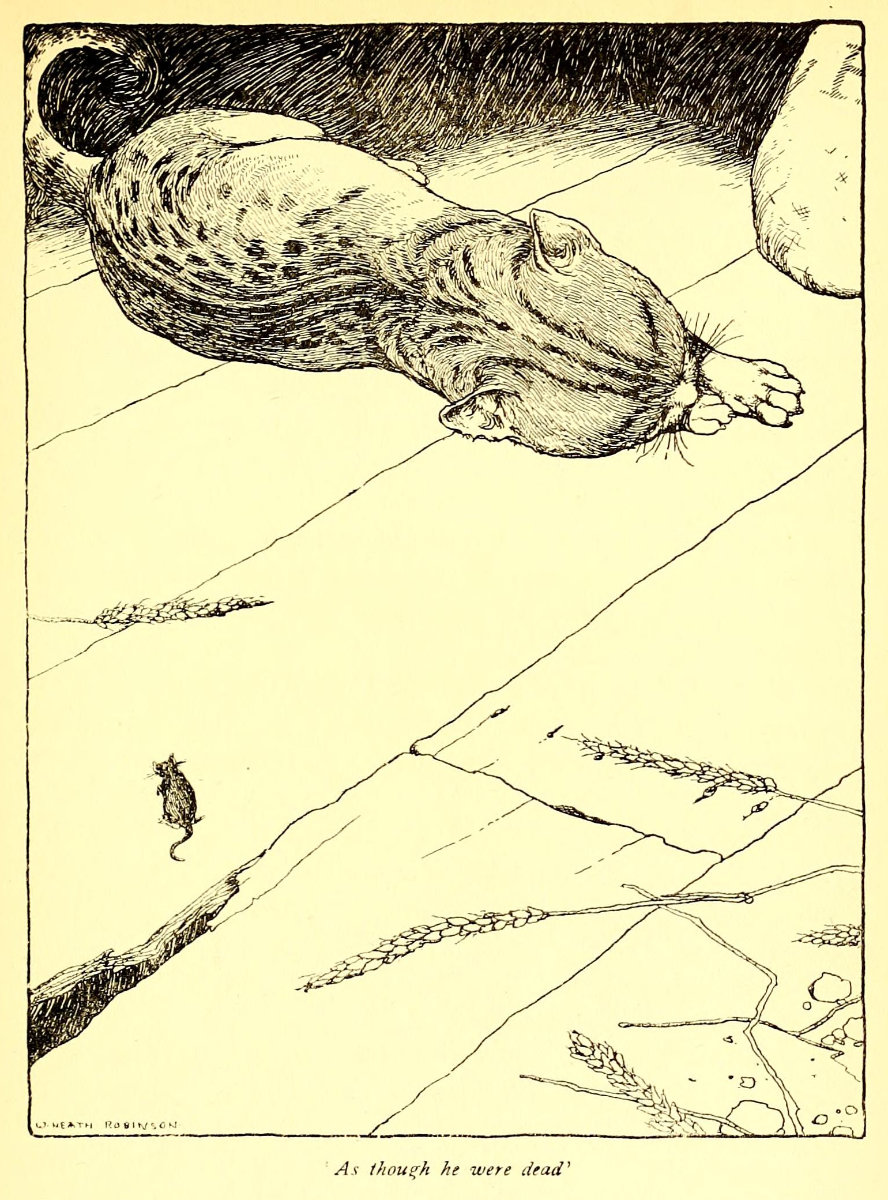
“Puss in Boots” is a European fairy tale about an anthropomorphic cat who uses trickery and deceit to gain power, wealth, and the hand in marriage of a princess for his penniless and low-born master. The oldest written telling is Costantino Fortunato (Italian for “Lucky Costantino”) by Italian author Giovanni Francesco Straparola, included in The Facetious Nights of Straparola (c. 1550–1553). In this version, the cat is a disguised fairy who helps his owner, a poor boy named Costantino from Bohemia, in earning the princess’ hand by duping a king, a lord, and many commoners. Another version was published in 1634 by Giambattista Basile with the title Cagliuso. The most popular version of the tale was published in French in 1697 by Charles Perrault (1628–1703)… The story begins with a poor miller who, upon his death, leaves his possessions to his three sons. The eldest inherits the mill, the second son gets a donkey, and the youngest son is left with only a cat. The youngest son laments his poor inheritance, but the cat, who turns out to be extraordinarily clever and resourceful, assures his master that he can bring him great fortune if provided with a pair of boots and a simple sack…
First Appearance “Costantino Fortunato” in Le piacevoli notti (The Facetious Nights, c. 1550–1553) by Giovanni Francesco Straparola
First Publisher ○
Appearance List “Costantino Fortunato” in Le piacevoli notti (The Facetious Nights, c. 1550–1553) by Giovanni Francesco Straparola; “Cagliuso” in Lo cunto de li cunti (Pentamerone, 1634–1636) by Giambattista Basile; “Le Maître Chat, ou le Chat botté” in Histoires ou contes du temps passé (1697) by Charles Perrault; “Der gestiefelte Kater” (1797) by Ludwig Tieck; “The Marvelous Story of Puss in Boots” (1904) by Louis Wain, illustrated edition; Old-Time Stories Told by Master Charles Perrault (1921), trans. A. E. Johnson, ill. W. Heath Robinson [Internet Archive]; The Master Cat (1974) by David Garnett. Opera: Puss in Boots (1913; premiered 1915) by César Cui. Film: Puss in Boots (1934) dir. Ub Iwerks; Puss in Boots (1961) dir. Roberto Rodríguez, live-action feature adaptation (El gato con botas); Nagagutsu wo Haita Neko (1969) — Toei Animation (Miyazaki involvement); Puss in Boots (1972) by Rankin/Bass Productions.
Sample Read Old-Time Stories Told by Master Charles Perrault (1921) [Internet Archive]
Description “Puss in Boots” is a European fairy tale about an anthropomorphic cat who uses trickery and deceit to gain power, wealth, and the hand in marriage of a princess for his penniless and low-born master. The oldest written telling is Costantino Fortunato (Italian for “Lucky Costantino”) by Italian author Giovanni Francesco Straparola, included in The Facetious Nights of Straparola (c. 1550–1553). In this version, the cat is a disguised fairy who helps his owner, a poor boy named Costantino from Bohemia, in earning the princess’ hand by duping a king, a lord, and many commoners. Another version was published in 1634 by Giambattista Basile with the title Cagliuso. The most popular version of the tale was published in French in 1697 by Charles Perrault (1628–1703)… The story begins with a poor miller who, upon his death, leaves his possessions to his three sons. The eldest inherits the mill, the second son gets a donkey, and the youngest son is left with only a cat. The youngest son laments his poor inheritance, but the cat, who turns out to be extraordinarily clever and resourceful, assures his master that he can bring him great fortune if provided with a pair of boots and a simple sack…

 ,
,  ,
,