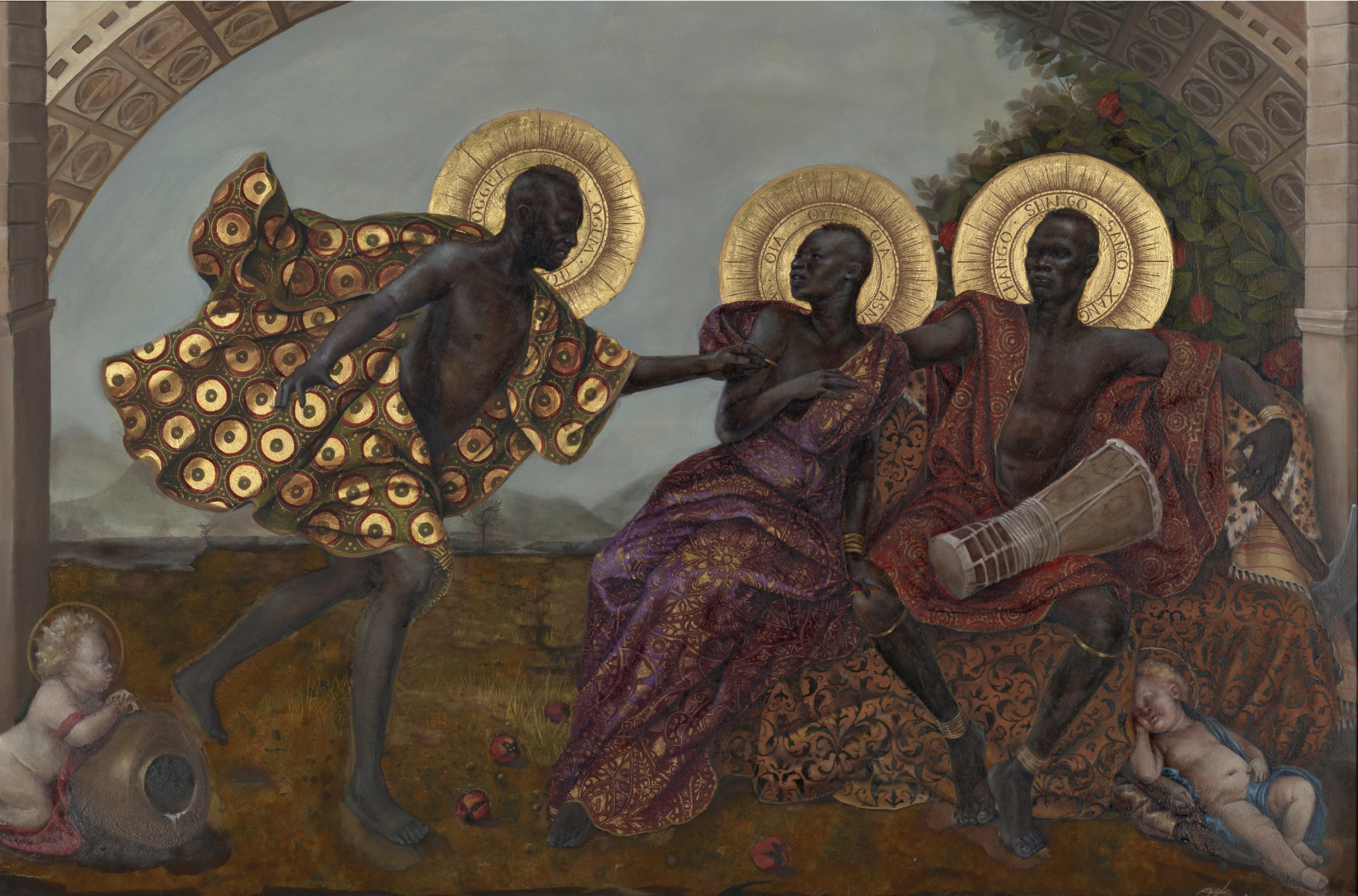
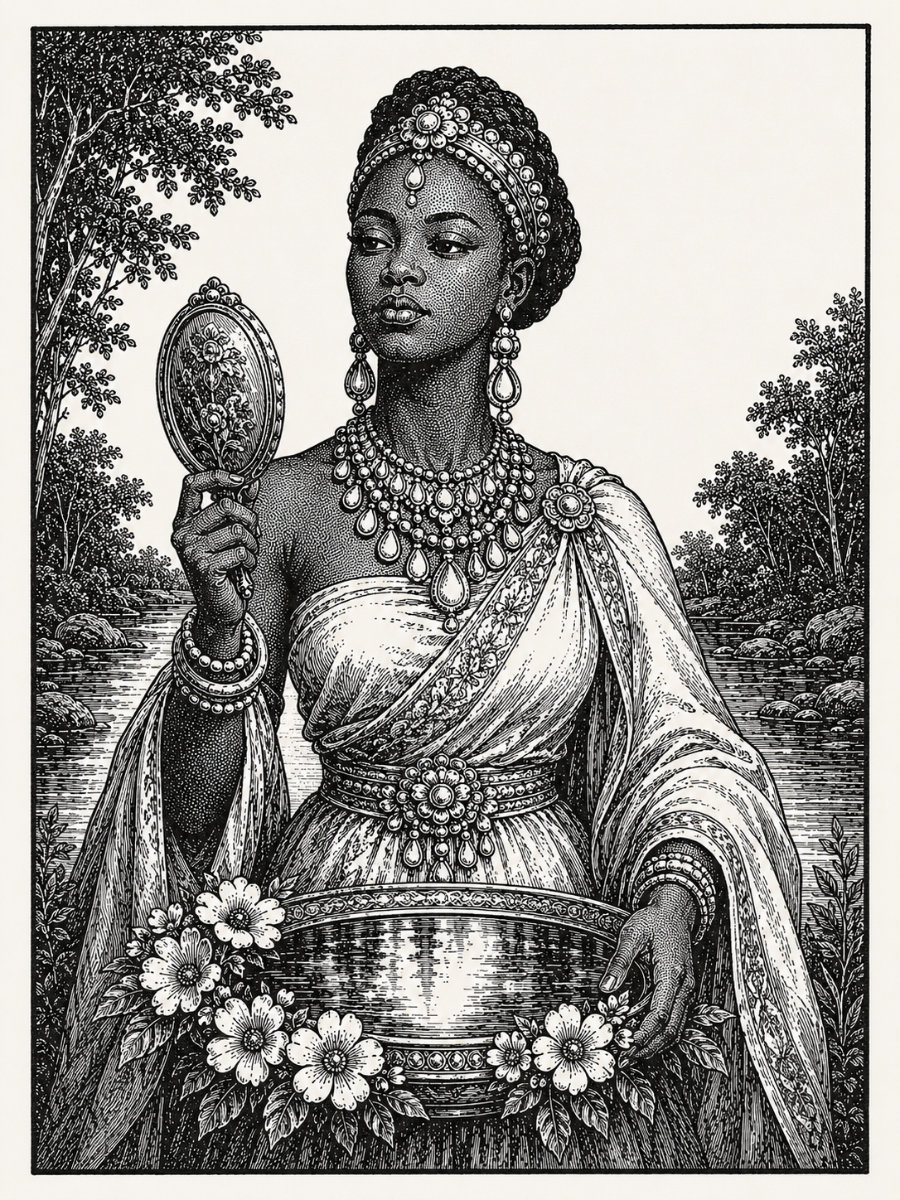
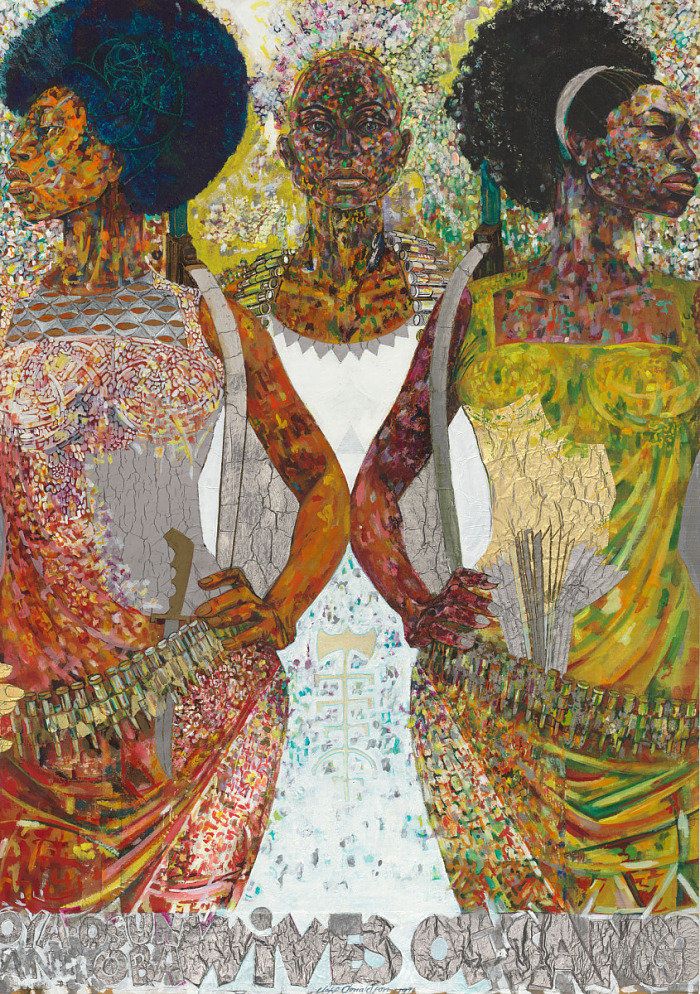
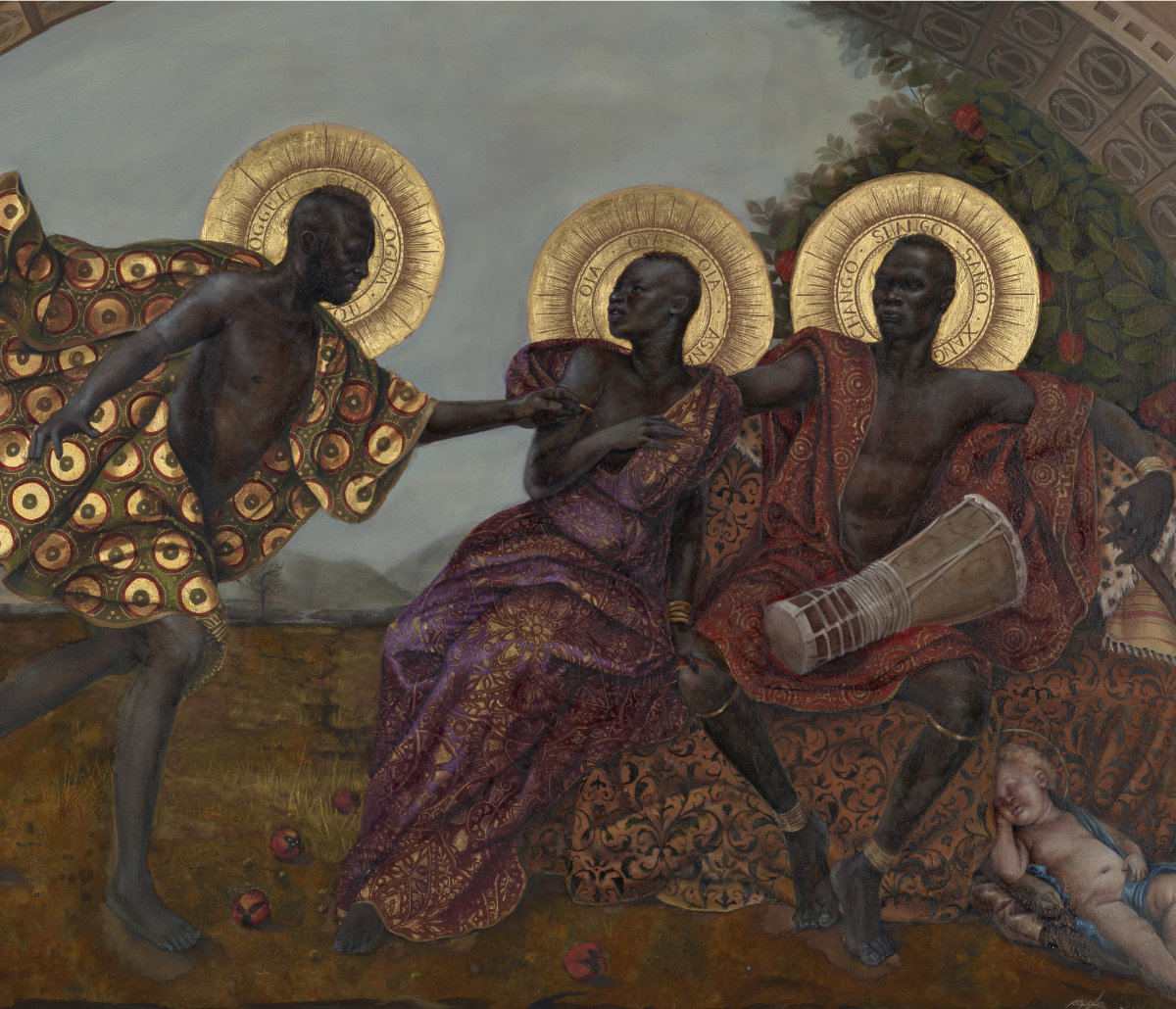
Oshun is the orisha associated with love, sexuality, fertility, femininity, water, destiny, divination, purity, wealth, prosperity and beauty, and the Osun River, in the Yoruba religion. She is considered one of the most popular and venerated of the 401 orishas. According to traditional beliefs, Oshun was once the queen consort to King Shango of Oyo, and deified following her death, honored at the Osun-Osogbo Festival, a two-week-long annual festival that usually takes place in August, at the Oṣun-Osogbo Sacred Grove in Osogbo… According to the Ifa Literary Corpus, Oshun was the only female Irunmole (primordial spirit) sent to assist Shango to create the world by Olodumare, the Supreme God. The other spirits sent ignored Oshun, who went to Shango for guidance. One version of the story claims that female spirits were tempted to take matters into their own hands, but all of their creative attempts failed because they acted without male spiritual leadership. Another version, one more consistent with the beginning of the story, claims that the male spirits attempted to make the world without female influence, and this exclusion is what caused the world to fail. Regardless of the version, the myth ends with Shango forcing the other spirits to respect Oshun as they would him…
Appearance List The voice of Africa v. 1 (1913) by Leo Frobenius — valued for early observations and visual documentation despite controversial diffusionist interpretations of African civilization [Smithsonian]; The history of the Yorubas : from the earliest times to the beginning of the British Protectorate (1921) by Rev. Samuel Johnson, Paster of Oyo; ed. Dr. O. (Obadiah) Johnson, Lagos [Internet Archive]; Os africanos no Brasil (1932) by Raymundo Nina Rodrigues; The Religion of the Yorùbá (1948) by J. Olumide Luca; Candomblés da Bahia (first ed. 1948; 2nd ed. 1954) by Edison Carneiro; West African Religion (1949) by Geoffrey Parrinder; Dieux d’Afrique (1954) by Pierre Verger (original edition; later reissued); Olódùmarè: God in Yoruba Belief (1962) by E. Bolaji Idowu; Three Yoruba Plays (1964) by Duro Ladipo; The Shango Cult in Trinidad (1965) by George Eaton Simpson (monograph; first ed. 1965); African Religions in Brazil (French: Les religions africaines au Brésil, 1960) by Roger Bastide; Ifa Divination: Communication Between Gods and Men in West Africa (1969) by William Bascom; Yoruba Beliefs and Sacrificial Rites (1979) by J. Ọmọṣade Awolalu.
Sample Read Yoruba Beliefs and Sacrificial Rites (1979) [Internet Archive]
Description Oshun is the orisha associated with love, sexuality, fertility, femininity, water, destiny, divination, purity, wealth, prosperity and beauty, and the Osun River, in the Yoruba religion. She is considered one of the most popular and venerated of the 401 orishas. According to traditional beliefs, Oshun was once the queen consort to King Shango of Oyo, and deified following her death, honored at the Osun-Osogbo Festival, a two-week-long annual festival that usually takes place in August, at the Oṣun-Osogbo Sacred Grove in Osogbo… According to the Ifa Literary Corpus, Oshun was the only female Irunmole (primordial spirit) sent to assist Shango to create the world by Olodumare, the Supreme God. The other spirits sent ignored Oshun, who went to Shango for guidance. One version of the story claims that female spirits were tempted to take matters into their own hands, but all of their creative attempts failed because they acted without male spiritual leadership. Another version, one more consistent with the beginning of the story, claims that the male spirits attempted to make the world without female influence, and this exclusion is what caused the world to fail. Regardless of the version, the myth ends with Shango forcing the other spirits to respect Oshun as they would him…

 ,
,  ,
,