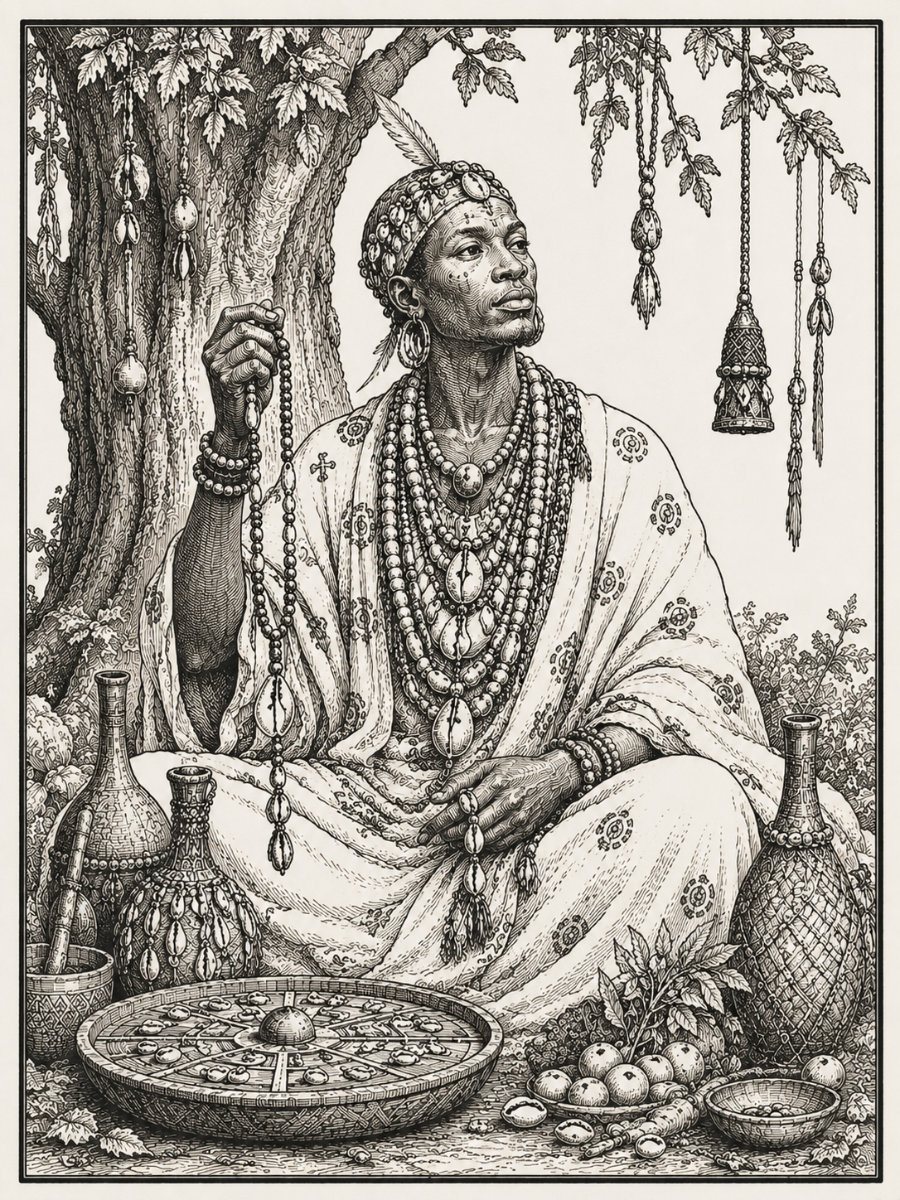
Ọrunmila is one of the most principal deities in the Yoruba religion, venerated as the Orisha of wisdom, knowledge, fate, prophecy, enlightenment, and divination. He is believed to be the creator of the Ifá system. Following the categories developed by the Nigerian scholar Peju Yemaje, Orunmila is recognized as a primordial Orisha, an Irunmọlẹ, one that existed before the creation of humanity and resides in Ọrun. Equivocally, he is praised as “Igbákejì Olódùmarè” (second in command to Olodumare) and “Ẹlẹ́rìí ìpín” (witness of fate). Priests of Ifá are known as babalawos and Priestesses of Ifá are known as iyanifas. Orunmila is considered a sage, recognizing that Olodumare placed Ori (intuitive knowledge) in him as a prime Orisha. It is Ori who can intercede and affect the reality of a person much more than any other Orisha… Awo (babalawos and iyalawos) in every tradition study the 256 Odu; each Odu is traditionally considered to include stories and prayers that have been passed down from the time that Orunmila walked the Earth as a prophet… Some initiatory lineages have only male priests of Orunmila, while other lineages include female priestesses. The term “Awo”, meaning “secret” is a gender-neutral title for an initiated priest of Orunmila. The debate surrounding gender is a result of diversity in the history of Ifá in various locations. In Latin America and some areas of West Africa, only men may become full priests of Orunmila, while in other regions of West Africa the priesthood is open to women. Ifá practitioners believe in duality in life: males exist because of the female essence and females exist because of the male essence, so every major rite or ceremony includes both genders. Every Ifá stanza has one portion dedicated to the issue of teaching the Iwa that Ifá supports. This Iwa, which Ifá teaches transcends religious doctrine, is central to every human being, and imparts communal, social and civic responsibility that Olodumare supports. Of great importance to this is the theme of righteousness and practicing good moral behavior.
Appearance List The voice of Africa v. 1 (1913) by Leo Frobenius — valued for early observations and visual documentation despite controversial diffusionist interpretations of African civilization [Smithsonian]; The history of the Yorubas : from the earliest times to the beginning of the British Protectorate (1921) by Rev. Samuel Johnson, Paster of Oyo; ed. Dr. O. (Obadiah) Johnson, Lagos [Internet Archive]; Os africanos no Brasil (1932) by Raymundo Nina Rodrigues; The Religion of the Yorùbá (1948) by J. Olumide Luca; Candomblés da Bahia (first ed. 1948; 2nd ed. 1954) by Edison Carneiro; West African Religion (1949) by Geoffrey Parrinder; Dieux d’Afrique (1954) by Pierre Verger (original edition; later reissued); Olódùmarè: God in Yoruba Belief (1962) by E. Bolaji Idowu; Three Yoruba Plays (1964) by Duro Ladipo; The Shango Cult in Trinidad (1965) by George Eaton Simpson (monograph; first ed. 1965); African Religions in Brazil (French: Les religions africaines au Brésil, 1960) by Roger Bastide; Ifa Divination: Communication Between Gods and Men in West Africa (1969) by William Bascom; Yoruba Beliefs and Sacrificial Rites (1979) by J. Ọmọṣade Awolalu.
Sample Read Yoruba Beliefs and Sacrificial Rites (1979) [Internet Archive]
Description Ọrunmila is one of the most principal deities in the Yoruba religion, venerated as the Orisha of wisdom, knowledge, fate, prophecy, enlightenment, and divination. He is believed to be the creator of the Ifá system. Following the categories developed by the Nigerian scholar Peju Yemaje, Orunmila is recognized as a primordial Orisha, an Irunmọlẹ, one that existed before the creation of humanity and resides in Ọrun. Equivocally, he is praised as “Igbákejì Olódùmarè” (second in command to Olodumare) and “Ẹlẹ́rìí ìpín” (witness of fate). Priests of Ifá are known as babalawos and Priestesses of Ifá are known as iyanifas. Orunmila is considered a sage, recognizing that Olodumare placed Ori (intuitive knowledge) in him as a prime Orisha. It is Ori who can intercede and affect the reality of a person much more than any other Orisha… Awo (babalawos and iyalawos) in every tradition study the 256 Odu; each Odu is traditionally considered to include stories and prayers that have been passed down from the time that Orunmila walked the Earth as a prophet… Some initiatory lineages have only male priests of Orunmila, while other lineages include female priestesses. The term “Awo”, meaning “secret” is a gender-neutral title for an initiated priest of Orunmila. The debate surrounding gender is a result of diversity in the history of Ifá in various locations. In Latin America and some areas of West Africa, only men may become full priests of Orunmila, while in other regions of West Africa the priesthood is open to women. Ifá practitioners believe in duality in life: males exist because of the female essence and females exist because of the male essence, so every major rite or ceremony includes both genders. Every Ifá stanza has one portion dedicated to the issue of teaching the Iwa that Ifá supports. This Iwa, which Ifá teaches transcends religious doctrine, is central to every human being, and imparts communal, social and civic responsibility that Olodumare supports. Of great importance to this is the theme of righteousness and practicing good moral behavior.