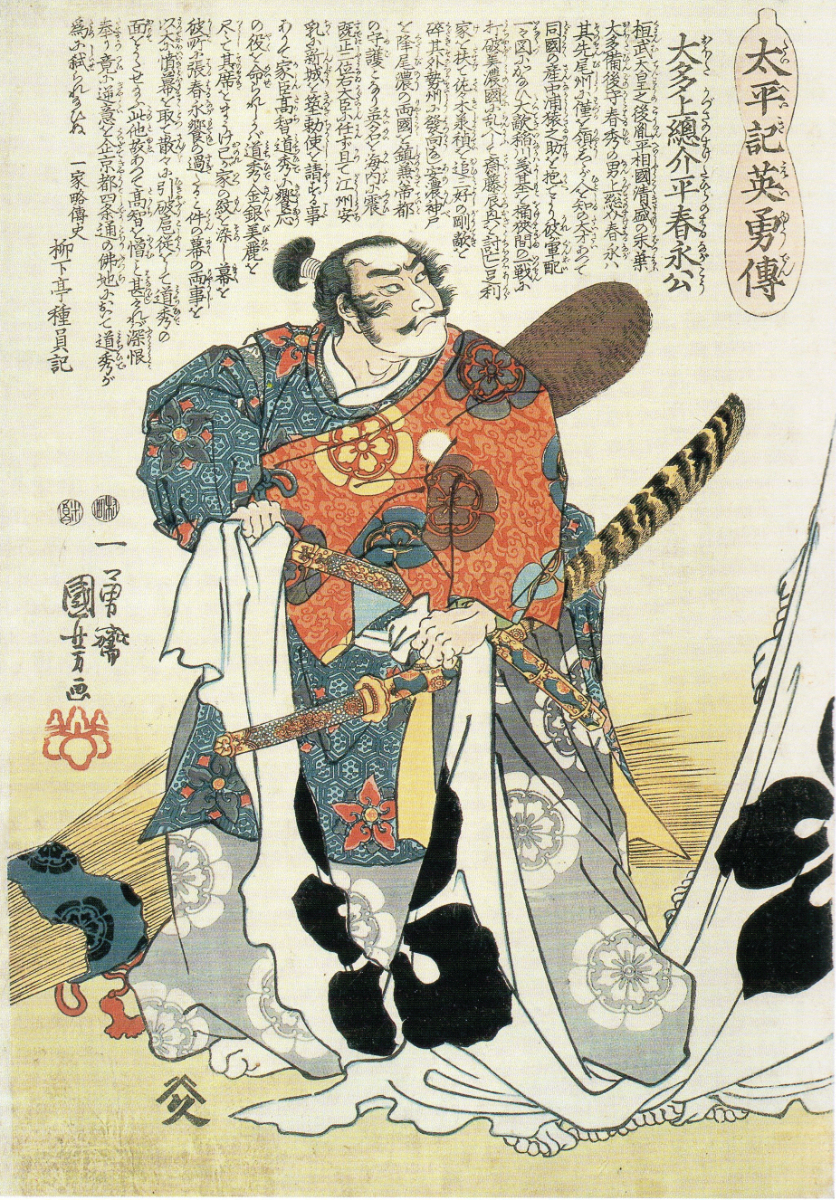
Oda Nobunaga (23 June 1534 – 21 June 1582) was a Japanese daimyō and one of the leading figures of the Sengoku and Azuchi-Momoyama periods. He was the Tenka-bito (天下人, lit. ”person under heaven”) and regarded as the first “Great Unifier” of Japan. He is sometimes referred as the “Demon Daimyō” and “Demon King of the Sixth Heaven”. Nobunaga was an influential figure in Japanese history and is regarded as one of the three great unifiers of Japan, along with his retainers, Toyotomi Hideyoshi and Tokugawa Ieyasu. Nobunaga paved the way for the successful reigns of Hideyoshi and Ieyasu by consolidating power, as head of the very powerful Oda clan, through a series of wars against other daimyō beginning in the 1560s… Nobunaga’s rule was noted for innovative military tactics, fostering of free trade, reforms of Japan’s civil government, and the start of the Momoyama historical art period, but also for the brutal suppression of those who refused to cooperate or yield to his demands…
Alias Oda Nobunaga (織田 信長), Demon Daimyō, Demon King of the Sixth Heaven
First Appearance Historical figure (b. 1534 – d. 1582)
First Publisher ○
Appearance List Jesuit eyewitness material on 1582 (Fróis, etc.) — the Honnōji context that frames Toshimitsu’s last year; Taikōki (1626) — early-Edo biography of Toyotomi Hideyoshi by Oze Hoan; Akechi gunki (1697; Edo war tale) — Earliest dedicated narrative of the Akechi; Taiko: An Epic Novel of War and Glory in Feudal Japan (1930s) by Yoshikawa Eiji; Shinsho Taikōki (1939–41; compiled 1967) — Yoshikawa’s novelized Hideyoshi saga; Kunitori Monogatari serialized novel in Sunday Mainichi (1963–1966) by Ryōtarō Shiba; Japonius Tyrannus: Oda Nobunaga Reconsidered (Hotei, 2000) by Jeroen P. Lamers; The Chronicle of Lord Nobunaga (2011) by Ōta Gyūichi. Film: Fū-unji: Oda Nobunaga (1959).
Sample Read A History of Japan, Vol. 2, 1542-1651 [Internet Archive]
Description Oda Nobunaga (23 June 1534 – 21 June 1582) was a Japanese daimyō and one of the leading figures of the Sengoku and Azuchi-Momoyama periods. He was the Tenka-bito (天下人, lit. ”person under heaven”) and regarded as the first “Great Unifier” of Japan. He is sometimes referred as the “Demon Daimyō” and “Demon King of the Sixth Heaven”. Nobunaga was an influential figure in Japanese history and is regarded as one of the three great unifiers of Japan, along with his retainers, Toyotomi Hideyoshi and Tokugawa Ieyasu. Nobunaga paved the way for the successful reigns of Hideyoshi and Ieyasu by consolidating power, as head of the very powerful Oda clan, through a series of wars against other daimyō beginning in the 1560s… Nobunaga’s rule was noted for innovative military tactics, fostering of free trade, reforms of Japan’s civil government, and the start of the Momoyama historical art period, but also for the brutal suppression of those who refused to cooperate or yield to his demands…