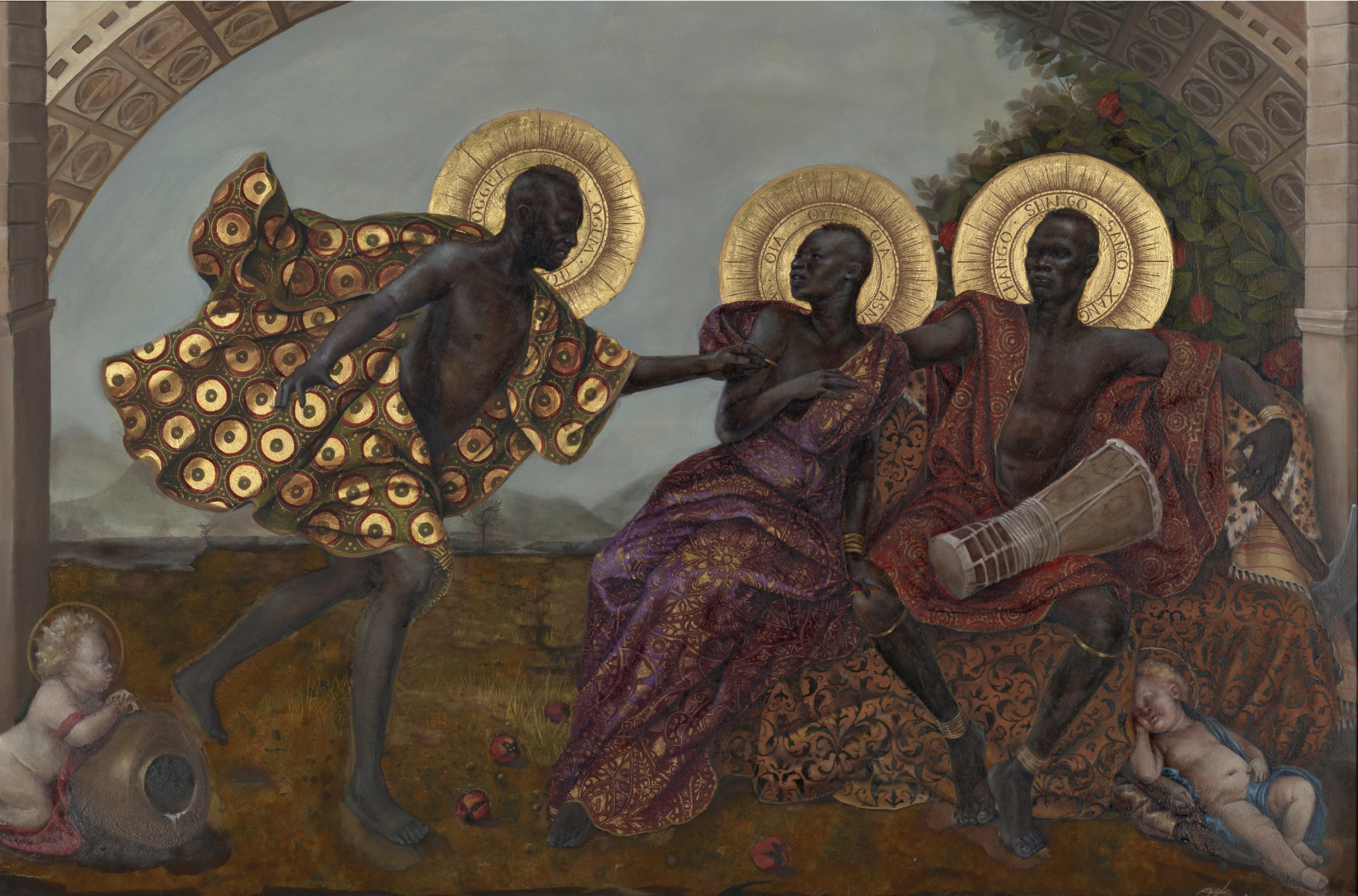
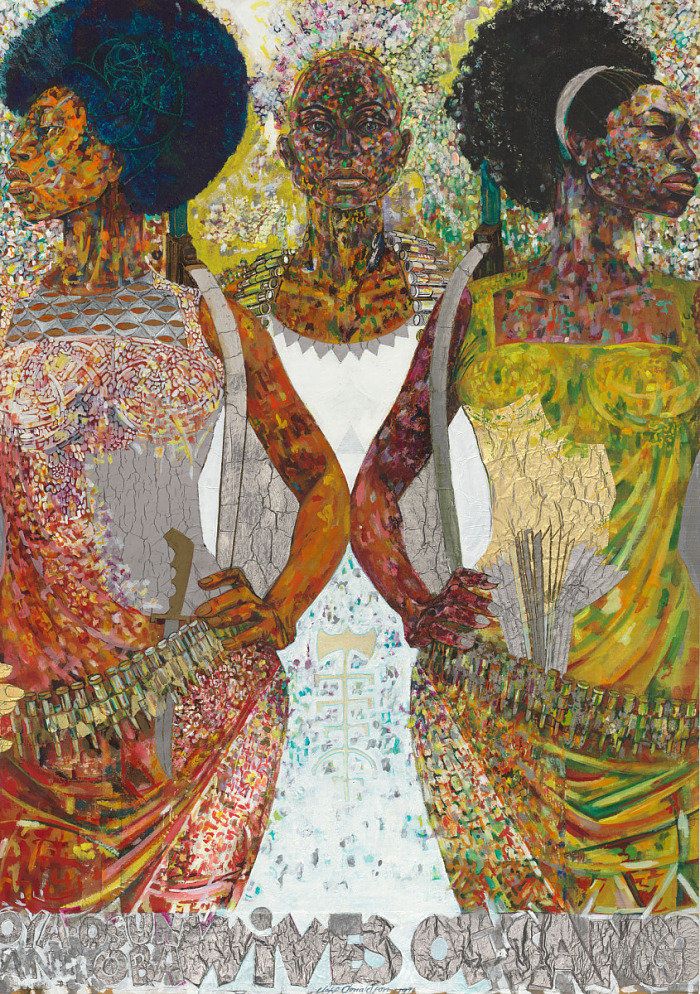
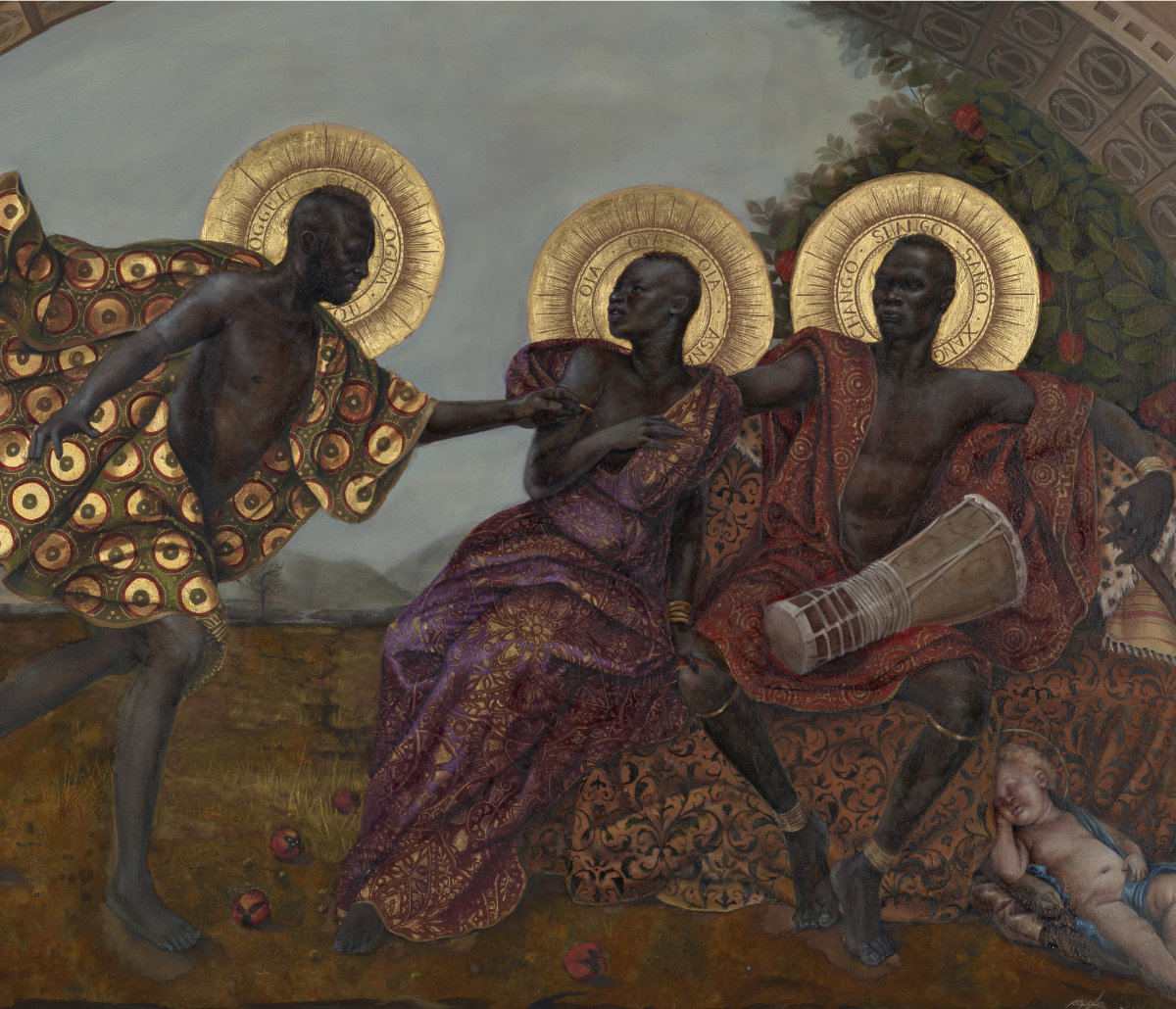
Ọbà is the orisha of the River Oba, the source of which lies near Igbon, where her worship originates. During the wars of the 19th century, her centers of worship moved to the more secure town Ogbomosho. She is traditionally identified as the senior wife of Shango (the third king of the Oyo Empire and an orisha). Oba metaphorically “gave her ear” to Shango by listening and being attentive to her husband. She represents stability and sacred bonds. She is syncretized with Saint Catherine of Siena… The most popular myth found in West Africa, Brazil, and Cuba has Oba cutting off her ear to serve to her husband Shango as food, because one of her co-wives (most often Oshun) has convinced her this will secure Shango’s attention. Once Shango sees the ear and realizes Oba has mutilated herself, he chases her from his house and into permanent exile… There are a few variations of the myth in Cuba where Oya rather than Oshun tricks Oba. Another Cuban variation excludes the wifely rivalry entirely, explaining Oba’s self-mutilation of both ears as an effort to feed Shango after they run out of goat and he is in need of food for his struggle against Ogun. By comparison, in the verses of the Odu Ifá, Oba lends her ear at the advice of Ifá and the measure successfully ties Shango to Oba, as none of his other wives would listen to his ideas. Oya, representing the independent woman, did not need Shango’ advice. Oshun, representing love and the honey of life, was busy with other men.
Appearance List The voice of Africa v. 1 (1913) by Leo Frobenius — valued for early observations and visual documentation despite controversial diffusionist interpretations of African civilization [Smithsonian]; The history of the Yorubas : from the earliest times to the beginning of the British Protectorate (1921) by Rev. Samuel Johnson, Paster of Oyo; ed. Dr. O. (Obadiah) Johnson, Lagos [Internet Archive]; Os africanos no Brasil (1932) by Raymundo Nina Rodrigues; The Religion of the Yorùbá (1948) by J. Olumide Luca; Candomblés da Bahia (first ed. 1948; 2nd ed. 1954) by Edison Carneiro; West African Religion (1949) by Geoffrey Parrinder; Dieux d’Afrique (1954) by Pierre Verger (original edition; later reissued); Olódùmarè: God in Yoruba Belief (1962) by E. Bolaji Idowu; Three Yoruba Plays (1964) by Duro Ladipo; The Shango Cult in Trinidad (1965) by George Eaton Simpson (monograph; first ed. 1965); African Religions in Brazil (French: Les religions africaines au Brésil, 1960) by Roger Bastide; Ifa Divination: Communication Between Gods and Men in West Africa (1969) by William Bascom; Yoruba Beliefs and Sacrificial Rites (1979) by J. Ọmọṣade Awolalu.
Sample Read Yoruba Beliefs and Sacrificial Rites (1979) [Internet Archive]
Description Ọbà is the orisha of the River Oba, the source of which lies near Igbon, where her worship originates. During the wars of the 19th century, her centers of worship moved to the more secure town Ogbomosho. She is traditionally identified as the senior wife of Shango (the third king of the Oyo Empire and an orisha). Oba metaphorically “gave her ear” to Shango by listening and being attentive to her husband. She represents stability and sacred bonds. She is syncretized with Saint Catherine of Siena… The most popular myth found in West Africa, Brazil, and Cuba has Oba cutting off her ear to serve to her husband Shango as food, because one of her co-wives (most often Oshun) has convinced her this will secure Shango’s attention. Once Shango sees the ear and realizes Oba has mutilated herself, he chases her from his house and into permanent exile… There are a few variations of the myth in Cuba where Oya rather than Oshun tricks Oba. Another Cuban variation excludes the wifely rivalry entirely, explaining Oba’s self-mutilation of both ears as an effort to feed Shango after they run out of goat and he is in need of food for his struggle against Ogun. By comparison, in the verses of the Odu Ifá, Oba lends her ear at the advice of Ifá and the measure successfully ties Shango to Oba, as none of his other wives would listen to his ideas. Oya, representing the independent woman, did not need Shango’ advice. Oshun, representing love and the honey of life, was busy with other men.

 ,
,  ,
,