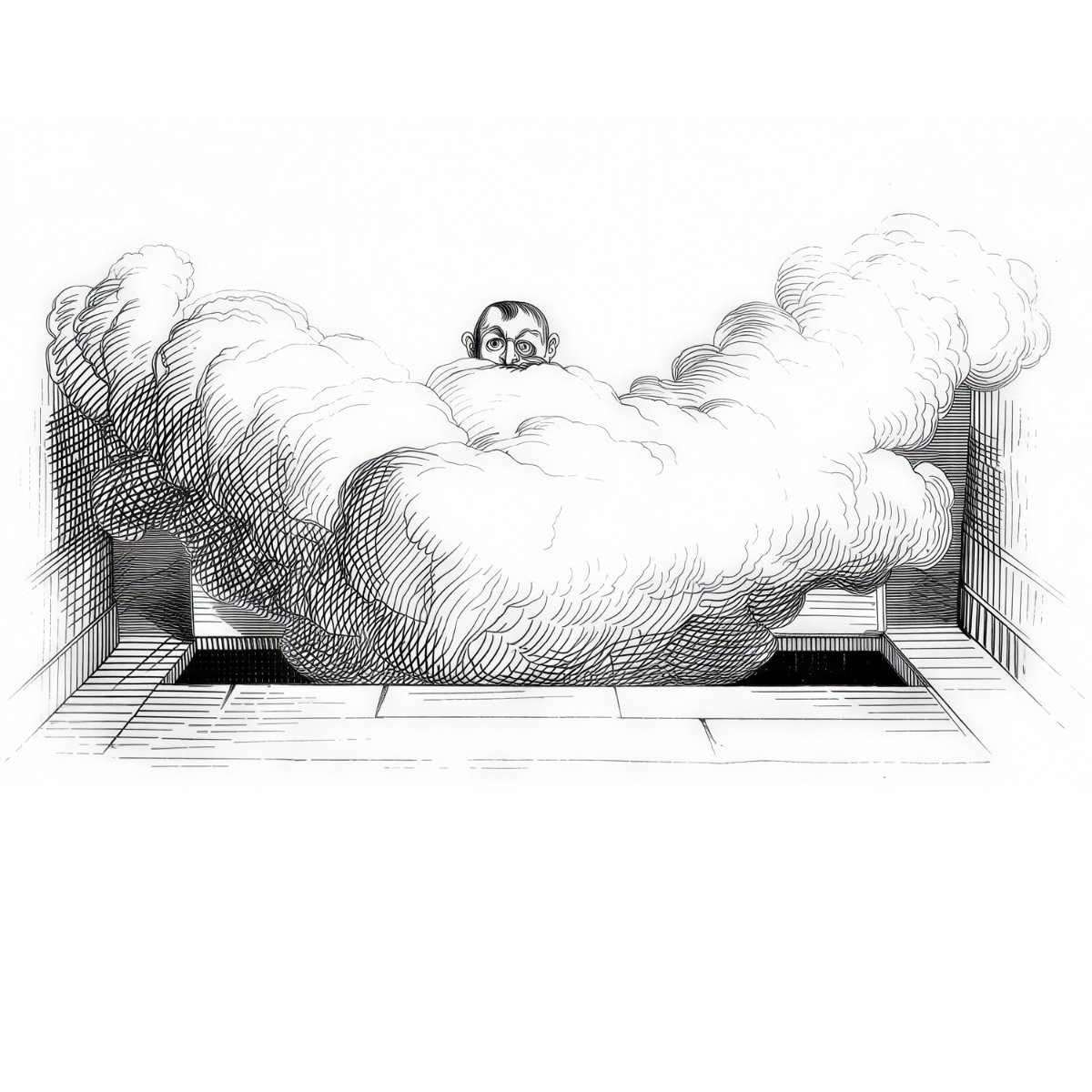
– Do you know you’re not the first, Alfred? – I know that very well, he said. But what does it matter? – And I, I continued, I know very well why you never spoke to me about your predecessors: one named Gardner and one named Chambrun. They died in a funny way. Look at me, Alfred, don’t turn your head away. It is said that The Invisibles killed them, as they were both on the eve of violating their mystery… ~ “L’Œil fantastique” (January 8, 1938). In three linked tales by Maurice Renard, amateur investigators confront a hidden order of beings — “the Invisible Ones” — who exist alongside humanity but evade ordinary perception. In “Gardner et l’invisible” (December 1929), Gardner deduces from subtle physical anomalies that unseen entities share the same space as humans and can intermittently affect matter. In “Eux” (August 1, 1934), Philippe Chambrun extends this idea, recognizing that these Invisible Ones constitute a parallel order whose presence explains otherwise inexplicable disturbances. Finally, in “L’Œil fantastique” (January 8, 1938), Alfred uses an optical device that alters vision, briefly revealing these beings and demonstrating that their invisibility stems not from absence but from the limits of human perception. Across the three stories, each man independently uncovers part of the same truth: reality is inhabited by intelligences that remain hidden because human senses are fundamentally incomplete, and will commit murder to maintain their secret existence. ~ Eidolon Station. Metapsychics or parapsychology, a movement that encouraged scientists to investigate the fringes of science, deeply influenced the merveilleux-scientifique genre. In many of their novels, authors normalised marvels once considered supernatural using technology or scientific discovery. For example, in the short story “L’œil fantastique” (1938), or “The Fantastic Eye”, Renard imagined an aspiring scientist who uses a photographic device to see creatures from another dimension, which turns him mad in return. Similarly, in La lumière bleue (1930), or ‘The Blue Light’, by Paul Féval fils and Henri Boo-Silhen, a photographic plate coated with a mysterious preparation allowed mind-reading.
| Alias Invisible Ones |
| Real Names/Alt Names L’invisible, The Invisible Ones, Them |
| Characteristics Villain, Merveilleux-scientifique, Extra-Dimensional, Power: Invisibility, Modernism Era, Public Domain |
| Creators/Key Contributors Maurice Renard |
| First Appearance “Gardner et l’invisible” by Maurice Renard in Le Matin, « Les Mille et un matins » (n° 16694, 3 décembre 1929) |
| First Publisher Le Matin |
| Appearance List “Gardner et l’invisible” by Maurice Renard in Le Matin, « Les Mille et un matins » (n° 16694, 3 décembre 1929) [Gallica BnF]; “Eux” (1939) by Maurice Renard in La Revue des Vivants, organe de la génération de la guerre (n° 8, 1 août 1934); “L’Œil fantastique” by Maurice Renard in Le Matin, « Les Mille et un matins » (n° 19650, 8 January 1938) [Gallica BnF]; “The Fantastic Eye” in The Bald Giants: Thirty-Nine French Scientific Romances (2020), translated by Brian Stableford [Black Coat Press]. |
| Sample Read Les 1001 Matins de Maurice Renard [La Porte Ouverte] |
| Description – Do you know you’re not the first, Alfred? – I know that very well, he said. But what does it matter? – And I, I continued, I know very well why you never spoke to me about your predecessors: one named Gardner and one named Chambrun. They died in a funny way. Look at me, Alfred, don’t turn your head away. It is said that The Invisibles killed them, as they were both on the eve of violating their mystery… ~ “L’Œil fantastique” (January 8, 1938). In three linked tales by Maurice Renard, amateur investigators confront a hidden order of beings — “the Invisible Ones” — who exist alongside humanity but evade ordinary perception. In “Gardner et l’invisible” (December 1929), Gardner deduces from subtle physical anomalies that unseen entities share the same space as humans and can intermittently affect matter. In “Eux” (August 1, 1934), Philippe Chambrun extends this idea, recognizing that these Invisible Ones constitute a parallel order whose presence explains otherwise inexplicable disturbances. Finally, in “L’Œil fantastique” (January 8, 1938), Alfred uses an optical device that alters vision, briefly revealing these beings and demonstrating that their invisibility stems not from absence but from the limits of human perception. Across the three stories, each man independently uncovers part of the same truth: reality is inhabited by intelligences that remain hidden because human senses are fundamentally incomplete, and will commit murder to maintain their secret existence. ~ Eidolon Station. Metapsychics or parapsychology, a movement that encouraged scientists to investigate the fringes of science, deeply influenced the merveilleux-scientifique genre. In many of their novels, authors normalised marvels once considered supernatural using technology or scientific discovery. For example, in the short story “L’œil fantastique” (1938), or “The Fantastic Eye”, Renard imagined an aspiring scientist who uses a photographic device to see creatures from another dimension, which turns him mad in return. Similarly, in La lumière bleue (1930), or ‘The Blue Light’, by Paul Féval fils and Henri Boo-Silhen, a photographic plate coated with a mysterious preparation allowed mind-reading. |
| Source Merveilleux-scientifique — Aeon.co |
 |