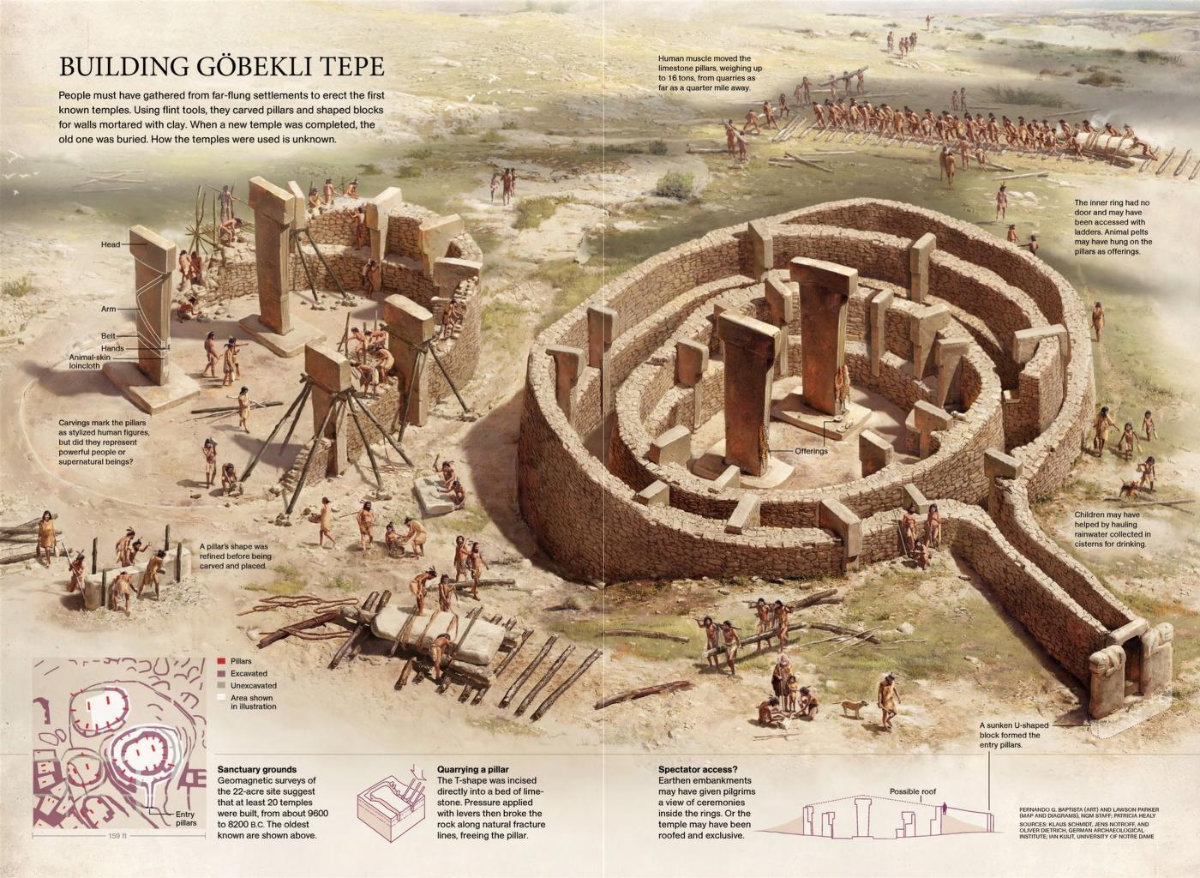
Göbekli Tepe (Turkish: “Potbelly Hill”) is a Neolithic archaeological site in the Southeastern Anatolia Region of Turkey. Dated to the Pre-Pottery Neolithic, between c. 9500 and 8000 BCE, the site comprises a number of large circular structures supported by massive stone pillars – the world’s oldest known megaliths. Many of these pillars are richly decorated with abstract anthropomorphic details, clothing, and reliefs of wild animals. The site was first used at the dawn of the Southwest Asian Neolithic period, which marked the appearance of the oldest permanent human settlements anywhere in the world. Prehistorians link this Neolithic Revolution to the advent of agriculture, but disagree on whether farming caused people to settle down or vice versa. Göbekli Tepe, a monumental complex built on the top of a rocky mountaintop, with no clear evidence of agricultural cultivation produced to date, has played a prominent role in this debate. The site’s original excavator, German archaeologist Klaus Schmidt, described it as the “world’s first temple”: a sanctuary used by groups of nomadic hunter-gatherers from a wide area, with few or no permanent inhabitants. Göbekli Tepe follows a geometric pattern, an equilateral triangle. Most carvings depict animals, mostly serpents, foxes, and boars, but also gazelle, mouflon (wild sheep), onager, ducks, and vultures. Insofar as they can be identified, the animals are male, and often depicted with an aggressive posture. Abstract shapes are also depicted, mostly an upright or horizontal ‘H’-shaped symbol, but also crescents and disks. Schmidt suggested it was a central location for a cult of the dead and that the carved animals are there to protect the dead.
Appearance List Article: National Geographic Magazine Vol. 219 #6 (June 2011) [Internet Archive]. Podcast: Astonishing Legends: Episode 108-110 Göbekli Tepe
Sample Read Astonishing Legends: Episode 108 Göbekli Tepe Part 1 [YT]
Description Göbekli Tepe (Turkish: “Potbelly Hill”) is a Neolithic archaeological site in the Southeastern Anatolia Region of Turkey. Dated to the Pre-Pottery Neolithic, between c. 9500 and 8000 BCE, the site comprises a number of large circular structures supported by massive stone pillars – the world’s oldest known megaliths. Many of these pillars are richly decorated with abstract anthropomorphic details, clothing, and reliefs of wild animals. The site was first used at the dawn of the Southwest Asian Neolithic period, which marked the appearance of the oldest permanent human settlements anywhere in the world. Prehistorians link this Neolithic Revolution to the advent of agriculture, but disagree on whether farming caused people to settle down or vice versa. Göbekli Tepe, a monumental complex built on the top of a rocky mountaintop, with no clear evidence of agricultural cultivation produced to date, has played a prominent role in this debate. The site’s original excavator, German archaeologist Klaus Schmidt, described it as the “world’s first temple”: a sanctuary used by groups of nomadic hunter-gatherers from a wide area, with few or no permanent inhabitants. Göbekli Tepe follows a geometric pattern, an equilateral triangle. Most carvings depict animals, mostly serpents, foxes, and boars, but also gazelle, mouflon (wild sheep), onager, ducks, and vultures. Insofar as they can be identified, the animals are male, and often depicted with an aggressive posture. Abstract shapes are also depicted, mostly an upright or horizontal ‘H’-shaped symbol, but also crescents and disks. Schmidt suggested it was a central location for a cult of the dead and that the carved animals are there to protect the dead.