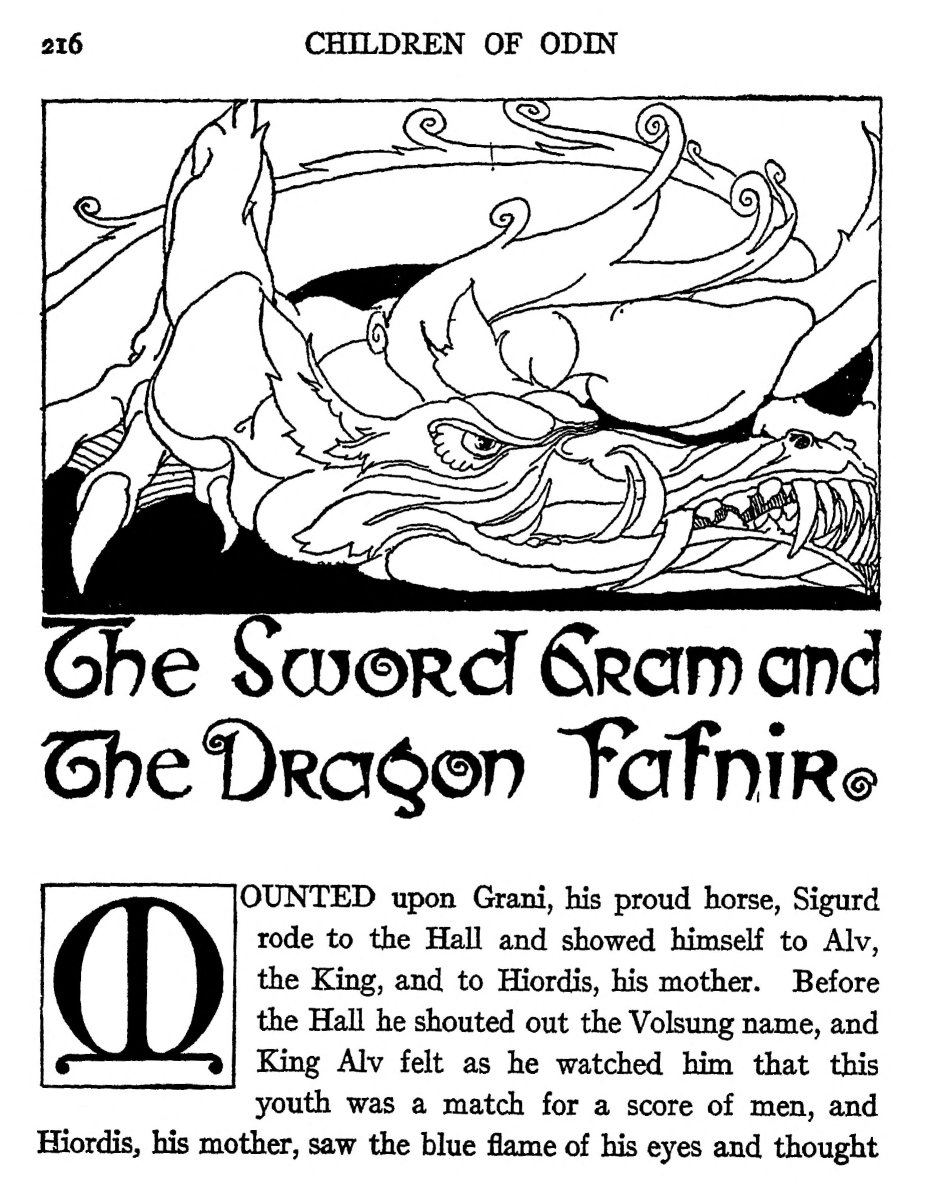
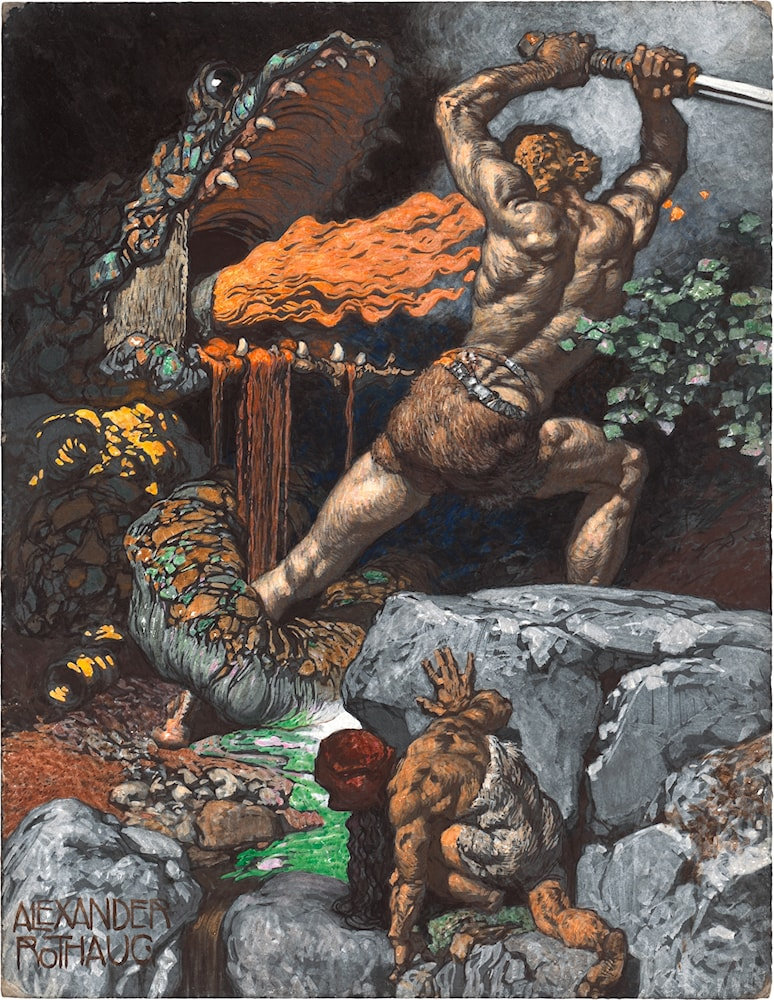
In Germanic heroic legend and folklore, Fáfnir was a dwarf or other type of humanoid who had shifted into the hamr of a Germanic dragon (a worm, “serpent”, in period nomenclature) in order to protect a treasure, eventually being slain by a member of the Völsung family, typically Sigurð. In Nordic mythology, he is the son of Hreiðmarr, as well as brother of Regin and Ótr. He is attested throughout the Völsung Cycle, where he commits patricide out of greed, taking the ring and hoard of the dwarf Andvari and shapeshifting into a dragon. Fáfnir’s brother, Regin, later assisted Sigurð in obtaining the sword Gram by which Fáfnir is killed. Fáfnir has been identified with an unnamed dragon killed by a Völsung in other Germanic works, including Beowulf, the Nibelunglied and a number of skaldic poems. Fáfnir and his killing by Sigurð are further represented in numerous medieval carvings from the British Isles and Scandinavia, and a single axe head in a Scandinavian style found in Russia…
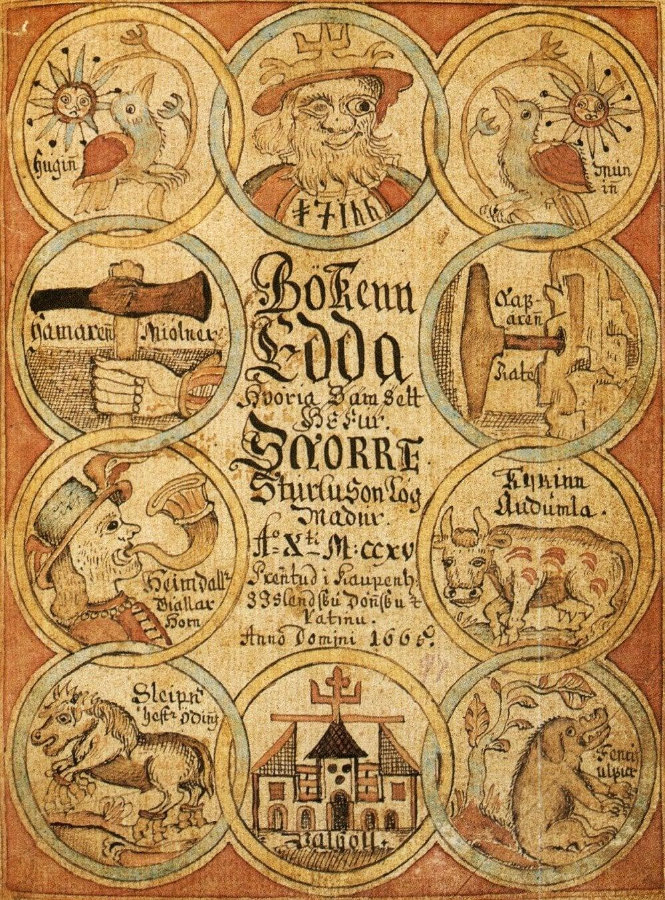
Appearance List Literary: Prose Edda (c. 1220 CE) by Snorri Sturluson; Poetic Edda (c. 1270 CE); Northern Mythology (1851–1852) by Benjamin Thorpe [Internet Archive]; Asgard Stories: Tales from Norse Mythology (1901) by Mary H. Foster and Mabel H. Cummings [Internet Archive]; In the Days of Giants: A Book of Norse Tales by Abbie Farwell Brown (1902) [Internet Archive]; The Elder or Poetic Edda (1908) [Internet Archive]; The Heroes of Asgard: Tales from Scandinavian Mythology by Keary and Keary (1909) [Internet Archive]; Teutonic Myths and Legends (1912) by Donald A. Mackenzie [Internet Archive]; The Children of Odin (1920) by Padraic Colum [Internet Archive].
Sample Read The Heroes of Asgard: Tales from Scandinavian Mythology [Internet Archive]
Description In Germanic heroic legend and folklore, Fáfnir was a dwarf or other type of humanoid who had shifted into the hamr of a Germanic dragon (a worm, “serpent”, in period nomenclature) in order to protect a treasure, eventually being slain by a member of the Völsung family, typically Sigurð. In Nordic mythology, he is the son of Hreiðmarr, as well as brother of Regin and Ótr. He is attested throughout the Völsung Cycle, where he commits patricide out of greed, taking the ring and hoard of the dwarf Andvari and shapeshifting into a dragon. Fáfnir’s brother, Regin, later assisted Sigurð in obtaining the sword Gram by which Fáfnir is killed. Fáfnir has been identified with an unnamed dragon killed by a Völsung in other Germanic works, including Beowulf, the Nibelunglied and a number of skaldic poems. Fáfnir and his killing by Sigurð are further represented in numerous medieval carvings from the British Isles and Scandinavia, and a single axe head in a Scandinavian style found in Russia…

 ,
,