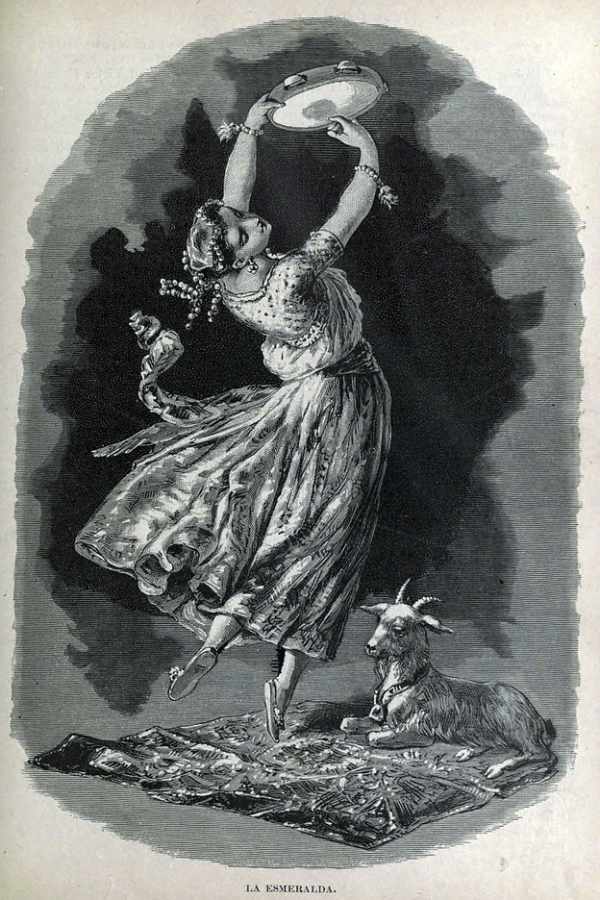
Esméralda’s birth-name was Agnes. She is the illegitimate daughter of Paquette Guybertaut, nicknamed ‘la Chantefleurie’, an orphaned minstrel’s daughter who lives in Rheims. Paquette has become a prostitute after being seduced by a young nobleman, and lives a miserable life in poverty and loneliness. Agnes’s birth makes Paquette happy once more, and she lavishes attention and care upon her adored child: even the neighbours begin to forgive Paquette for her past behaviour when they watch the pair. Tragedy strikes, however, when Gypsies kidnap the young baby, leaving a hideously deformed child (the infant Quasimodo) in her place. The townsfolk come to the conclusion that the Gypsies have cannibalised baby Agnes; the mother flees Reims in despair, and the Gypsy child is exorcised and sent to Paris, to be left on the foundling bed at Notre-Dame. Fifteen years later, Agnes— now named La Esméralda, in reference to the paste emerald she wears around her neck— is living happily amongst the Gypsies in Paris. She serves as a public dancer. Her pet goat, Djali, also performs counting tricks with a tambourine, an act later used as courtroom evidence that Esméralda is a witch. Claude Frollo sends his adopted son, Quasimodo, to kidnap Esméralda from the streets. Esméralda is rescued by Captain Phoebus, with whom she instantly falls in love to the point of obsession. Later that night, Clopin Trouillefou, the King of Truands, prepares to execute a poet named Pierre Gringoire for trespassing the Beggars’ territory known as The Court of Miracles. In a compassionate act to save his life, Esméralda agrees to marry Gringoire. When Quasimodo is sentenced to the pillory for his attempted kidnapping, it is Esméralda, his victim, who pities him and serves him water. There, Paquette la Chantefleurie, now known as Sister Gudule, an anchoress, curses Esmeralda, claiming she and the other Gypsies ate her lost child. Two months later, Esméralda is walking in the streets when Fleur-de-Lys de Gondelaurier, the fiancée of Phoebus, and her wealthy, aristocratic friends spot the Gypsy girl from the Gondelaurier house. Fleur-de-Lys becomes jealous of Esmeralda’s beauty and pretends to not see her, but Fleur’s friends call Esméralda to them out of curiosity. When Esméralda enters the room, tension immediately appears — the wealthy young women, who all appeared equally pretty when compared to each other, are plain in comparison to Esméralda. Knowing that Esméralda’s beauty far surpasses their own, the aristocrats make fun of her clothes instead. Phoebus tries to make Esméralda feel better, but Fleur grabs Esméralda’s bag and opens it. Pieces of wood with letters written on them fall out, and Djali moves the letters to spell out “Phoebus”. Fleur, realizing that she now has competition, calls Esméralda a witch and passes out. Esméralda runs off, and Phoebus follows her. Later that month, she meets with Phoebus and declares her love for him. Phoebus takes the opportunity to kiss her as she speaks, and he pretends to love her. He asks Esméralda what the point of marriage is (he has no intentions of leaving his fiancée, he just wants to have sex with Esméralda), which leaves the girl hurt. Phoebus, seeing the girl’s reaction, pretends to be sad and says that Esméralda must no longer love him. Esméralda then says that she does love him and will do whatever he asks. Phoebus begins to undo Esméralda’s shirt and kisses her again. Frollo, who was watching from behind a door, bursts into the room in a jealous rage, stabs Phoebus, and flees. Esméralda passes out at the sight of Frollo, and when she comes to, she finds herself framed for murder, for a miscommunication makes the jury believe that Phoebus is in fact dead. Esméralda proclaims her innocence, but when she is threatened with having her foot crushed in a vice, she confesses. The court sentences her to death for murder and witchcraft (the court has seen Djali’s spelling trick), and she is locked away in a cell. Frollo visits her, and Esméralda hides in the corner (before this point in the book, the readers know that Frollo’s lustful obsession of the girl has caused him to publicly denounce and stalk her). Frollo tells Esméralda about his inner conflict about her, and he gives her an ultimatum: give herself to him or face death. Esméralda is repulsed that Frollo would harm her to this extent for his own selfishness. She refuses. Frollo, mad with emotion, leaves the city. The next day, minutes before she is to be hanged, Quasimodo dramatically arrives from Notre Dame, takes Esméralda, and runs back in while crying, “Sanctuary!”.
First Appearance The Hunchback of Notre-Dame (Fr: Notre-Dame de Paris, 1831)
First Publisher Gosselin
Appearance List Novel: The Hunchback of Notre-Dame (1831). Editions (short list): Notre-Dame de Paris (Paris: Perrotin, Garnier Frères, 1844) (The Hunchback of Notre-Dame) [Internet Archive], Complete Works by Victor Hugo (4 volumes, J. Hetzel edition, 1853-1854), Notre-Dame de Paris (1889). Stage: La Esmeralda (1836), Esmeralda (1847, Esmeralda (1883), Notre Dame (1914). Ballet: La Esmeralda (1844), Gudule’s Daughter, or Esmiralda (1902). Comics: Jumbo Comics #1-8,10, Four Color Comics #854, Wonderworld Comics #4. Film: Esmeralda (1905), The Hunchback of Notre Dame (1911), The Darling of Paris (1917), Esmeralda (1922), The Hunch-Back of Notre Dame (1923).
Description Esméralda’s birth-name was Agnes. She is the illegitimate daughter of Paquette Guybertaut, nicknamed ‘la Chantefleurie’, an orphaned minstrel’s daughter who lives in Rheims. Paquette has become a prostitute after being seduced by a young nobleman, and lives a miserable life in poverty and loneliness. Agnes’s birth makes Paquette happy once more, and she lavishes attention and care upon her adored child: even the neighbours begin to forgive Paquette for her past behaviour when they watch the pair. Tragedy strikes, however, when Gypsies kidnap the young baby, leaving a hideously deformed child (the infant Quasimodo) in her place. The townsfolk come to the conclusion that the Gypsies have cannibalised baby Agnes; the mother flees Reims in despair, and the Gypsy child is exorcised and sent to Paris, to be left on the foundling bed at Notre-Dame. Fifteen years later, Agnes— now named La Esméralda, in reference to the paste emerald she wears around her neck— is living happily amongst the Gypsies in Paris. She serves as a public dancer. Her pet goat, Djali, also performs counting tricks with a tambourine, an act later used as courtroom evidence that Esméralda is a witch. Claude Frollo sends his adopted son, Quasimodo, to kidnap Esméralda from the streets. Esméralda is rescued by Captain Phoebus, with whom she instantly falls in love to the point of obsession. Later that night, Clopin Trouillefou, the King of Truands, prepares to execute a poet named Pierre Gringoire for trespassing the Beggars’ territory known as The Court of Miracles. In a compassionate act to save his life, Esméralda agrees to marry Gringoire. When Quasimodo is sentenced to the pillory for his attempted kidnapping, it is Esméralda, his victim, who pities him and serves him water. There, Paquette la Chantefleurie, now known as Sister Gudule, an anchoress, curses Esmeralda, claiming she and the other Gypsies ate her lost child. Two months later, Esméralda is walking in the streets when Fleur-de-Lys de Gondelaurier, the fiancée of Phoebus, and her wealthy, aristocratic friends spot the Gypsy girl from the Gondelaurier house. Fleur-de-Lys becomes jealous of Esmeralda’s beauty and pretends to not see her, but Fleur’s friends call Esméralda to them out of curiosity. When Esméralda enters the room, tension immediately appears — the wealthy young women, who all appeared equally pretty when compared to each other, are plain in comparison to Esméralda. Knowing that Esméralda’s beauty far surpasses their own, the aristocrats make fun of her clothes instead. Phoebus tries to make Esméralda feel better, but Fleur grabs Esméralda’s bag and opens it. Pieces of wood with letters written on them fall out, and Djali moves the letters to spell out “Phoebus”. Fleur, realizing that she now has competition, calls Esméralda a witch and passes out. Esméralda runs off, and Phoebus follows her. Later that month, she meets with Phoebus and declares her love for him. Phoebus takes the opportunity to kiss her as she speaks, and he pretends to love her. He asks Esméralda what the point of marriage is (he has no intentions of leaving his fiancée, he just wants to have sex with Esméralda), which leaves the girl hurt. Phoebus, seeing the girl’s reaction, pretends to be sad and says that Esméralda must no longer love him. Esméralda then says that she does love him and will do whatever he asks. Phoebus begins to undo Esméralda’s shirt and kisses her again. Frollo, who was watching from behind a door, bursts into the room in a jealous rage, stabs Phoebus, and flees. Esméralda passes out at the sight of Frollo, and when she comes to, she finds herself framed for murder, for a miscommunication makes the jury believe that Phoebus is in fact dead. Esméralda proclaims her innocence, but when she is threatened with having her foot crushed in a vice, she confesses. The court sentences her to death for murder and witchcraft (the court has seen Djali’s spelling trick), and she is locked away in a cell. Frollo visits her, and Esméralda hides in the corner (before this point in the book, the readers know that Frollo’s lustful obsession of the girl has caused him to publicly denounce and stalk her). Frollo tells Esméralda about his inner conflict about her, and he gives her an ultimatum: give herself to him or face death. Esméralda is repulsed that Frollo would harm her to this extent for his own selfishness. She refuses. Frollo, mad with emotion, leaves the city. The next day, minutes before she is to be hanged, Quasimodo dramatically arrives from Notre Dame, takes Esméralda, and runs back in while crying, “Sanctuary!”.