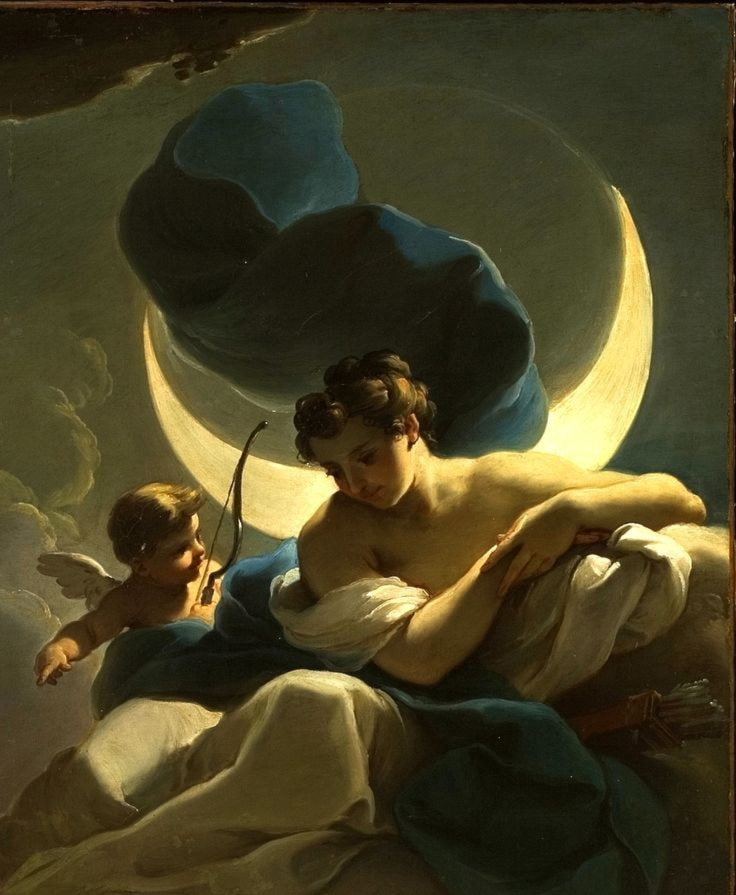
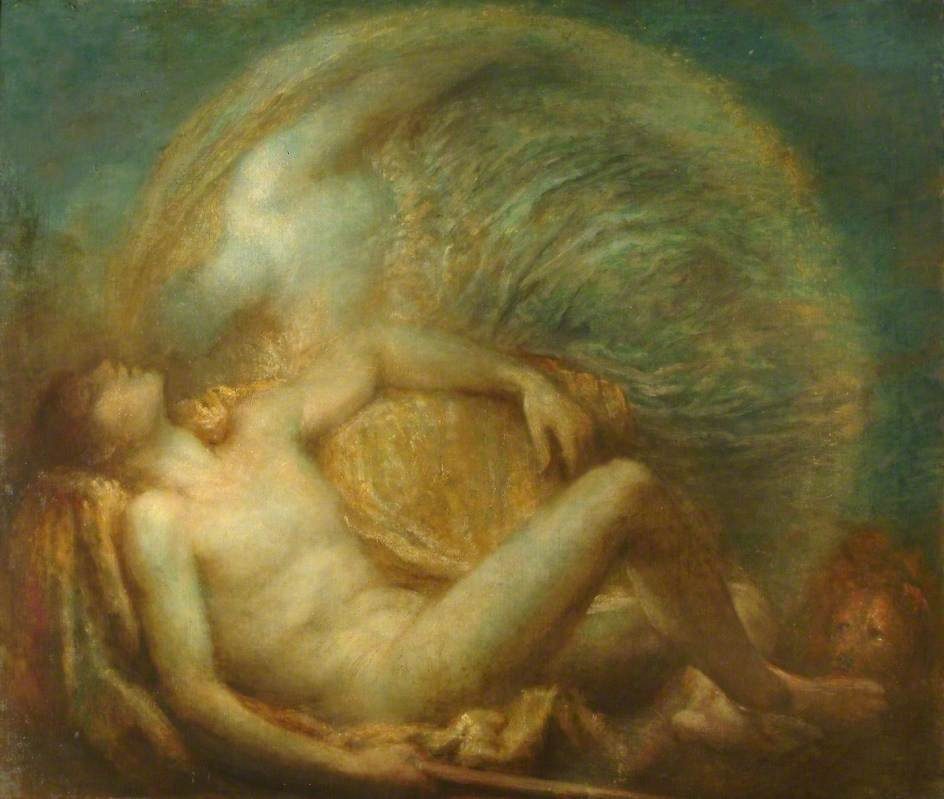
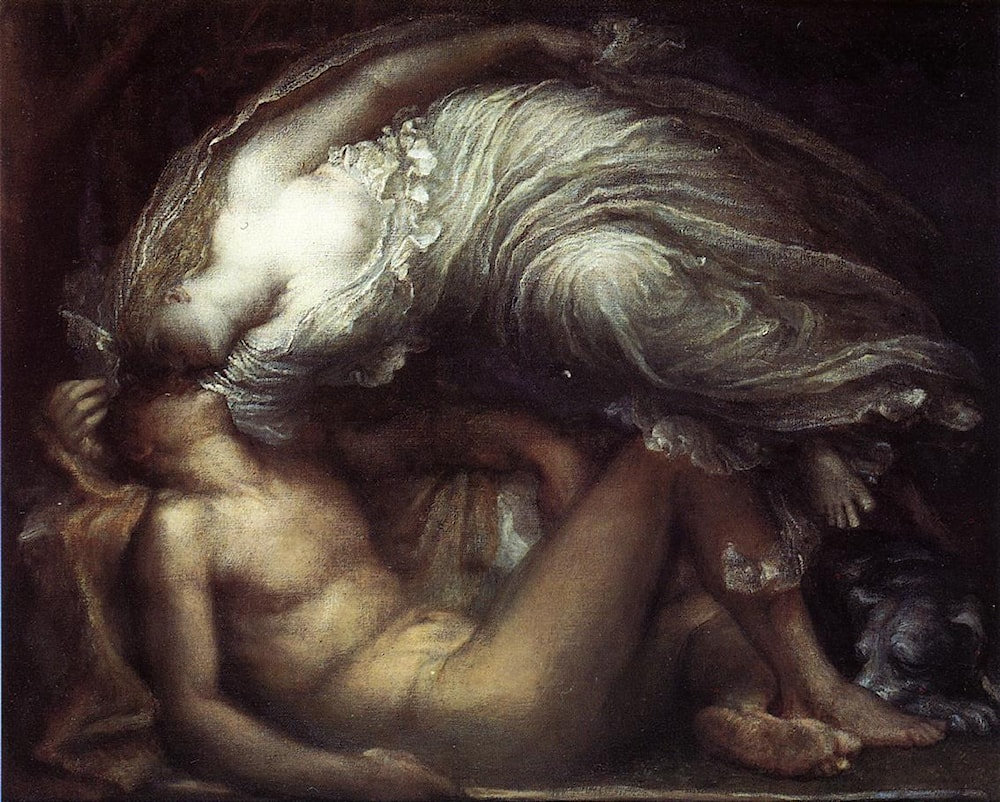
Apollonius of Rhodes (3rd century BC) is one of the many poets who tell how Selene, the Titan goddess of the Moon, loved the mortal Endymion. She found Endymion so beautiful that she asked her cousin, Zeus, to grant him eternal youth so that he would never leave her. Alternatively, Selene so loved how Endymion looked when he was asleep in the cave on Mount Latmus, near Miletus in Caria, that she entreated Zeus that he might remain that way. In some versions, Zeus wanted to punish Endymion for daring to show romantic interest in Hera (much like Ixion). Whatever the case, Zeus granted Selene’s wish and put Endymion into an eternal sleep. Every night, Selene visited him where he slept, and by him had fifty daughters who are equated by some scholars (such as James George Frazer or H. J. Rose) with the fifty months of the Olympiad.
First Appearance Catalogue of Women / Ehoiai (archaic Greek; fragmentary) by Pseudo-Hesiod
First Publisher ○
Appearance List Catalogue of Women / Ehoiai (archaic Greek; fragmentary) by Pseudo-Hesiod / Hesiodic tradition — early genealogical source for Endymion; Idylls (3rd century BCE) by Theocritus — early poetic allusion to Endymion as the beloved of Selene/the Moon; Argonautica (3rd century BCE) by Apollonius Rhodius; Bibliotheca / The Library (1st–2nd century CE) by Pseudo-Apollodorus; Dialogues of the Gods (2nd century CE) by Lucian of Samosata; Description of Greece (2nd century CE) by Pausanias; Endimion and Phoebe (1595) by Michael Drayton — Elizabethan poetic retelling of Endymion and the moon goddess; Endymion, the Man in the Moon (1591) by John Lyly — Elizabethan dramatic adaptation using Endymion, Cynthia, sleep, and lunar allegory; Endymion: A Poetic Romance (1818) by John Keats; A Dictionary of Greek and Roman Biography and Mythology (1844–1849; widely used into late 19th c.) by William Smith; The Age of Fable (1855; many later eds.) by Thomas Bulfinch; Myths of the Greeks and Romans (1893) by H. A. Guerber; The Myths of Greece and Rome (1942) by Edith Hamilton; The Greek Myths (1955) by Robert Graves.
Sample Read Bulfinch’s Mythology by Thomas Bulfinch [Internet Archive]
Description Apollonius of Rhodes (3rd century BC) is one of the many poets who tell how Selene, the Titan goddess of the Moon, loved the mortal Endymion. She found Endymion so beautiful that she asked her cousin, Zeus, to grant him eternal youth so that he would never leave her. Alternatively, Selene so loved how Endymion looked when he was asleep in the cave on Mount Latmus, near Miletus in Caria, that she entreated Zeus that he might remain that way. In some versions, Zeus wanted to punish Endymion for daring to show romantic interest in Hera (much like Ixion). Whatever the case, Zeus granted Selene’s wish and put Endymion into an eternal sleep. Every night, Selene visited him where he slept, and by him had fifty daughters who are equated by some scholars (such as James George Frazer or H. J. Rose) with the fifty months of the Olympiad.

 ,
,