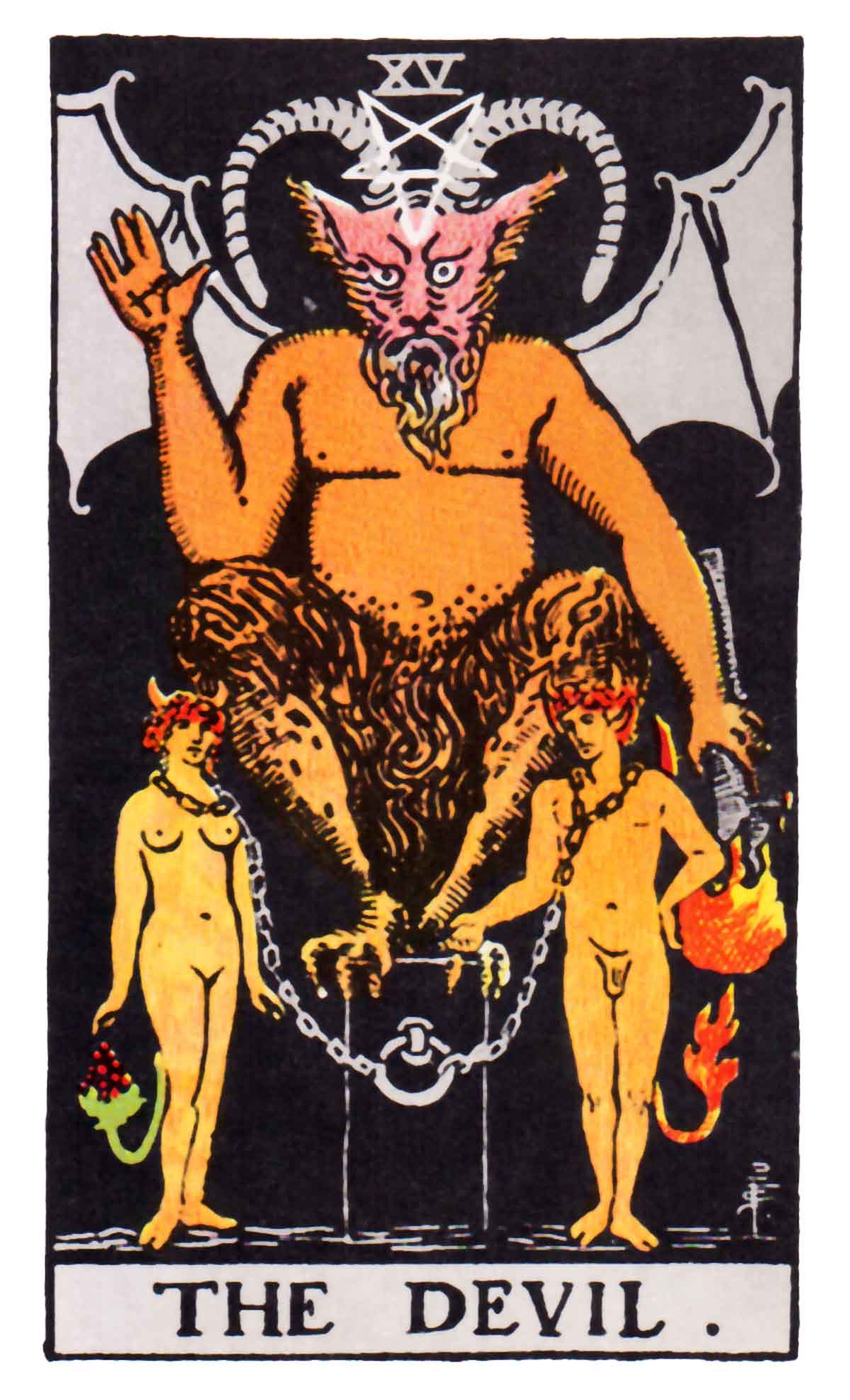
The Tarot Devil is all about temptation and how we’re often enslaved by our lust. There are many other devils, pointing to other vices and weaknesses of mankind. This one focuses on sexual aspects, which makes it much less frightening. At the time of the production of this Tarot card deck, the beginning of the 20th century, lust was generally regarded as a sin, and sex was shameful — at least out of wedlock. Times have changed, though not completely and not everywhere. Still, modern society usually has a much brighter view on the sexual urges and their satisfaction than what the picture on the Tarot Devil card implies. There are indeed many devils, in such a way that the ideas about what the devil signifies varies through time as well as from one congregation to another. The fallen angel of the Old Testament usually tried to expose people as not being that very devoted to their god. Sin was to deviate from the path man was supposed to travel. When the praise of chastity grew in the monasteries and around them, as a way of remaining faithful to God, so did the condemnation of lust and sex. A good Christian was supposed to deny carnal instincts and become spiritual, almost as if leaving the body already in this life. In such a world, the Tarot Devil would be the one tempting people to give in to their carnal desires. But there have been different views of the devil as well as of what is sin. Goethe in his Faust made the devil a clever guy who revealed people’s hypocrisy, thereby sort of doing God’s work. Occultists in the early 20th century and onwards, such as Aleister Crowley of The Golden Dawn, saw the devil as a representation of the necessity to liberate oneself of inhibitions, in order to realize one’s full potential as a human being. That devil was sort of a challenger. In comparative religion, the devil is definitely what’s called a trickster, a divinity acting as sort of a mediator between gods and men, often working for the benefit of the latter against the will of the former. A revolutionary of sorts. As for the image of the devil, which we are quite familiar with, its inspiration is bound to come from Greek and Roman mythical creatures, such as Pan, the Fauns, and Satyrs. The horns are there, the goat legs too. Also, Pan and the others are notoriously lustful and uninhibited in the myths – the very opposite of what the Bible seems to preach… But back to the Devil portrayed on this Tarot card. He sits like a ruler of the enchained woman and man, who also have horns on their heads, albeit small ones. That makes them willfully enchained — two persons giving in to their temptations. The Tarot Devil card should be compared to that of the Lovers, who are guarded by an angel and who seem to remain in chastity. It’s Eros against Agape — carnal love against spiritual. This Tarot deck condemns the former and praises the latter. But life would cease to exist without both. So, the Tarot Devil is not necessarily a card about evil things happening. It’s about temptation and satisfaction, lust and passion and boundless delight. It’s about challenging one’s limitations and inhibitions, daring to question established morals, revolting against prejudice… When the Tarot Devil card represents a person, it’s somebody behaving in the above described devilish way — uninhibited and tempting. It’s the kind of person you know you’d do best to stay far away from, but that’s not easy…
First Appearance Ducal courts of northern Italy (c. 1440)
First Publisher ○
Appearance List Sola Busca (1490s) — earliest surviving deck [Open Culture] [WaiteSmith.org]; Monde primitif… (Vol. 8: “Du Jeu des Tarots”) (1781) by Antoine Court de Gébelin; Manière de se récréer avec le jeu de cartes nommées Tarots (1783–1785) by Etteilla (Jean-Baptiste Alliette); Dogme et rituel de la haute magie (1856) by Éliphas Lévi; The Tarot: Its Occult Signification, Use in Fortune-Telling, and Method of Play (1888) by S. L. MacGregor Mathers; Le Tarot des Bohémiens (1889) by Papus (Gérard Encausse); Rider Waite Tarot (1909) by A. E. Waite and Pamela Colman Smith [WaiteSmith.org]; The Tarot of the Bohemians (1910) by A. P Morton [Internet Archive]; The Pictorial Key to the Tarot (1911, 1959) by A. E. Waite and Pamela Colman Smith; Le tarot des imagiers du moyen âge (1926) by Oswald Wirth; The Book of Thoth: A Short Essay on the Tarot of the Egyptians (1944) by Aleister Crowley; Le Tarot de Marseille (1949) by Paul Marteau; The Tarot Revealed (1960) by Eden Gray; Tarot Cards for Fun and Fortune Telling (1970) by Stuart R. Kaplan; The Encyclopedia of Tarot (Vol. 1) (1978) by Stuart R. Kaplan.
Sample Read The Pictorial Key to the Tarot (1911, 1959) by A. E. Waite and Pamela Colman Smith [Internet Archive]
Description The Tarot Devil is all about temptation and how we’re often enslaved by our lust. There are many other devils, pointing to other vices and weaknesses of mankind. This one focuses on sexual aspects, which makes it much less frightening. At the time of the production of this Tarot card deck, the beginning of the 20th century, lust was generally regarded as a sin, and sex was shameful — at least out of wedlock. Times have changed, though not completely and not everywhere. Still, modern society usually has a much brighter view on the sexual urges and their satisfaction than what the picture on the Tarot Devil card implies. There are indeed many devils, in such a way that the ideas about what the devil signifies varies through time as well as from one congregation to another. The fallen angel of the Old Testament usually tried to expose people as not being that very devoted to their god. Sin was to deviate from the path man was supposed to travel. When the praise of chastity grew in the monasteries and around them, as a way of remaining faithful to God, so did the condemnation of lust and sex. A good Christian was supposed to deny carnal instincts and become spiritual, almost as if leaving the body already in this life. In such a world, the Tarot Devil would be the one tempting people to give in to their carnal desires. But there have been different views of the devil as well as of what is sin. Goethe in his Faust made the devil a clever guy who revealed people’s hypocrisy, thereby sort of doing God’s work. Occultists in the early 20th century and onwards, such as Aleister Crowley of The Golden Dawn, saw the devil as a representation of the necessity to liberate oneself of inhibitions, in order to realize one’s full potential as a human being. That devil was sort of a challenger. In comparative religion, the devil is definitely what’s called a trickster, a divinity acting as sort of a mediator between gods and men, often working for the benefit of the latter against the will of the former. A revolutionary of sorts. As for the image of the devil, which we are quite familiar with, its inspiration is bound to come from Greek and Roman mythical creatures, such as Pan, the Fauns, and Satyrs. The horns are there, the goat legs too. Also, Pan and the others are notoriously lustful and uninhibited in the myths – the very opposite of what the Bible seems to preach… But back to the Devil portrayed on this Tarot card. He sits like a ruler of the enchained woman and man, who also have horns on their heads, albeit small ones. That makes them willfully enchained — two persons giving in to their temptations. The Tarot Devil card should be compared to that of the Lovers, who are guarded by an angel and who seem to remain in chastity. It’s Eros against Agape — carnal love against spiritual. This Tarot deck condemns the former and praises the latter. But life would cease to exist without both. So, the Tarot Devil is not necessarily a card about evil things happening. It’s about temptation and satisfaction, lust and passion and boundless delight. It’s about challenging one’s limitations and inhibitions, daring to question established morals, revolting against prejudice… When the Tarot Devil card represents a person, it’s somebody behaving in the above described devilish way — uninhibited and tempting. It’s the kind of person you know you’d do best to stay far away from, but that’s not easy…