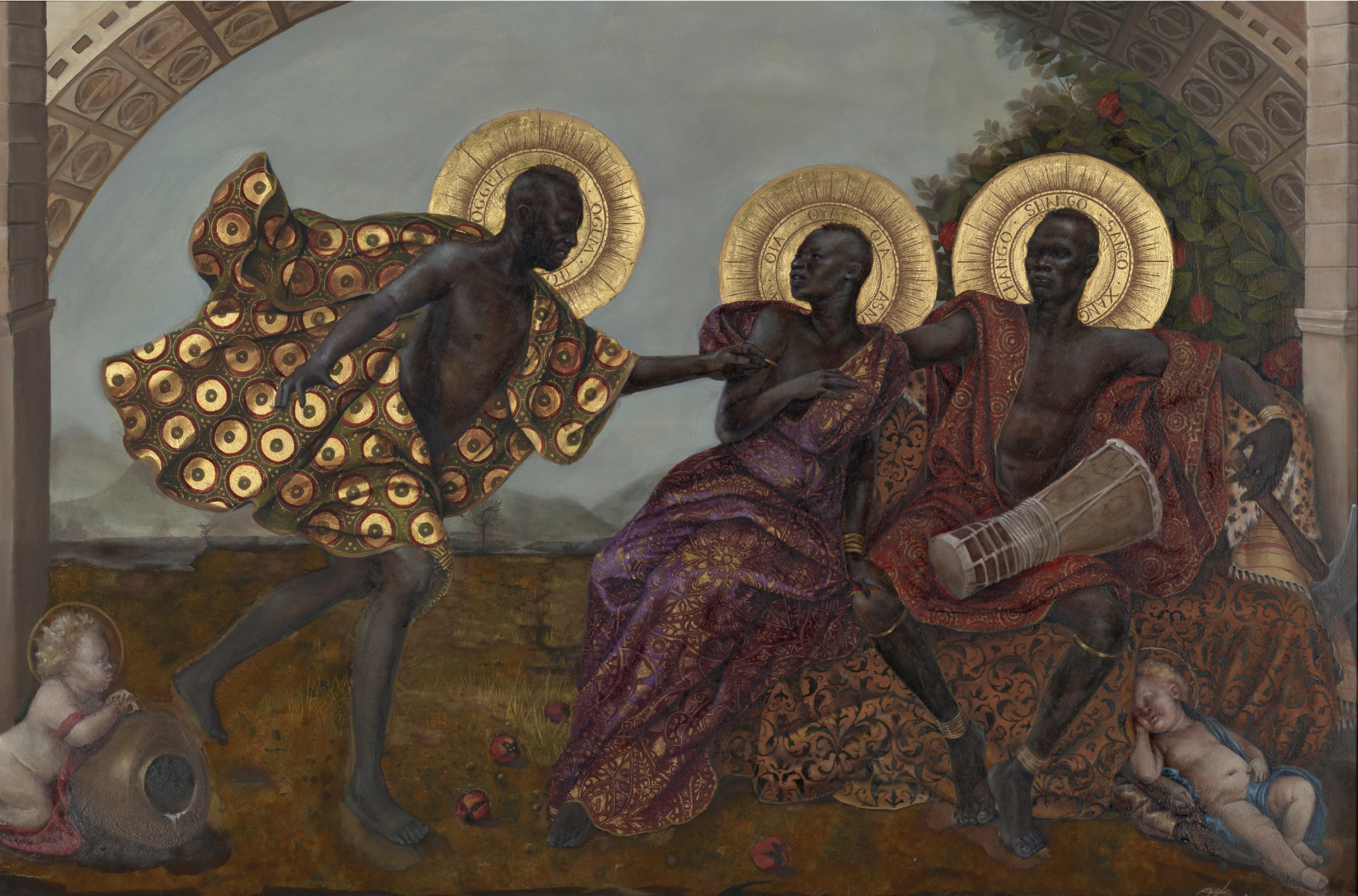
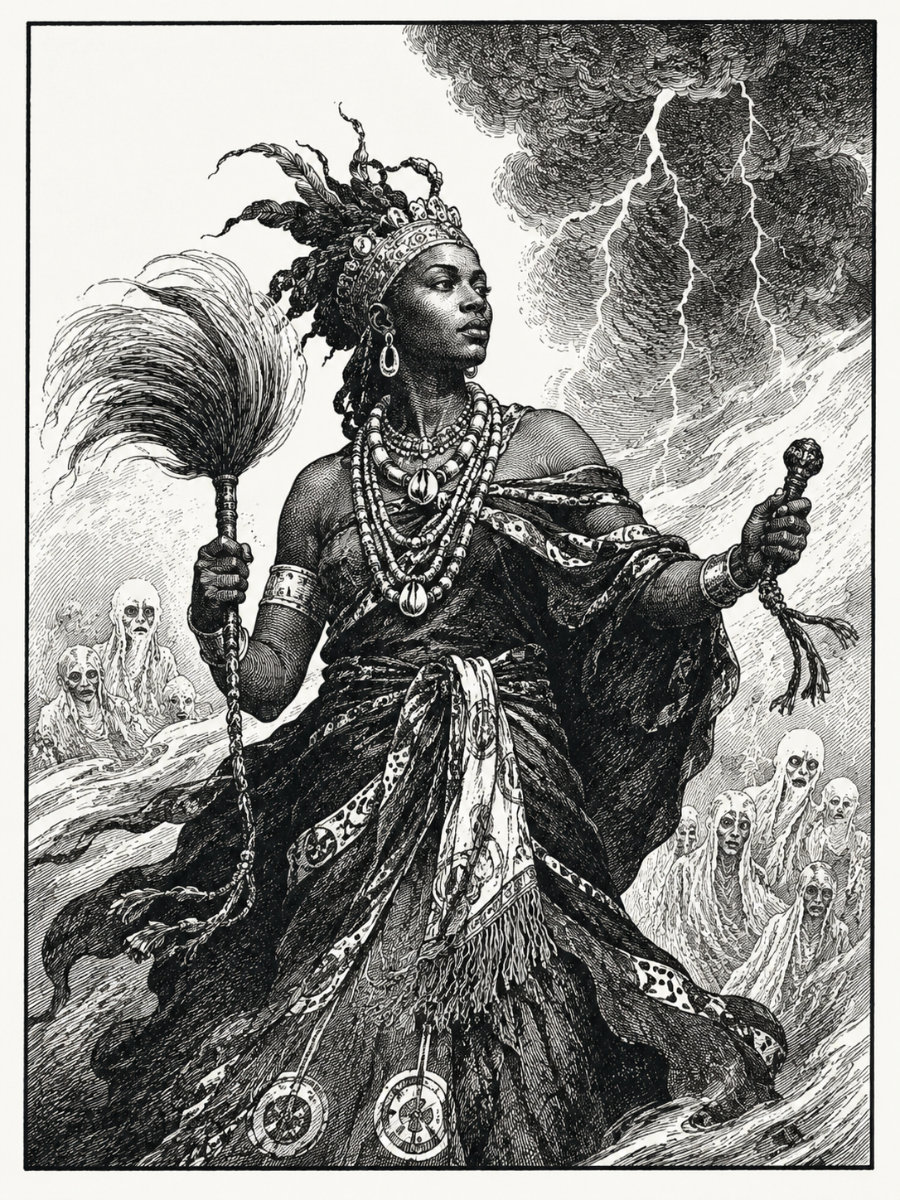
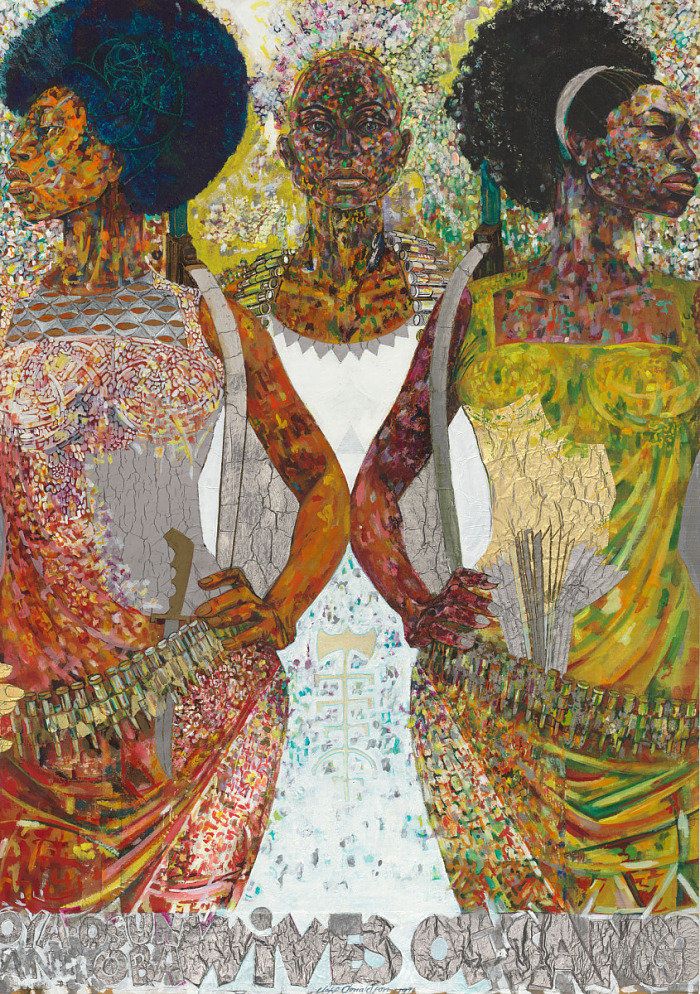
Ọya is one of the principal female deities of the Yoruba pantheon. She is the oriṣa of winds, lightning, and storms and is the only oriṣa capable of controlling the Eégún (spirits of the dead), a power given to her by Babalú Ayé. Ọya lived on Earth as a human from the town of Ira, in present day Kwara state, Nigeria, where she was a wife of the Alaafin of Oyo, Shango. In Yorùbá, the name Ọya is believed to derive from the phrase coined from “ọ ya” which means “she tore,” referring to her association with powerful winds. She was believed to have the power to shape-shift into a buffalo, and is often depicted as one in traditional Yorùbá poetry. As such, the buffalo serves as a major symbol of Ọya, and it is forbidden for her priests to kill one. She is known as Ọya Ìyáńsàn-án, the “mother of nine”, because of the nine children she gave birth to with her third husband Oko, after suffering from a lifetime of barrenness. She is the patroness of the Niger River (known to the Yorùbá as the Odò-Ọya). In the Yoruba religion, Ọya was married three times, first to the warrior orisha Ogun, then Shango, and finally, another hunting and farming deity, Oko.
Appearance List The voice of Africa v. 1 (1913) by Leo Frobenius — valued for early observations and visual documentation despite controversial diffusionist interpretations of African civilization [Smithsonian]; The history of the Yorubas : from the earliest times to the beginning of the British Protectorate (1921) by Rev. Samuel Johnson, Paster of Oyo; ed. Dr. O. (Obadiah) Johnson, Lagos [Internet Archive]; Os africanos no Brasil (1932) by Raymundo Nina Rodrigues; The Religion of the Yorùbá (1948) by J. Olumide Luca; Candomblés da Bahia (first ed. 1948; 2nd ed. 1954) by Edison Carneiro; West African Religion (1949) by Geoffrey Parrinder; Dieux d’Afrique (1954) by Pierre Verger (original edition; later reissued); Olódùmarè: God in Yoruba Belief (1962) by E. Bolaji Idowu; Three Yoruba Plays (1964) by Duro Ladipo; The Shango Cult in Trinidad (1965) by George Eaton Simpson (monograph; first ed. 1965); African Religions in Brazil (French: Les religions africaines au Brésil, 1960) by Roger Bastide; Ifa Divination: Communication Between Gods and Men in West Africa (1969) by William Bascom; Yoruba Beliefs and Sacrificial Rites (1979) by J. Ọmọṣade Awolalu.
Sample Read Yoruba Beliefs and Sacrificial Rites (1979) [Internet Archive]
Description Ọya is one of the principal female deities of the Yoruba pantheon. She is the oriṣa of winds, lightning, and storms and is the only oriṣa capable of controlling the Eégún (spirits of the dead), a power given to her by Babalú Ayé. Ọya lived on Earth as a human from the town of Ira, in present day Kwara state, Nigeria, where she was a wife of the Alaafin of Oyo, Shango. In Yorùbá, the name Ọya is believed to derive from the phrase coined from “ọ ya” which means “she tore,” referring to her association with powerful winds. She was believed to have the power to shape-shift into a buffalo, and is often depicted as one in traditional Yorùbá poetry. As such, the buffalo serves as a major symbol of Ọya, and it is forbidden for her priests to kill one. She is known as Ọya Ìyáńsàn-án, the “mother of nine”, because of the nine children she gave birth to with her third husband Oko, after suffering from a lifetime of barrenness. She is the patroness of the Niger River (known to the Yorùbá as the Odò-Ọya). In the Yoruba religion, Ọya was married three times, first to the warrior orisha Ogun, then Shango, and finally, another hunting and farming deity, Oko.

 ,
,  ,
,