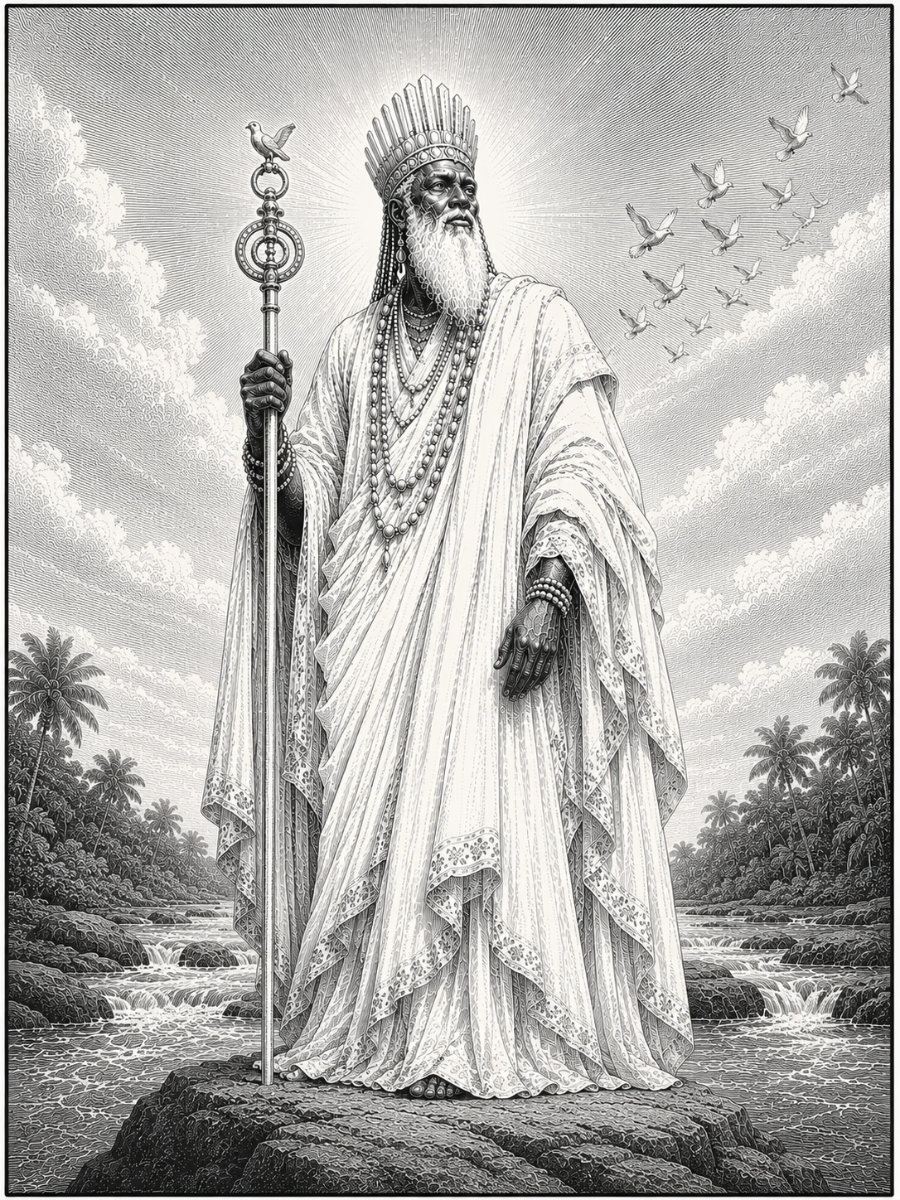
Obatala (lit. ’King of White Cloth’) also known as Oriṣanla (lit. ’The Great God’) is the king of all oriṣa in the Yoruba religion, believed to have created the Earth (Ile Ayé) and humans. In some versions of the story, he failed the task by being drunk on palm wine after being tempted by the trickster deity Eshu and was outperformed by his little brother Oduduwa. He was instead given the job of creating human beings. This was authorized by the Supreme Deity, Olodumare which gave Obatala the name “sculptor of humankind”. “Obatala descended from Heaven on a chain to mold the first humans and now molds every child in the womb, according to the Yoruba. Obatala created the world and humanity, whereas Ọlọrun breathed life into humanity. Ọbatala is therefore considered the father of humanity and owner of all the heads where human souls reside.” Obatala had worked on his task with the assistance of Yemòó. He is believed to be successful at creating human beings with water and clay…
Alias Ọbàtálá
Real Names/Alt Names Ọbàtálá, Òrìṣànlá, King of White Cloth, The Great God
Appearance List The voice of Africa v. 1 (1913) by Leo Frobenius — valued for early observations and visual documentation despite controversial diffusionist interpretations of African civilization [Smithsonian]; The history of the Yorubas : from the earliest times to the beginning of the British Protectorate (1921) by Rev. Samuel Johnson, Paster of Oyo; ed. Dr. O. (Obadiah) Johnson, Lagos [Internet Archive]; Os africanos no Brasil (1932) by Raymundo Nina Rodrigues; The Religion of the Yorùbá (1948) by J. Olumide Luca; Candomblés da Bahia (first ed. 1948; 2nd ed. 1954) by Edison Carneiro; West African Religion (1949) by Geoffrey Parrinder; Dieux d’Afrique (1954) by Pierre Verger (original edition; later reissued); Olódùmarè: God in Yoruba Belief (1962) by E. Bolaji Idowu; Three Yoruba Plays (1964) by Duro Ladipo; The Shango Cult in Trinidad (1965) by George Eaton Simpson (monograph; first ed. 1965); African Religions in Brazil (French: Les religions africaines au Brésil, 1960) by Roger Bastide; Ifa Divination: Communication Between Gods and Men in West Africa (1969) by William Bascom; Yoruba Beliefs and Sacrificial Rites (1979) by J. Ọmọṣade Awolalu.
Sample Read Yoruba Beliefs and Sacrificial Rites (1979) [Internet Archive]
Description Obatala (lit. ’King of White Cloth’) also known as Oriṣanla (lit. ’The Great God’) is the king of all oriṣa in the Yoruba religion, believed to have created the Earth (Ile Ayé) and humans. In some versions of the story, he failed the task by being drunk on palm wine after being tempted by the trickster deity Eshu and was outperformed by his little brother Oduduwa. He was instead given the job of creating human beings. This was authorized by the Supreme Deity, Olodumare which gave Obatala the name “sculptor of humankind”. “Obatala descended from Heaven on a chain to mold the first humans and now molds every child in the womb, according to the Yoruba. Obatala created the world and humanity, whereas Ọlọrun breathed life into humanity. Ọbatala is therefore considered the father of humanity and owner of all the heads where human souls reside.” Obatala had worked on his task with the assistance of Yemòó. He is believed to be successful at creating human beings with water and clay…