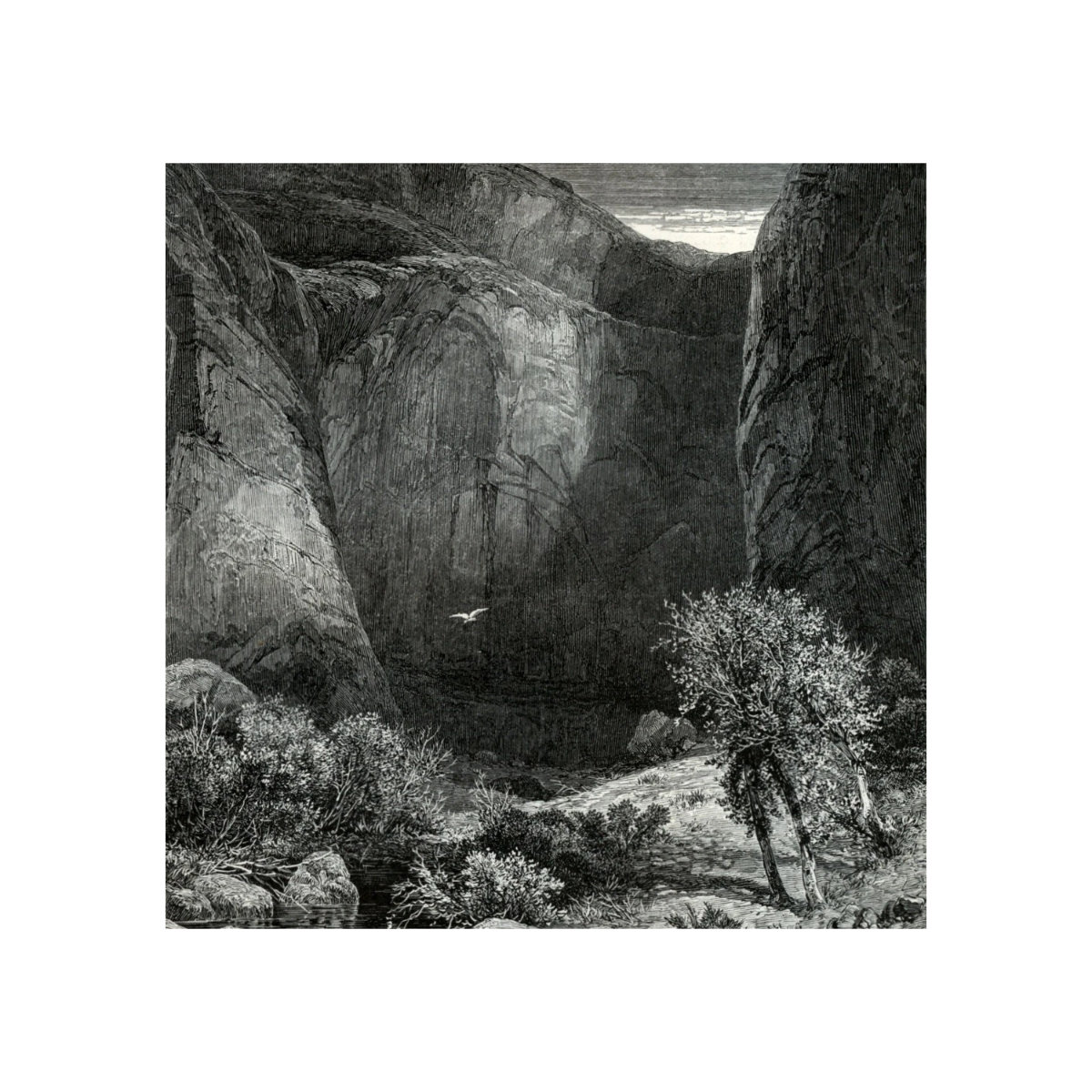
“La Rumeur dans la montagne” follows Florent Max, a middle-aged painter who becomes obsessed with a mysterious sound in the mountains. While on a hike, Florent Max hears a faint “rumeur” (murmur). Returning the next day, he locates a precise spot where the sound can be heard: a complex, musical blend of voices, tones, and distant activity, as if from a living city. He determines that a rock formation acts like an acoustic reflector, concentrating sounds from far away into a single point. Listening more closely, he distinguishes voices, rhythms, and a recurring gong. The sound resembles a distant, harmonic crowd. He recalls a book from his childhood describing a mirage of a magnificent unknown city, and becomes convinced that the sound is the echo of a real, hidden civilization. Florent Max neglects his work, returns daily, and tries to keep the phenomenon secret. The sound brings him intense joy, especially a particular female voice he finds uniquely moving. However, changes in weather affect the sound’s intensity, and nearby road construction eventually disrupts the acoustic pathway. Explosions in the mountains destroy the conditions necessary for the echo. Desperate, Florent Max searches for the lost sound. Climbing above the ravine at night, he falls to his death. The story ends by suggesting uncertainty: whether he ever reached or understood the source of the “rumeur,” or whether it remained only an echo—“beautiful as a memory.”
First Appearance L’Homme truqué ; suivi de Château hanté et de La rumeur dans la montagne (1921) by Maurice Renard
First Publisher G. Crès
Appearance List L’Homme truqué ; suivi de Château hanté et de La rumeur dans la montagne (1921) by Maurice Renard, published in Paris by G. Crès; Romans et contes fantastiques by Maurice Renard (1990) — ed. Francis Lacassin and Jean Tulard; La rumeur dans la montagne [édition intégrale revue et mise à jour] (2013, digital ebook reissue); “Sound in the Mountain” in The Big Book of Classic Fantasy: The Ultimate Collection (2019) ed. Ann VanderMeer and Jeff VanderMeer, trans. Gio Clairval.
Sample Read La Rumeur dans la montague (1921) [Internet Archive]
Description “La Rumeur dans la montagne” follows Florent Max, a middle-aged painter who becomes obsessed with a mysterious sound in the mountains. While on a hike, Florent Max hears a faint “rumeur” (murmur). Returning the next day, he locates a precise spot where the sound can be heard: a complex, musical blend of voices, tones, and distant activity, as if from a living city. He determines that a rock formation acts like an acoustic reflector, concentrating sounds from far away into a single point. Listening more closely, he distinguishes voices, rhythms, and a recurring gong. The sound resembles a distant, harmonic crowd. He recalls a book from his childhood describing a mirage of a magnificent unknown city, and becomes convinced that the sound is the echo of a real, hidden civilization. Florent Max neglects his work, returns daily, and tries to keep the phenomenon secret. The sound brings him intense joy, especially a particular female voice he finds uniquely moving. However, changes in weather affect the sound’s intensity, and nearby road construction eventually disrupts the acoustic pathway. Explosions in the mountains destroy the conditions necessary for the echo. Desperate, Florent Max searches for the lost sound. Climbing above the ravine at night, he falls to his death. The story ends by suggesting uncertainty: whether he ever reached or understood the source of the “rumeur,” or whether it remained only an echo—“beautiful as a memory.”