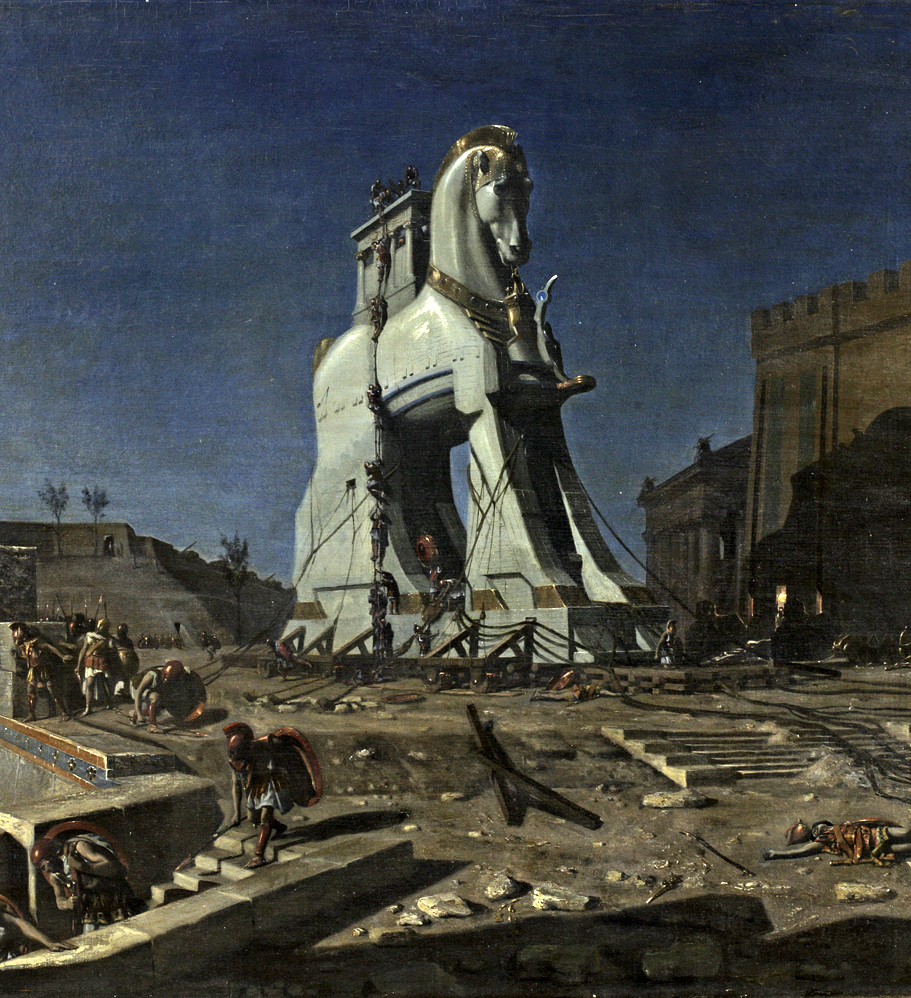
In Greek mythology, the Trojan Horse was a wooden horse said to have been used by the Greeks during the Trojan War to enter the city of Troy and win the war. The Trojan Horse is not mentioned in Homer’s Iliad, with the poem ending before the war is concluded, and it is only briefly mentioned in the Odyssey. It is described at length in the Aeneid, in which Virgil recounts how, after a fruitless ten-year siege, the Greeks constructed a huge wooden horse at the behest of Odysseus, and hid a select force of men inside, including Odysseus himself. The Greeks pretended to sail away, and the Trojans pulled the horse into their city as a victory trophy. That night, the Greek force crept out of the horse and opened the gates for the rest of the Greek army, which had sailed back under the cover of darkness. The Greeks entered and destroyed the city, ending the war. The main ancient source for the story still extant is the Aeneid of Virgil, a Latin epic poem from the time of Augustus. The story featured heavily in the Little Iliad and the Sack of Troy, both part of the Epic Cycle, but these have only survived in fragments and epitomes. As Odysseus was the chief architect of the Trojan Horse, it is also referred to in Homer’s Odyssey.
Appearance List Literature: Homer’s Odyssey (c. 8th century BCE, English 1614), Homer’s Iliad (c. 8th century BC), Virgil’s Aeneid (29 to 19 BC), 5th century plays by Aeschylus, Sophocles (Ajax, Philoctetes), and Euripides (Hecuba, Rhesus, Cyclops), Plato’s Hippias Minor, Shakespeare’s Troilus and Cressida (1602), Dante Alighieri’s Divine Comedy (1308–1320), Lord Tennyson’s “Ulysses” (1842), The Story of Greece: Told to Boys and Girls by Mary Macgregor (191-?) [Internet Archive], Frederick Rolfe’s The Weird of the Wanderer (1912), James Joyce’s Ulysses (1918–1920), Nikos Kazantzakis’ The Odyssey: A Modern Sequel (1938), Eyvind Johnson’s Return to Ithaca (1946), The Luck of Troy (1961), et. al. Film: The Mysterious Island (1905), L’Odissea (1911), Ulysses (1954), Ulysses (1955), The Trojan Horse (1961), The Fury of Achilles (1962), Ulysses Against the Son of Hercules (1962), The Lion of Thebes (1964), et. al. Comics: Blue Bolt vol. 2 #1-2, Treasure Chest vol. 14 #5.
Sample Read The Odyssey (Translated by W. C. Bryant, August, 1871) [Standard eBooks]
Description In Greek mythology, the Trojan Horse was a wooden horse said to have been used by the Greeks during the Trojan War to enter the city of Troy and win the war. The Trojan Horse is not mentioned in Homer’s Iliad, with the poem ending before the war is concluded, and it is only briefly mentioned in the Odyssey. It is described at length in the Aeneid, in which Virgil recounts how, after a fruitless ten-year siege, the Greeks constructed a huge wooden horse at the behest of Odysseus, and hid a select force of men inside, including Odysseus himself. The Greeks pretended to sail away, and the Trojans pulled the horse into their city as a victory trophy. That night, the Greek force crept out of the horse and opened the gates for the rest of the Greek army, which had sailed back under the cover of darkness. The Greeks entered and destroyed the city, ending the war. The main ancient source for the story still extant is the Aeneid of Virgil, a Latin epic poem from the time of Augustus. The story featured heavily in the Little Iliad and the Sack of Troy, both part of the Epic Cycle, but these have only survived in fragments and epitomes. As Odysseus was the chief architect of the Trojan Horse, it is also referred to in Homer’s Odyssey.