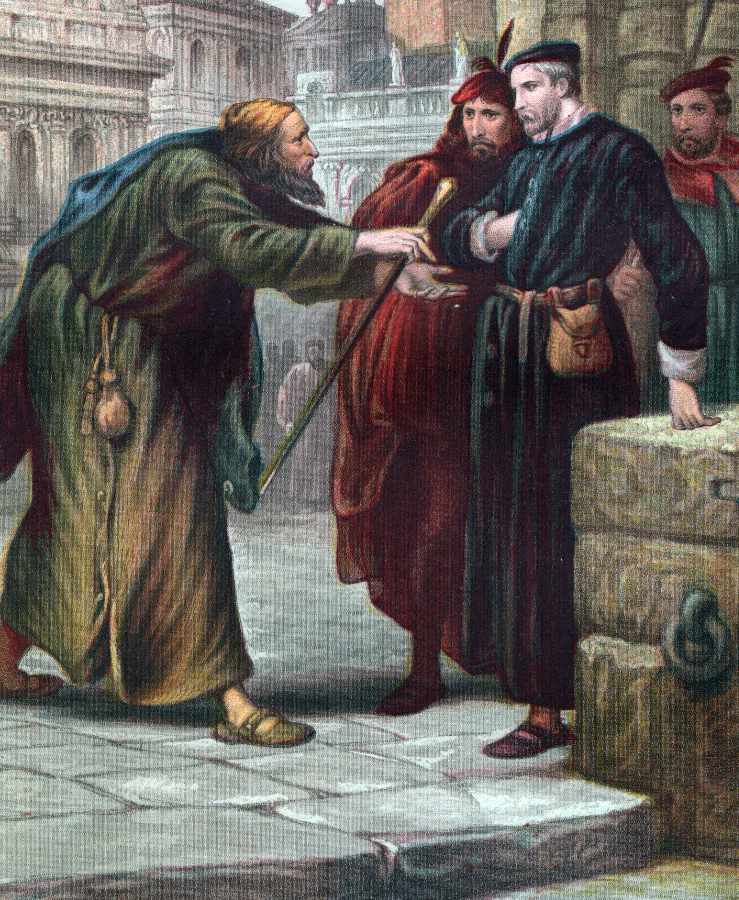
In The Merchant of Venice, Shylock is a Jewish moneylender who lends to his Christian rival, Antonio, setting the security at a pound of Antonio’s flesh. When a bankrupt Antonio defaults on the loan, Shylock demands the pound of flesh, as revenge for Antonio having previously insulted and spat on him. Meanwhile, his daughter, Jessica, elopes with Antonio’s friend, Lorenzo, and becomes a Christian, further fuelling Shylock’s rage. She also takes money and jewels from Shylock. Note: In Shakespeare’s time, no Jews had been legally present in England for several hundred years (since the Edict of Expulsion in 1290). However, stereotypes of Jews as money lenders remained. Historically, money lending had been a fairly common occupation among Jews, in part because Christians were not permitted to practice usury, then considered to mean charging interest of any kind on loans.
First Appearance Shakespeare’s The Merchant of Venice first performed c. 1596–1597 (court performance for Elizabeth I)
First Publisher Edward Blount and William and Isaac Jaggard
Appearance List One of the First Quartos (1600), Mr. William Shakespeares Comedies, Histories, & Tragedies – Published according to the True Originall Copies, i.e. First Folio (1623)
Description In The Merchant of Venice, Shylock is a Jewish moneylender who lends to his Christian rival, Antonio, setting the security at a pound of Antonio’s flesh. When a bankrupt Antonio defaults on the loan, Shylock demands the pound of flesh, as revenge for Antonio having previously insulted and spat on him. Meanwhile, his daughter, Jessica, elopes with Antonio’s friend, Lorenzo, and becomes a Christian, further fuelling Shylock’s rage. She also takes money and jewels from Shylock. Note: In Shakespeare’s time, no Jews had been legally present in England for several hundred years (since the Edict of Expulsion in 1290). However, stereotypes of Jews as money lenders remained. Historically, money lending had been a fairly common occupation among Jews, in part because Christians were not permitted to practice usury, then considered to mean charging interest of any kind on loans.