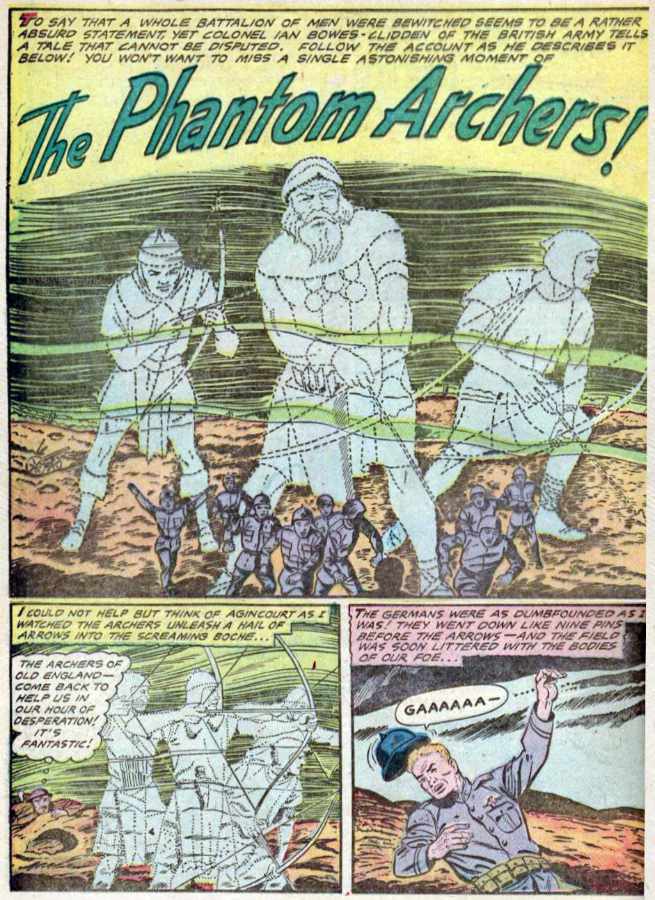
A reputed appearance of a variety of supernatural entities which protected the British Army from defeat by the invading forces of the German Empire at the beginning of World War I during the Battle of Mons in Belgium on 23 August 1914. On 22–23 August 1914, the first major engagement of the British Expeditionary Force in the First World War occurred at the Battle of Mons. Advancing German forces were thrown back by heavily outnumbered British troops, who suffered heavy casualties and, being outflanked, were forced into rapid retreat the next day. The retreat and the battle were rapidly perceived by the British public as being a key moment in the war. The Angels of Mons is one of several stories about the ghostly protectors. On 29 September 1914, the Welsh author Arthur Machen published a short story entitled “The Bowmen” in The Evening News, inspired by accounts that he had read of the fighting at Mons and an idea he had had soon after the battle. Machen, who had already written some factual articles on the conflict for the paper, set his story at the time of the retreat from the Battle of Mons in August 1914. The story described phantom bowmen from the Battle of Agincourt summoned by a soldier calling on St. George, destroying a German host. Machen’s soldier saw “a long line of shapes, with a shining about them.” A Mr. A. P. Sinnett, writing in The Occult Review, stated that “those who could see said they saw ‘a row of shining beings’ between the two armies.” This led Machen to suggest that the bowmen of his story had become the Angels of Mons. Machen’s story was not, however, labelled as fiction, and the same edition of The Evening News ran a story by a different author under the heading “Our Short Story”. Machen’s story was written from a first-hand perspective and was a kind of false document, a technique Machen knew well. The unintended result was that Machen had a number of requests to provide evidence for his sources for the story soon after its publication, from readers who thought it was true, to which he responded that it was completely imaginary, as he had no desire to create a hoax. Variations of the story began to appear, told as authentic histories, including an account that told how the corpses of German soldiers had been found on the battlefield with arrow wounds.
First Appearance “The Bowmen” in The Evening News (29 September 1914)
First Publisher London Evening News
Appearance List The Bowmen in The Evening News (29 September 1914). Books: The Bowmen and Other Legends of the War (1915), On the Side of the Angels: A Reply to Arthur Machen (1915). Comics: Strange #3.
Description A reputed appearance of a variety of supernatural entities which protected the British Army from defeat by the invading forces of the German Empire at the beginning of World War I during the Battle of Mons in Belgium on 23 August 1914. On 22–23 August 1914, the first major engagement of the British Expeditionary Force in the First World War occurred at the Battle of Mons. Advancing German forces were thrown back by heavily outnumbered British troops, who suffered heavy casualties and, being outflanked, were forced into rapid retreat the next day. The retreat and the battle were rapidly perceived by the British public as being a key moment in the war. The Angels of Mons is one of several stories about the ghostly protectors. On 29 September 1914, the Welsh author Arthur Machen published a short story entitled “The Bowmen” in The Evening News, inspired by accounts that he had read of the fighting at Mons and an idea he had had soon after the battle. Machen, who had already written some factual articles on the conflict for the paper, set his story at the time of the retreat from the Battle of Mons in August 1914. The story described phantom bowmen from the Battle of Agincourt summoned by a soldier calling on St. George, destroying a German host. Machen’s soldier saw “a long line of shapes, with a shining about them.” A Mr. A. P. Sinnett, writing in The Occult Review, stated that “those who could see said they saw ‘a row of shining beings’ between the two armies.” This led Machen to suggest that the bowmen of his story had become the Angels of Mons. Machen’s story was not, however, labelled as fiction, and the same edition of The Evening News ran a story by a different author under the heading “Our Short Story”. Machen’s story was written from a first-hand perspective and was a kind of false document, a technique Machen knew well. The unintended result was that Machen had a number of requests to provide evidence for his sources for the story soon after its publication, from readers who thought it was true, to which he responded that it was completely imaginary, as he had no desire to create a hoax. Variations of the story began to appear, told as authentic histories, including an account that told how the corpses of German soldiers had been found on the battlefield with arrow wounds.