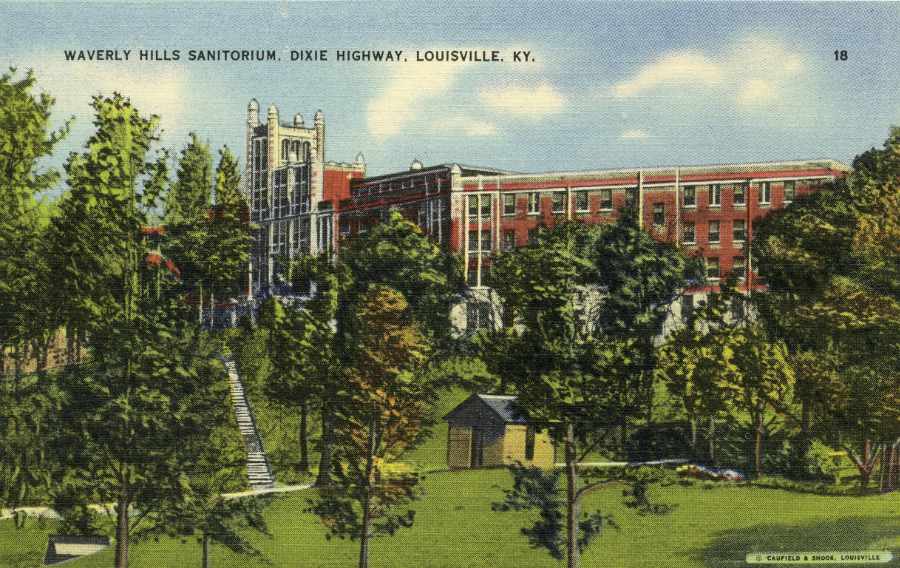
The Waverly Hills Sanatorium is a former sanatorium located in southwestern Louisville/Jefferson County, Kentucky. It opened in 1910 as a two-story hospital to accommodate 40 to 50 tuberculosis patients. It included a passageway to transport bodies and supplies in and out of the sanatorium, which came to be known as the “Body Chute” or “Death Tunnel”. In the early 1900s, Jefferson County was ravaged by an outbreak of tuberculosis – known as the “White Plague” – which prompted the construction of a new hospital. On August 31, 1912, all tuberculosis patients from the City Hospital were relocated to temporary quarters in tents on the grounds of Waverly Hills pending the completion of a hospital for advanced cases. The construction of a five-story building that could hold more than 400 patients began in March 1924. The new building opened on October 17, 1926, but after the introduction of streptomycin in 1943, the number of tuberculosis cases gradually lowered, until there was no longer need for such a large hospital. The hospital closed in 1961. The notorious tunnel was built on the first floor with the rest of the building. The corridor is 500 feet to the bottom of the hill and has a set of stairs on one side, which were the stairs used for the workers. On the other side, there was a cart that moved up and down the staircase which transported supplies and other necessities.Since antibiotics did not exist in the time that the sanatorium was active, other forms of aid were used to treat TB patients. For example, heat lamps, fresh air, and positive talk and reassurance helped to keep patients alive, since the death rate of TB patients at the time was one death per day. However, at the peak of the disease, the sight of the dead being carried away in full view of the patients lowered the patient morale. Therefore, the sanatorium tried transporting the dead bodies as secretively as possible to increase the morale and lower the death rates, using the tunnel to that end. The doctors and workers of this time also believed that this would help to lower the disease’s spreading rate. Hence, the tunnel was also known as the “Body Chute” or “Death Tunnel” by the locals and paranormal investigators visiting the sanatorium. Apart from transporting dead bodies out of the sanatorium, the tunnel also served as a temporary air raid shelter during World War II.
Appearance List Article: Report of Board of Tuberculosis Hospitals (1915), “Sanatorium Has Waiting List for Treatment, Effective In Early Stages” in The Louisville Times (December 5, 1928), “How Waverly Hills Got Its Name” in Waverly Herald (circa 1953). Podcast: Astonishing Legends: Episode 154 Lockdown at the Waverly Hills Sanatorium.
Sample Read Astonishing Legends: Episode 154A Lockdown at the Waverly Hills Sanatorium [YT]
Description The Waverly Hills Sanatorium is a former sanatorium located in southwestern Louisville/Jefferson County, Kentucky. It opened in 1910 as a two-story hospital to accommodate 40 to 50 tuberculosis patients. It included a passageway to transport bodies and supplies in and out of the sanatorium, which came to be known as the “Body Chute” or “Death Tunnel”. In the early 1900s, Jefferson County was ravaged by an outbreak of tuberculosis – known as the “White Plague” – which prompted the construction of a new hospital. On August 31, 1912, all tuberculosis patients from the City Hospital were relocated to temporary quarters in tents on the grounds of Waverly Hills pending the completion of a hospital for advanced cases. The construction of a five-story building that could hold more than 400 patients began in March 1924. The new building opened on October 17, 1926, but after the introduction of streptomycin in 1943, the number of tuberculosis cases gradually lowered, until there was no longer need for such a large hospital. The hospital closed in 1961. The notorious tunnel was built on the first floor with the rest of the building. The corridor is 500 feet to the bottom of the hill and has a set of stairs on one side, which were the stairs used for the workers. On the other side, there was a cart that moved up and down the staircase which transported supplies and other necessities.Since antibiotics did not exist in the time that the sanatorium was active, other forms of aid were used to treat TB patients. For example, heat lamps, fresh air, and positive talk and reassurance helped to keep patients alive, since the death rate of TB patients at the time was one death per day. However, at the peak of the disease, the sight of the dead being carried away in full view of the patients lowered the patient morale. Therefore, the sanatorium tried transporting the dead bodies as secretively as possible to increase the morale and lower the death rates, using the tunnel to that end. The doctors and workers of this time also believed that this would help to lower the disease’s spreading rate. Hence, the tunnel was also known as the “Body Chute” or “Death Tunnel” by the locals and paranormal investigators visiting the sanatorium. Apart from transporting dead bodies out of the sanatorium, the tunnel also served as a temporary air raid shelter during World War II.