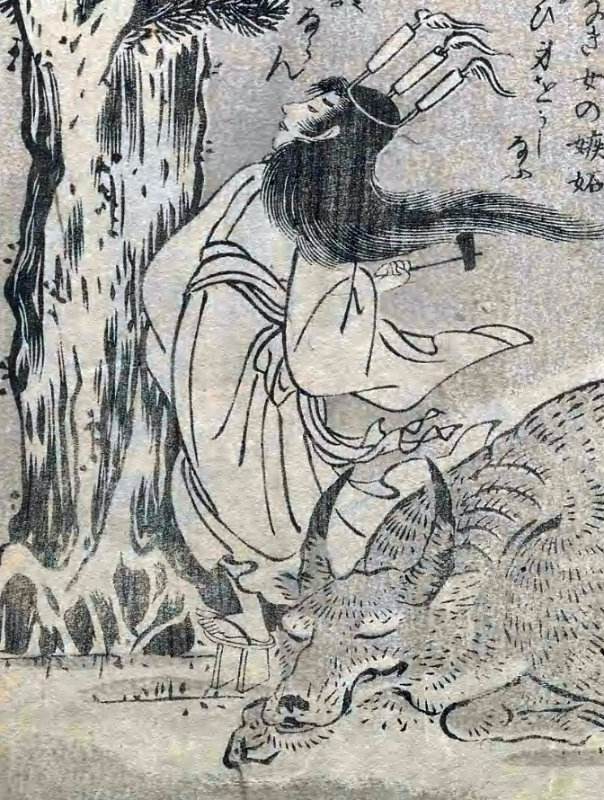
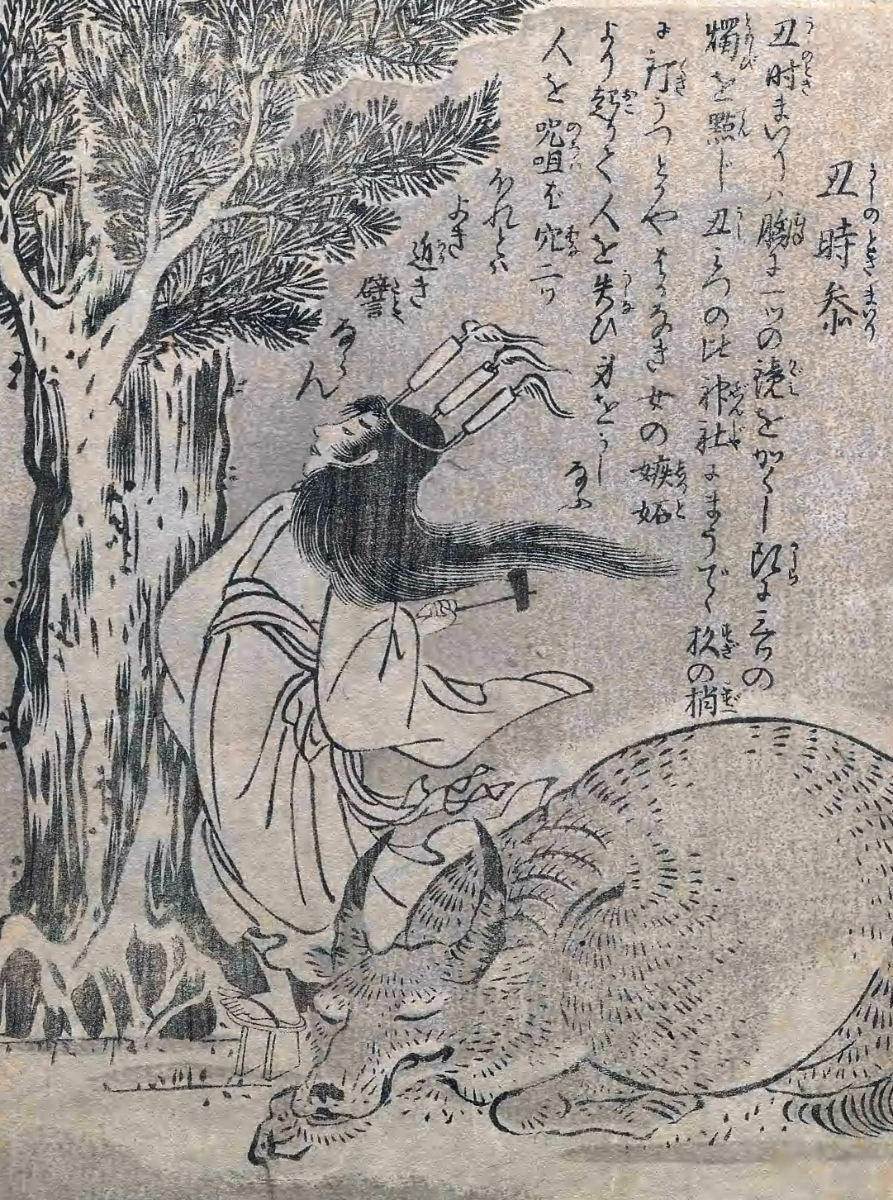
Ushi no toki mairi refers to a prescribed method of laying a curse upon a target that is traditional to Japan, so-called because it is conducted during the hours of the Ox (between 1 and 3 AM). The practitioner—typically a scorned woman—while dressed in white and crowning herself with an iron ring set with three lit candles upright, hammers nails into a sacred tree (神木, shinboku) of the Shinto shrine. In the modern-day common conception, the nails are driven through a straw effigy of the victim, impaled upon the tree behind it. The ritual must be repeated seven days running, after which the curse is believed to succeed, causing death to the target, but being witnessed in the act is thought to nullify the spell. The woman performing the curse is generally portrayed as dressed in white, with disheveled hair, wearing an iron “crown” that holds three burning candles, suspending (from her neck) a mirror upon her chest (which lies hidden) and wearing a pair of tall clogs (geta). She would then nail a straw doll representing her target to a sacred tree (神木, shimboku) at the Shinto shrine. The iron “crown” that she wears is actually a tripod (五徳, gotoku) (or trivet, a stand for setting cooking pots, etc., above a heat source) which she wears inverted, slipping the iron ring over her head and sticking candles on its three legs. It was believed that the spot struck on the straw doll corresponded to the area of the body where the target would begin to experience illness or injury. However, this straw doll or other form of effigy was not a definitive requisite in the ritual even relatively late in the Edo Period. For instance, in Toriyama Sekien’s Konjaku Gazu Zoku Hyakki (1779, pictured top right) depicts the woman holding a hammer but no doll, nor is the doll mentioned in the caption. In this case, the nails are driven directly into the branches of the sacred tree.
Alias Ushi no toki mairi (丑の時参り)
Real Names/Alt Names “Ox-hour shrine-visit”; Alt: Ushi no koku mairi (丑の刻参り), Ushi no toki mōde (丑の時詣で), Ushi mairi (丑参り), Ushimitsu mairi (丑三参り)
Description Ushi no toki mairi refers to a prescribed method of laying a curse upon a target that is traditional to Japan, so-called because it is conducted during the hours of the Ox (between 1 and 3 AM). The practitioner—typically a scorned woman—while dressed in white and crowning herself with an iron ring set with three lit candles upright, hammers nails into a sacred tree (神木, shinboku) of the Shinto shrine. In the modern-day common conception, the nails are driven through a straw effigy of the victim, impaled upon the tree behind it. The ritual must be repeated seven days running, after which the curse is believed to succeed, causing death to the target, but being witnessed in the act is thought to nullify the spell. The woman performing the curse is generally portrayed as dressed in white, with disheveled hair, wearing an iron “crown” that holds three burning candles, suspending (from her neck) a mirror upon her chest (which lies hidden) and wearing a pair of tall clogs (geta). She would then nail a straw doll representing her target to a sacred tree (神木, shimboku) at the Shinto shrine. The iron “crown” that she wears is actually a tripod (五徳, gotoku) (or trivet, a stand for setting cooking pots, etc., above a heat source) which she wears inverted, slipping the iron ring over her head and sticking candles on its three legs. It was believed that the spot struck on the straw doll corresponded to the area of the body where the target would begin to experience illness or injury. However, this straw doll or other form of effigy was not a definitive requisite in the ritual even relatively late in the Edo Period. For instance, in Toriyama Sekien’s Konjaku Gazu Zoku Hyakki (1779, pictured top right) depicts the woman holding a hammer but no doll, nor is the doll mentioned in the caption. In this case, the nails are driven directly into the branches of the sacred tree.