Tokutaro, a young samurai of twenty years, is traveling alone without arms despite his status. He has left his domain after refusing a marriage arranged with Yada-Sin, and journeys toward Mount Fuji. He lives austerely, practices religious observances, and spends time writing and singing his own compositions. His imagination occupies him continuously. His path leads, without his awareness, toward the garden of Murasaki, a sixteen-year-old girl who lives in seclusion with her servant Nezumi. Murasaki tends a garden composed of many flowering plants arranged in distinct groupings, including a miniature representation of the surrounding landscape. She treats the flowers as divinities and maintains them carefully so that most remain in bloom. One evening, while Murasaki walks in the garden, she sees a man-shaped form outside the enclosure. Nezumi identifies the figure as Inari, a fox spirit, and the two retreat indoors. On subsequent nights, the figure returns, approaching the garden and singing while playing the shamisen. Nezumi then identifies the figure as Tanuki, a badger spirit. The visitor speaks indirectly and declares that he possesses wealth, is a samurai, and is named Tokutaro, but Murasaki and Nezumi do not believe him. He declares that he will no longer return. On a later night, the figure appears again. Murasaki confronts him. The mysterious figure performs a gesture which increases the light and opens flowers, including chrysanthemums. Murasaki recognizes Tokutaro, who embraces her, and they kiss. Tokutaro and Murasaki remain together continuously for eight days. Nezumi disapproves of their immorality and states that they should marry. Tokutaro agrees. The marriage takes place before the funerary tablets of Tokutaro’s parents, with witnesses present, and is completed according to the described rites. After the marriage, Murasaki follows custom by removing her eyebrows and blackening her teeth. Tokutaro reacts with distress. They go to the garden, where Murasaki observes the flowers and asks about them. Tokutaro declares his continued love, but he no longer sees the miraculous flowers.
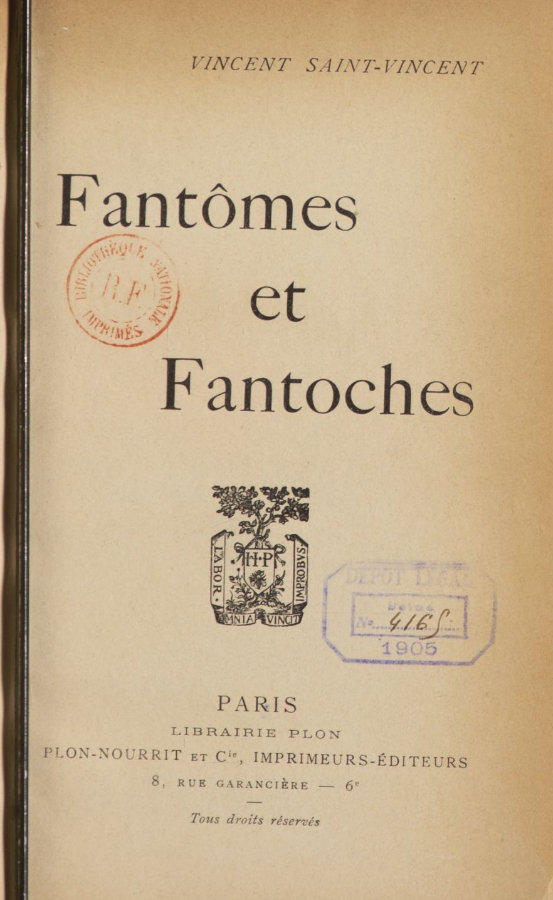
First Appearance “Tokutaro et Murasaki” included in Fantômes et fantoches (1905) by Vincent Saint-Vincent (pseud. of Maurice Renard)
First Publisher Plon-Nourrit
Appearance List “Tokutaro et Murasaki” included in Fantômes et fantoches (1905) by Vincent Saint-Vincent (pseud. of Maurice Renard), Paris: Plon-Nourrit [Gallica BnF]; “Tokutaro et Murasaki” included in Romans et contes fantastiques (1990) by Maurice Renard — collected reissue, Robert Laffont, collection “Bouquins”.
Description Tokutaro, a young samurai of twenty years, is traveling alone without arms despite his status. He has left his domain after refusing a marriage arranged with Yada-Sin, and journeys toward Mount Fuji. He lives austerely, practices religious observances, and spends time writing and singing his own compositions. His imagination occupies him continuously. His path leads, without his awareness, toward the garden of Murasaki, a sixteen-year-old girl who lives in seclusion with her servant Nezumi. Murasaki tends a garden composed of many flowering plants arranged in distinct groupings, including a miniature representation of the surrounding landscape. She treats the flowers as divinities and maintains them carefully so that most remain in bloom. One evening, while Murasaki walks in the garden, she sees a man-shaped form outside the enclosure. Nezumi identifies the figure as Inari, a fox spirit, and the two retreat indoors. On subsequent nights, the figure returns, approaching the garden and singing while playing the shamisen. Nezumi then identifies the figure as Tanuki, a badger spirit. The visitor speaks indirectly and declares that he possesses wealth, is a samurai, and is named Tokutaro, but Murasaki and Nezumi do not believe him. He declares that he will no longer return. On a later night, the figure appears again. Murasaki confronts him. The mysterious figure performs a gesture which increases the light and opens flowers, including chrysanthemums. Murasaki recognizes Tokutaro, who embraces her, and they kiss. Tokutaro and Murasaki remain together continuously for eight days. Nezumi disapproves of their immorality and states that they should marry. Tokutaro agrees. The marriage takes place before the funerary tablets of Tokutaro’s parents, with witnesses present, and is completed according to the described rites. After the marriage, Murasaki follows custom by removing her eyebrows and blackening her teeth. Tokutaro reacts with distress. They go to the garden, where Murasaki observes the flowers and asks about them. Tokutaro declares his continued love, but he no longer sees the miraculous flowers.
Source Eidolon Station
Scenes in Japan: Japanese warriors in fighting dress — The Illustrated London News (March 19, 1864) — No acknowledgment of tanuki tails | Charles Wirgman (?)