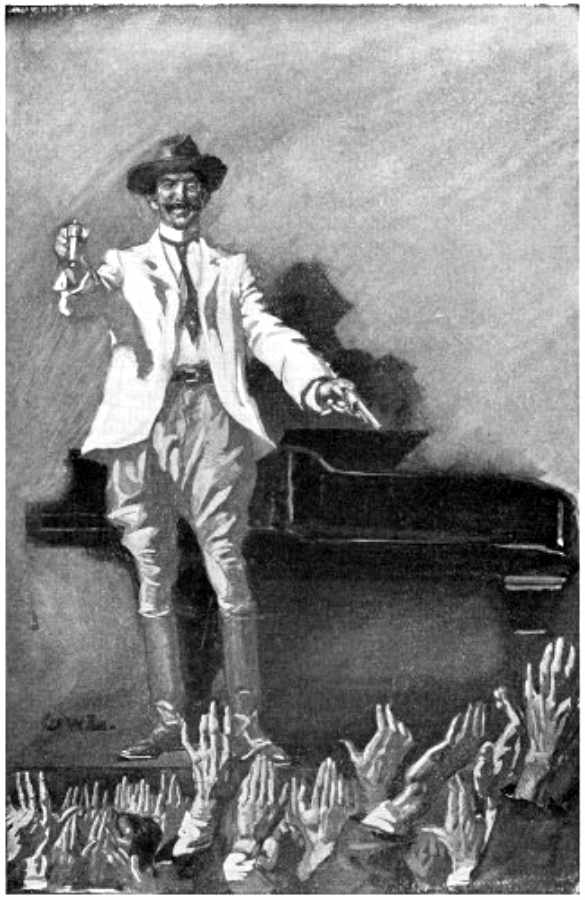
Stingaree was a charming but dangerous highway man who roamed the Outback of Australia. He was something of a dandy, wearing dapper clothes and taking an interest in the arts, but he quickly became one of the most feared criminals in the country, along with his brutish partner, Huge Howie. Stingaree took a liking to a young singer named Hilda Bouverie, and he helped her to achieve some degree of fame, before he disappeared. Stingaree was briefly placed in custody, but he escaped quite promptly and remained at large. Stingaree was a skilled rider and shooter who carried a pair of long barreled revolvers. Though he was happy to use his weapons, he usually didn’t kill unless necessary. He was also well educated, a connoisseur of cigars, and he could play the piano with great skill. He was said to be a swarthy man, still young with a “martial” mustache, a “military” monocle, a spruce duck jacket, and spurred top boots. He was originally from England. He rode a strong, milk-white mare named Barmaid. Notes: Stingaree is a name for an Australian sting ray, or a general term for stingrays.
First Appearance “Irralie’s Bushranger” serialised in Cassell’s Family Magazine (1895)
First Publisher Charles Scribner’s Sons
Appearance List Irralie’s Bushranger serialised in Cassell’s Family Magazine (1895), “The Taking of Stingaree” in The Graphic (July 1901), “A Voice in the Wilderness”, “The Black Hole of Glenranald”, “To the Vile Dust”, “A Bushranger at Bay”, “The Honor of the Road”, “A Duel in the Desert”, “The Villain-Worshipper”, “The Moth and the Star” in The Strand Magazine between September 1904 and April 1905. Collected short stories in Stingaree (Novel, 1905). “A Model Marauder” in Hearst’s Magazine (March 1919) and Nash’s Pall Mall Magazine (July 1919), “A Fallen Angel” in Hearst’s Magazine (October 1918) and Nash’s Pall Mall Magazine (April 1919), “The Flying Dustman” in Hearst’s Magazine (December 1918) and Nash’s Pall Mall Magazine (May 1919), “In Peacock Blue” in Nash’s Pall Mall Magazine (September 1921). Play: Stingaree (1908). Film: Stingaree (serial, 1915), The Further Adventures of Stingaree (serial, 1917), Stingaree (1934).
Description Stingaree was a charming but dangerous highway man who roamed the Outback of Australia. He was something of a dandy, wearing dapper clothes and taking an interest in the arts, but he quickly became one of the most feared criminals in the country, along with his brutish partner, Huge Howie. Stingaree took a liking to a young singer named Hilda Bouverie, and he helped her to achieve some degree of fame, before he disappeared. Stingaree was briefly placed in custody, but he escaped quite promptly and remained at large. Stingaree was a skilled rider and shooter who carried a pair of long barreled revolvers. Though he was happy to use his weapons, he usually didn’t kill unless necessary. He was also well educated, a connoisseur of cigars, and he could play the piano with great skill. He was said to be a swarthy man, still young with a “martial” mustache, a “military” monocle, a spruce duck jacket, and spurred top boots. He was originally from England. He rode a strong, milk-white mare named Barmaid. Notes: Stingaree is a name for an Australian sting ray, or a general term for stingrays.