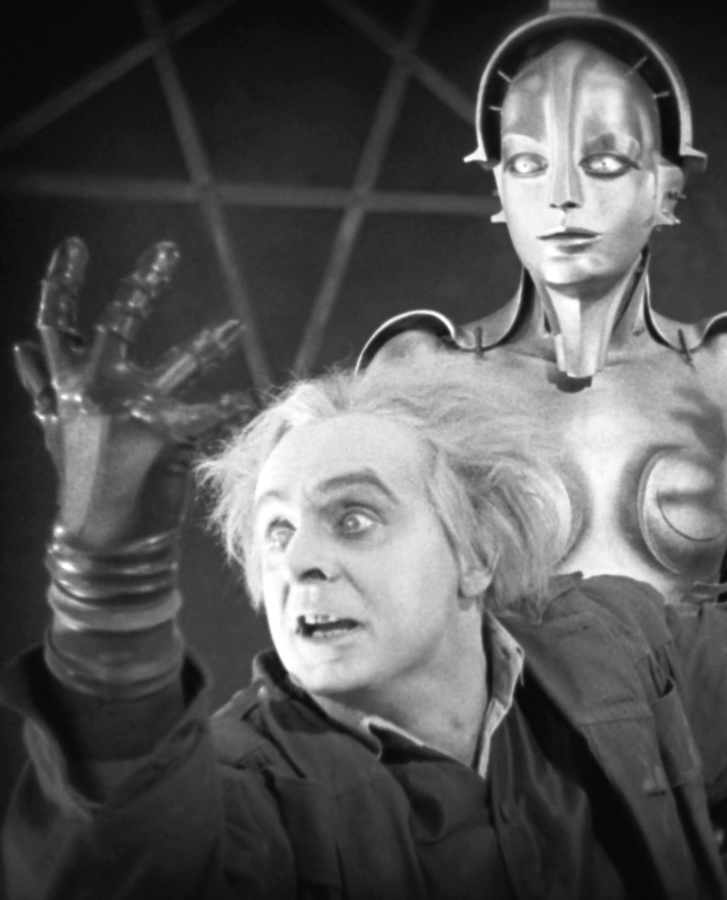
Rotwang is a brilliant scientist and inventor, whose greatest achievement is the creation of a robot made in the form of a woman (the Maschinenmensch, or Machine-Person). Originally, he intends to make a replacement for his lost love, Hel. Hel was a beautiful woman who eventually chose John Fredersen, master of the city and Rotwang’s rival, instead of him. She later died while giving birth to Fredersen’s son, Freder. Rotwang uses the robot to get revenge against Fredersen and Freder, while pretending that he is using the robot for Fredersen’s benefit, and under Fredersen’s instructions. Rotwang lives in a strange old house in the middle of Metropolis; its rough exterior design contrasts sharply with the futuristic elegance of the city. In its basement is a trap door that leads down into a network of catacombs, where Rotwang and Fredersen eavesdrop on a secret meeting of the workers and Maria, their spiritual counselor. He lost a hand while developing the Machine-Person and now wears a fully functioning metal prosthesis in its place, covered by a black glove. On Fredersen’s orders, Rotwang abducts Maria, transfers her appearance to the robot, and releases the duplicate to incite a rebellion among the workers. However, the robot is programmed to obey only Rotwang, who secretly instructs it to cause destructive lust among the wealthy elite of Metropolis as well in a plot to ruin Fredersen. During the ensuing riots and power blackout, Rotwang falls under the delusion that the real Maria is Hel and chases her to the roof of the city’s cathedral, with Freder in pursuit. The two men fight on the roof, and Rotwang falls to his death. The name “Rotwang” is derived from a series of German words. “Rot” is German for red, “Wang(e)” for cheek, “rotwangig” for rosy-cheeked. “Rotwang” therefore means “red-cheek” or “rosy-cheek”.
Description Rotwang is a brilliant scientist and inventor, whose greatest achievement is the creation of a robot made in the form of a woman (the Maschinenmensch, or Machine-Person). Originally, he intends to make a replacement for his lost love, Hel. Hel was a beautiful woman who eventually chose John Fredersen, master of the city and Rotwang’s rival, instead of him. She later died while giving birth to Fredersen’s son, Freder. Rotwang uses the robot to get revenge against Fredersen and Freder, while pretending that he is using the robot for Fredersen’s benefit, and under Fredersen’s instructions. Rotwang lives in a strange old house in the middle of Metropolis; its rough exterior design contrasts sharply with the futuristic elegance of the city. In its basement is a trap door that leads down into a network of catacombs, where Rotwang and Fredersen eavesdrop on a secret meeting of the workers and Maria, their spiritual counselor. He lost a hand while developing the Machine-Person and now wears a fully functioning metal prosthesis in its place, covered by a black glove. On Fredersen’s orders, Rotwang abducts Maria, transfers her appearance to the robot, and releases the duplicate to incite a rebellion among the workers. However, the robot is programmed to obey only Rotwang, who secretly instructs it to cause destructive lust among the wealthy elite of Metropolis as well in a plot to ruin Fredersen. During the ensuing riots and power blackout, Rotwang falls under the delusion that the real Maria is Hel and chases her to the roof of the city’s cathedral, with Freder in pursuit. The two men fight on the roof, and Rotwang falls to his death. The name “Rotwang” is derived from a series of German words. “Rot” is German for red, “Wang(e)” for cheek, “rotwangig” for rosy-cheeked. “Rotwang” therefore means “red-cheek” or “rosy-cheek”.