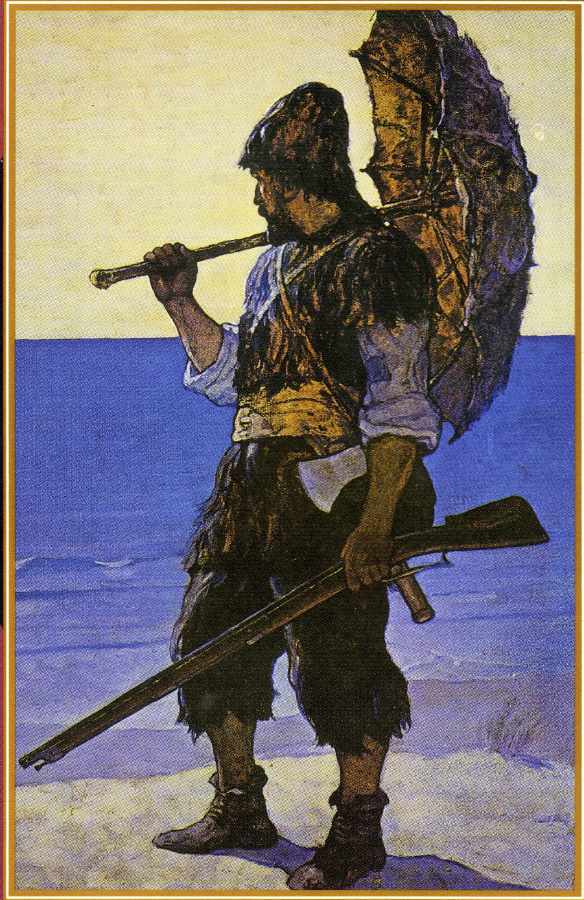
Robinson Crusoe is a novel by Daniel Defoe, first published on 25 April 1719. The first edition credited the work’s protagonist Robinson Crusoe as its author, leading many readers to believe he was a real person and the book a travelogue of true incidents. Epistolary, confessional, and didactic in form, the book is presented as an autobiography of the title character, a castaway who spends 28 years on a remote tropical desert island near the coasts of Venezuela and Trinidad, roughly resembling Tobago, encountering cannibals, captives, and mutineers before being rescued. Robinson Crusoe (the family name corrupted from the German name “Kreutznaer”) sets sail from Kingston upon Hull on a sea voyage in August 1651, against the wishes of his parents, who wanted him to pursue a career in law. After a tumultuous journey where his ship is wrecked in a storm, his desire for the sea remains so strong that he sets out to sea again. This journey, too, ends in disaster, as the ship is taken over by Salé pirates (the Salé Rovers) and Crusoe is enslaved by a Moor. Two years later, he escapes in a boat with a boy named Xury; a captain of a Portuguese ship off the west coast of Africa rescues him. The ship is en route to Brazil. Crusoe sells Xury to the captain. With the captain’s help, Crusoe procures a plantation in Brazil. In the years later, Crusoe joins an expedition to purchase slaves from Africa, but he is shipwrecked in a storm about forty miles out to sea on an island near the Venezuelan coast (which he calls the Island of Despair) near the mouth of the Orinoco river on 30 September 1659. He observes the latitude as 9 degrees and 22 minutes north. He sees penguins and seals on this island. Only he, the captain’s dog, and two cats survive the shipwreck. Overcoming his despair, he fetches arms, tools and other supplies from the ship before it breaks apart and sinks. He builds a fenced-in habitat near a cave which he excavates. By making marks in a wooden cross, he creates a calendar. By using tools salvaged from the ship, and some which he makes himself, he hunts, grows barley and rice, dries grapes to make raisins, learns to make pottery and raises goats. He also adopts a small parrot. He reads the Bible and becomes religious, thanking God for his fate in which nothing is missing but human society. More years pass and Crusoe discovers cannibals, who occasionally visit the island to kill and eat prisoners. He plans to kill them for committing an abomination, but later realizes he has no right to do so, as the cannibals do not knowingly commit a crime. He dreams of obtaining one or two servants by freeing some prisoners; when a prisoner escapes, Crusoe helps him, naming his new companion “Friday” after the day of the week he appeared. Crusoe teaches Friday English and converts him to Christianity. After more cannibals arrive to partake in a feast, Crusoe and Friday kill most of them and save two prisoners. One is Friday’s father and the other is a Spaniard, who informs Crusoe about other Spaniards shipwrecked on the mainland. A plan is devised wherein the Spaniard would return to the mainland with Friday’s father and bring back the others, build a ship, and sail to a Spanish port. Before the Spaniards return, an English ship appears; mutineers have commandeered the vessel and intend to maroon their captain on the island. Crusoe and the ship’s captain strike a deal in which Crusoe helps the captain and the loyal sailors retake the ship. With their ringleader executed by the captain, the mutineers take up Crusoe’s offer to be marooned on the island rather than being returned to England as prisoners to be hanged. Before embarking for England, Crusoe shows the mutineers how he survived on the island and states that there will be more men coming. Crusoe leaves the island 19 December 1686 and arrives in England on 11 June 1687. He learns that his family believed him dead; as a result, he was left nothing in his father’s will. Crusoe departs for Lisbon to reclaim the profits of his estate in Brazil, which has granted him much wealth. In conclusion, he transports his wealth overland to England from Portugal to avoid traveling by sea. Friday accompanies him and, en route, they endure one last adventure together as they fight off famished wolves while crossing the Pyrenees.
Creators/Key ContributorsN. C. Wyeth, Daniel Defoe
First Appearance The Life and Strange Surprizing Adventures of Robinson Crusoe, Of York, Mariner: Who lived Eight and Twenty Years, all alone in an un-inhabited Island on the Coast of America, near the Mouth of the Great River of Oroonoque; Having been cast on Shore by Shipwreck, wherein all the Men perished but himself. With An Account how he was at last as strangely deliver’d by Pyrates. Written by Himself. (1719)
First Publisher ○
Appearance List Books (short list): The Life and Strange Surprizing Adventures of Robinson Crusoe of York (1719), The Farther Adventures of Robinson Crusoe (1719), Serious Reflections During the Life & Surprising Adventures of Robinson Crusoe, with His Vision of the Angelic World (1720), The Life and Adventures of Robinson Crusoe by Daniel De Foe, with a Portrait, and One Hundred Illustrations by J.D. Watson (1864) [Internet Archive]; The Moonstone by Wilkie Collins (detective novel, 1868); The Life and Adventures of Robinson Crusoe by Daniel Defoe, with Twenty-one Full Page Coloured Illustrations and Upwards of Seventy Woodcuts, by Edward H. Wehnert (1883) [Internet Archive]; The Life and Adventures of Robinson Crusoe by Daniel Defoe, with Sixteen Illustrations by Thomas Stothard, R. A. (1884) [Internet Archive]; The Life and Strange Surprising Adventures of Robinson Crusoe. of York. Mariner. by Daniel Defoe, with nearly one hundred original drawings and decorations done from sketches made in the tropics specially for this work by The Brothers Louis and Frederick Rhead (1900) [Internet Archive]; The Life and Adventures of Robinson Crusoe by Daniel Defoe, illustrated by Milo Winter (1914) [Internet Archive]; Robinson Crusoe by Daniel Defoe, illustrated by N. C. Wyeth (1920) [Internet Archive]. Theater: Robinson Crusoe (pantomime, 1796), Robinson Crusoe (play, 1815), Robinson Crusoé (operetta, 1867). Song: “There Wasn’t Any Broadway on Robinson Crusoe’s Isle” (1913). Film: Robinson Crusoe (Les aventures de Robinson Crusoë) by Georges Méliès (1902), Robinson Crusoe (1927). Comics: True Comics #13, Classic Comics #10, Captain Marvel Adventures #30, 104, Calling All Kids #4, Real Life Comics #31, Kid Eternity #4, Scream Comics #11, Classics Illustrated #10, 94, The Spirit (7/8/1951), The Spirit #5 (reprint).
Sample Read Robinson Crusoe by Daniel Defoe, illustrated by N. C. Wyeth (1920) [Internet Archive]
Description Robinson Crusoe is a novel by Daniel Defoe, first published on 25 April 1719. The first edition credited the work’s protagonist Robinson Crusoe as its author, leading many readers to believe he was a real person and the book a travelogue of true incidents. Epistolary, confessional, and didactic in form, the book is presented as an autobiography of the title character, a castaway who spends 28 years on a remote tropical desert island near the coasts of Venezuela and Trinidad, roughly resembling Tobago, encountering cannibals, captives, and mutineers before being rescued. Robinson Crusoe (the family name corrupted from the German name “Kreutznaer”) sets sail from Kingston upon Hull on a sea voyage in August 1651, against the wishes of his parents, who wanted him to pursue a career in law. After a tumultuous journey where his ship is wrecked in a storm, his desire for the sea remains so strong that he sets out to sea again. This journey, too, ends in disaster, as the ship is taken over by Salé pirates (the Salé Rovers) and Crusoe is enslaved by a Moor. Two years later, he escapes in a boat with a boy named Xury; a captain of a Portuguese ship off the west coast of Africa rescues him. The ship is en route to Brazil. Crusoe sells Xury to the captain. With the captain’s help, Crusoe procures a plantation in Brazil. In the years later, Crusoe joins an expedition to purchase slaves from Africa, but he is shipwrecked in a storm about forty miles out to sea on an island near the Venezuelan coast (which he calls the Island of Despair) near the mouth of the Orinoco river on 30 September 1659. He observes the latitude as 9 degrees and 22 minutes north. He sees penguins and seals on this island. Only he, the captain’s dog, and two cats survive the shipwreck. Overcoming his despair, he fetches arms, tools and other supplies from the ship before it breaks apart and sinks. He builds a fenced-in habitat near a cave which he excavates. By making marks in a wooden cross, he creates a calendar. By using tools salvaged from the ship, and some which he makes himself, he hunts, grows barley and rice, dries grapes to make raisins, learns to make pottery and raises goats. He also adopts a small parrot. He reads the Bible and becomes religious, thanking God for his fate in which nothing is missing but human society. More years pass and Crusoe discovers cannibals, who occasionally visit the island to kill and eat prisoners. He plans to kill them for committing an abomination, but later realizes he has no right to do so, as the cannibals do not knowingly commit a crime. He dreams of obtaining one or two servants by freeing some prisoners; when a prisoner escapes, Crusoe helps him, naming his new companion “Friday” after the day of the week he appeared. Crusoe teaches Friday English and converts him to Christianity. After more cannibals arrive to partake in a feast, Crusoe and Friday kill most of them and save two prisoners. One is Friday’s father and the other is a Spaniard, who informs Crusoe about other Spaniards shipwrecked on the mainland. A plan is devised wherein the Spaniard would return to the mainland with Friday’s father and bring back the others, build a ship, and sail to a Spanish port. Before the Spaniards return, an English ship appears; mutineers have commandeered the vessel and intend to maroon their captain on the island. Crusoe and the ship’s captain strike a deal in which Crusoe helps the captain and the loyal sailors retake the ship. With their ringleader executed by the captain, the mutineers take up Crusoe’s offer to be marooned on the island rather than being returned to England as prisoners to be hanged. Before embarking for England, Crusoe shows the mutineers how he survived on the island and states that there will be more men coming. Crusoe leaves the island 19 December 1686 and arrives in England on 11 June 1687. He learns that his family believed him dead; as a result, he was left nothing in his father’s will. Crusoe departs for Lisbon to reclaim the profits of his estate in Brazil, which has granted him much wealth. In conclusion, he transports his wealth overland to England from Portugal to avoid traveling by sea. Friday accompanies him and, en route, they endure one last adventure together as they fight off famished wolves while crossing the Pyrenees.

 ,
,  ,
,  ,
,  ,
,  ,
,  ,
,  ,
,  ,
,  ,
,  ,
,  ,
,  ,
,  ,
,  ,
,  ,
,  ,
,  ,
, 