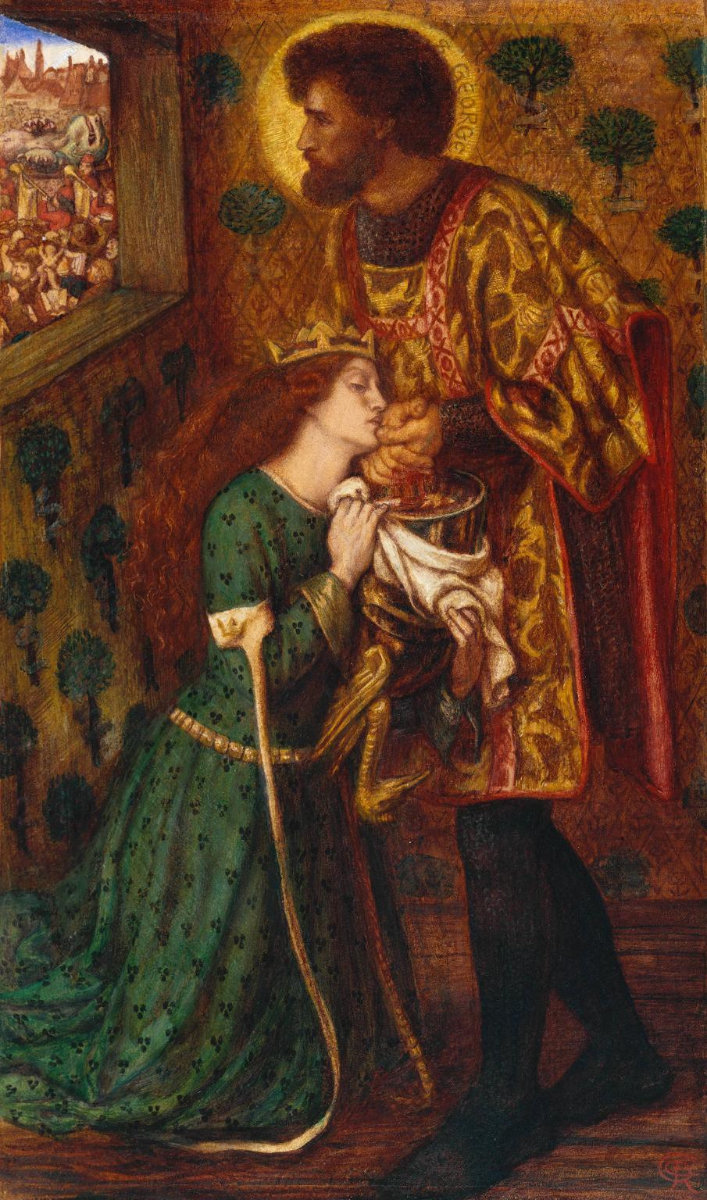
Saint George and the Dragon is a legend in which Saint George—a soldier venerated in Christianity and among the Druze— defeats a dragon. The story goes that the dragon originally extorted tribute from villagers. When they ran out of livestock and trinkets for the dragon, they started giving up a human tribute once a day. One day, the princess herself was chosen as the next offering. As she was walking toward the dragon’s cave, St. George saw her and asked her why she was crying. The princess told the saint about the dragon’s atrocities and asked him to flee immediately, in fear that he might be killed too. But the saint refused to flee, slew the dragon, and rescued the princess. The narrative was first set in Cappadocia in the earliest sources of the 11th and 12th centuries, but transferred to Libya in the 13th-century Golden Legend. The narrative has pre-Christian origins (Jason and Medea, Perseus and Andromeda, Typhon, etc.), and is recorded in various saints’ lives prior to its attribution to Saint George specifically… The Golden Legend narrative is the main source of the story of Saint George and the Dragon as received in Western Europe, and is therefore relevant for Saint George as patron saint of England. The princess remains unnamed in the Golden Legend version, and the name “Sabra” is supplied by Elizabethan era writer Richard Johnson in his Seven Champions of Christendom (1596). In the work, she is recast as a princess of Egypt. This work takes great liberties with the material, and makes Saint George marry Sabra and have English children, one of whom becomes Guy of Warwick. Alternative names given to the princess in Italian sources still of the 13th century are Cleolinda and Aia…
First Appearance The Seven Champions of Christendom (1596) by Richard Johnson
First Publisher Cuthbert Burby
Appearance List The Seven Champions of Christendom (1596) by Richard Johnson — First known appearance of Princess Sabra by name; St. George and the Dragon (17th–18th c., chapbook) by Anonymous; St. George of Merrie England (1894) by Walter Crane; The Red Romance Book (1905) ed. by Andrew Lang.
Sample Read The Legend of Saint George, abstracted from The Golden Legend; or, Lives of the Saints by D. L. Ashliman [Web]
Description Saint George and the Dragon is a legend in which Saint George—a soldier venerated in Christianity and among the Druze— defeats a dragon. The story goes that the dragon originally extorted tribute from villagers. When they ran out of livestock and trinkets for the dragon, they started giving up a human tribute once a day. One day, the princess herself was chosen as the next offering. As she was walking toward the dragon’s cave, St. George saw her and asked her why she was crying. The princess told the saint about the dragon’s atrocities and asked him to flee immediately, in fear that he might be killed too. But the saint refused to flee, slew the dragon, and rescued the princess. The narrative was first set in Cappadocia in the earliest sources of the 11th and 12th centuries, but transferred to Libya in the 13th-century Golden Legend. The narrative has pre-Christian origins (Jason and Medea, Perseus and Andromeda, Typhon, etc.), and is recorded in various saints’ lives prior to its attribution to Saint George specifically… The Golden Legend narrative is the main source of the story of Saint George and the Dragon as received in Western Europe, and is therefore relevant for Saint George as patron saint of England. The princess remains unnamed in the Golden Legend version, and the name “Sabra” is supplied by Elizabethan era writer Richard Johnson in his Seven Champions of Christendom (1596). In the work, she is recast as a princess of Egypt. This work takes great liberties with the material, and makes Saint George marry Sabra and have English children, one of whom becomes Guy of Warwick. Alternative names given to the princess in Italian sources still of the 13th century are Cleolinda and Aia…

 ,
,  ,
,