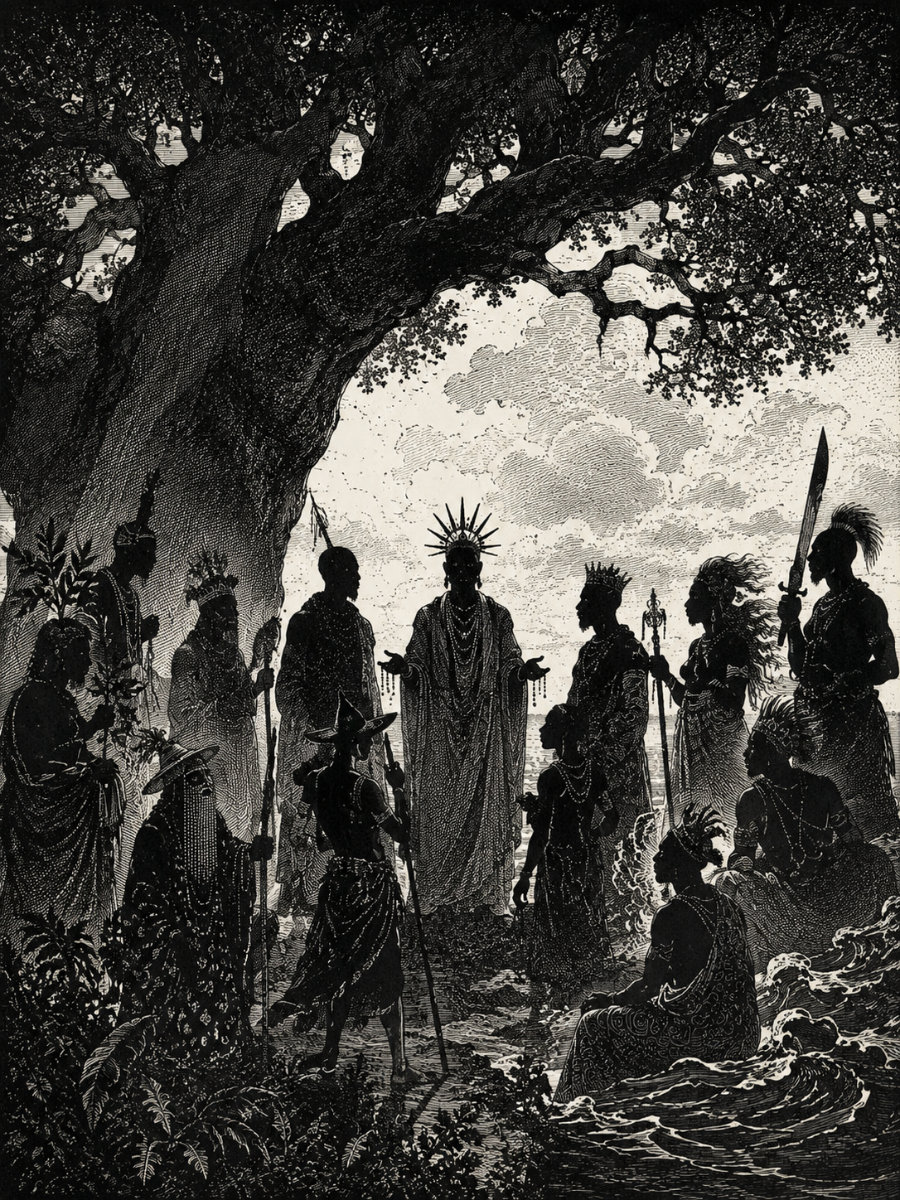
Orishas are divine spirits that play a key role in the Yoruba religion of West Africa and several religions of the African diaspora that derive from it, such as Haitian Vodou, Cuban Santería, and Brazilian Candomblé… In the Lucumí tradition, which evolved in Cuba, the orishas are syncretized with Catholic saints, forming a syncretic system of worship where Yoruba deities were hidden behind Christian iconography. This allowed enslaved Africans to preserve their traditions under colonial religious persecution. According to the teachings of these religions, the orishas are spirits sent by the supreme creator, Olodumare, to assist humanity and to teach them to be successful on Ayé (Earth). Rooted in the native religion of the Yoruba people, most orishas are said to have previously existed in Ọ̀rún (the spirit realm) and then incarnated as humans on Earth. These orishas are called Irúnmọlẹ̀. The Irunmọlẹ took upon human identities and lived as ordinary humans in the physical world, but because they had their origin in the divine, they had great wisdom and power at the moment of their creation… Yoruba tradition often holds that there are 400 + 1 orishas, which is associated with a sacred number. Other sources suggest that the number is “as many as you can think of, plus one more – an innumerable number”. Different oral traditions refer to 400, 700, or 1,440 orishas. This symbolic numbering system reflects the complexity and vastness of the spiritual world in Yoruba cosmology. The phrase “400 + 1” represents the idea that the divine world cannot be fully quantified or comprehended by human minds…
Alias Orisha
Real Names/Alt Names Orishas, òrìṣà (Yoruba), Orixá (Portuguese), Orisha/Oricha/Orichá/Orixá (Spanish)
Appearance List The voice of Africa v. 1 (1913) by Leo Frobenius — valued for early observations and visual documentation despite controversial diffusionist interpretations of African civilization [Smithsonian]; The history of the Yorubas : from the earliest times to the beginning of the British Protectorate (1921) by Rev. Samuel Johnson, Paster of Oyo; ed. Dr. O. (Obadiah) Johnson, Lagos [Internet Archive]; Os africanos no Brasil (1932) by Raymundo Nina Rodrigues; The Religion of the Yorùbá (1948) by J. Olumide Luca; Candomblés da Bahia (first ed. 1948; 2nd ed. 1954) by Edison Carneiro; West African Religion (1949) by Geoffrey Parrinder; Dieux d’Afrique (1954) by Pierre Verger (original edition; later reissued); Olódùmarè: God in Yoruba Belief (1962) by E. Bolaji Idowu; Three Yoruba Plays (1964) by Duro Ladipo; The Shango Cult in Trinidad (1965) by George Eaton Simpson (monograph; first ed. 1965); African Religions in Brazil (French: Les religions africaines au Brésil, 1960) by Roger Bastide; Ifa Divination: Communication Between Gods and Men in West Africa (1969) by William Bascom; Yoruba Beliefs and Sacrificial Rites (1979) by J. Ọmọṣade Awolalu.
Sample Read Yoruba Beliefs and Sacrificial Rites (1979) [Internet Archive]
Description Orishas are divine spirits that play a key role in the Yoruba religion of West Africa and several religions of the African diaspora that derive from it, such as Haitian Vodou, Cuban Santería, and Brazilian Candomblé… In the Lucumí tradition, which evolved in Cuba, the orishas are syncretized with Catholic saints, forming a syncretic system of worship where Yoruba deities were hidden behind Christian iconography. This allowed enslaved Africans to preserve their traditions under colonial religious persecution. According to the teachings of these religions, the orishas are spirits sent by the supreme creator, Olodumare, to assist humanity and to teach them to be successful on Ayé (Earth). Rooted in the native religion of the Yoruba people, most orishas are said to have previously existed in Ọ̀rún (the spirit realm) and then incarnated as humans on Earth. These orishas are called Irúnmọlẹ̀. The Irunmọlẹ took upon human identities and lived as ordinary humans in the physical world, but because they had their origin in the divine, they had great wisdom and power at the moment of their creation… Yoruba tradition often holds that there are 400 + 1 orishas, which is associated with a sacred number. Other sources suggest that the number is “as many as you can think of, plus one more – an innumerable number”. Different oral traditions refer to 400, 700, or 1,440 orishas. This symbolic numbering system reflects the complexity and vastness of the spiritual world in Yoruba cosmology. The phrase “400 + 1” represents the idea that the divine world cannot be fully quantified or comprehended by human minds…