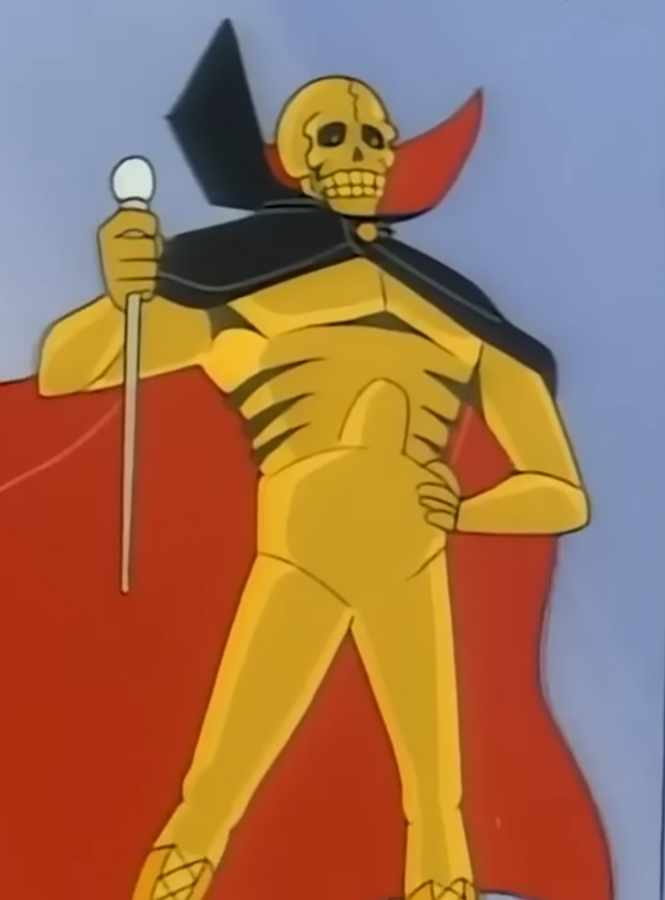
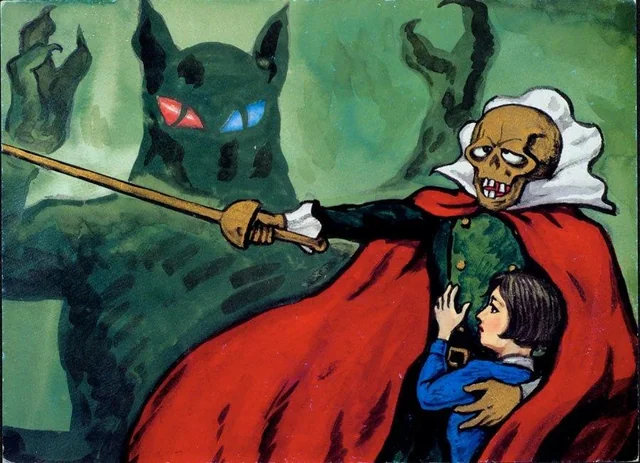
Ōgon Bat is a being from ancient Atlantis who was sent forward in time 10,000 years to battle evil forces threatening the present day. He has a golden skull-shaped head, wears a green and white swashbuckler outfit with a high-collared red cape, and carries a rapier. He lives in a fortress in the Japanese Alps. His superpowers include superhuman strength, invulnerability, and the ability to fly. Ōgon Bat has an evil counterpart known as Kurayami Bat (暗闇バット “Dark Bat”). His main enemy is Dr. Erich Nazō (ナゾー), the leader of a crime syndicate bent on world domination, who wears a black costume and mask with bat-like ears, a red eye and a blue eye. Ōgon Bat was created by 16-year old Takeo Nagamatsu and twenty-five year old Suzuki Ichiro in 1931 and was named after the Golden Bat cigarette brand. The two were inspired by drawings of mythological characters in Tokyo’s Ueno Royal Museum to create a new hero based on science rather than mythology. The character debuted in a kamishibai, a type of traveling show in which a sequence of pictures are shown, narrated by a storyteller. The character was popular enough to survive the decline of kamishibai following World War II, and was eventually adapted into manga (including one by Osamu Tezuka) and anime. The character featured in three live-action movies: Ôgon Bat: Matenrô no Kaijin, released in 1950; Ôgon Batto, released in 1966; and the comedy biopic Ôgon Batto ga Yattekuru, released in 1972. He also appeared in a 52-episode anime series that aired on Nippon TV from 1967 to 1968. Only the original depiction of the character is public domain in Japan. Any television appearances or films are still protected by their respective copyright owners. Ōgon Bat is considered to be the first Japanese superhero. Not only is Ōgon Bat Japan’s first superhero, Ōgon also predates both Superman (1938) and Batman (1939).
First Appearance Kamishibai (paper theater) (1931)
First Publisher ○
Appearance List Ōgon Bat (Tenku no Majō) (1948) by Nagamatsu Takeo; Ōgon Bat: Suisei Roketto (1949) by Nagamatsu Takeo; Ōgon Bat: Matenrō no Kaijin (1950) — live-action feature (generally considered lost today); Ōgon Bat (1966) — Toei live-action film directed by Hajime Satō starring Sonny Chiba; Ōgon Bat (1966–1967) — Weekly Shōnen King serialization; Ōgon Bat (1967–1968) — 52-episode TV anime; Kamishibai Shōwashi (1971) by Kata Kōji — context/history that treats Golden Bat’s kamishibai boom; Kamishibai Shōwashi: Ōgon Bat ga Yattekuru (1972) — Toho feature dramatizing the kamishibai boom and the character’s cultural rise; Ōgon Bat: Nazo no Maki; Chitei no Kuni (1975) by Nagamatsu Takeo; Ōgon Bat: Tenku no Majō; Suisei Roketto (1975) by Nagamatsu Takeo.
Sample Read This is Japan’s First Superhero: A Skeleton in a Cape [YT]
Description Ōgon Bat is a being from ancient Atlantis who was sent forward in time 10,000 years to battle evil forces threatening the present day. He has a golden skull-shaped head, wears a green and white swashbuckler outfit with a high-collared red cape, and carries a rapier. He lives in a fortress in the Japanese Alps. His superpowers include superhuman strength, invulnerability, and the ability to fly. Ōgon Bat has an evil counterpart known as Kurayami Bat (暗闇バット “Dark Bat”). His main enemy is Dr. Erich Nazō (ナゾー), the leader of a crime syndicate bent on world domination, who wears a black costume and mask with bat-like ears, a red eye and a blue eye. Ōgon Bat was created by 16-year old Takeo Nagamatsu and twenty-five year old Suzuki Ichiro in 1931 and was named after the Golden Bat cigarette brand. The two were inspired by drawings of mythological characters in Tokyo’s Ueno Royal Museum to create a new hero based on science rather than mythology. The character debuted in a kamishibai, a type of traveling show in which a sequence of pictures are shown, narrated by a storyteller. The character was popular enough to survive the decline of kamishibai following World War II, and was eventually adapted into manga (including one by Osamu Tezuka) and anime. The character featured in three live-action movies: Ôgon Bat: Matenrô no Kaijin, released in 1950; Ôgon Batto, released in 1966; and the comedy biopic Ôgon Batto ga Yattekuru, released in 1972. He also appeared in a 52-episode anime series that aired on Nippon TV from 1967 to 1968. Only the original depiction of the character is public domain in Japan. Any television appearances or films are still protected by their respective copyright owners. Ōgon Bat is considered to be the first Japanese superhero. Not only is Ōgon Bat Japan’s first superhero, Ōgon also predates both Superman (1938) and Batman (1939).


 ,
,  ,
,