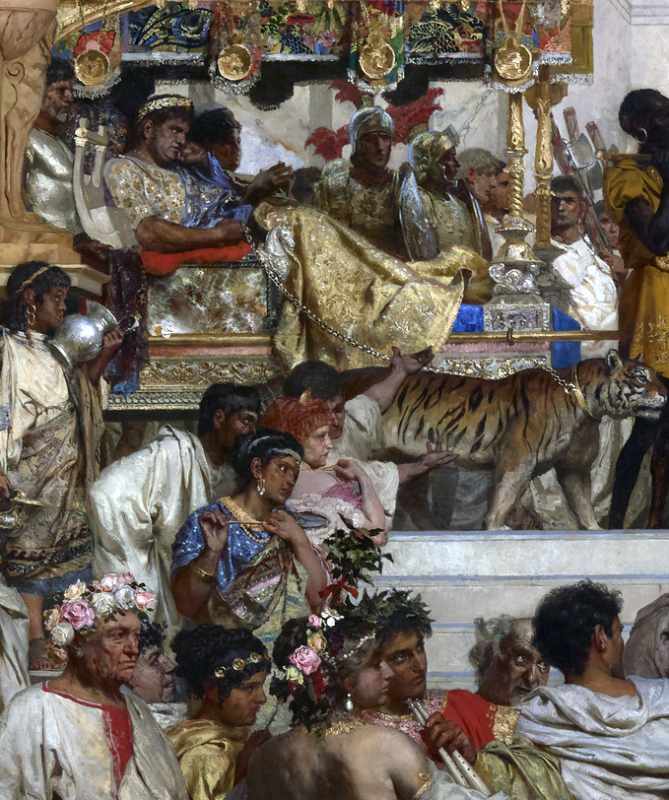
Nero Claudius Caesar Augustus Germanicus (born Lucius Domitius Ahenobarbus; 15 December AD 37 – 9 June AD 68) was the fifth Roman emperor and final emperor of the Julio-Claudian dynasty, reigning from AD 54 until his death in AD 68. He was adopted by the Roman emperor Claudius at the age of 13 and succeeded him on the throne. Nero was popular with the members of his Praetorian Guard and lower-class commoners in Rome and its provinces, but he was deeply resented by the Roman aristocracy. Most contemporary sources describe him as tyrannical, self-indulgent, and debauched. After being declared a public enemy by the Roman Senate, he committed suicide at age 30. In the early years of his reign Nero was advised and guided by his mother Agrippina, his tutor Seneca the Younger, and his praetorian prefect Sextus Afranius Burrus, but he soon sought to rule independently and to rid himself of restraining influences. His power struggle with his mother was eventually resolved when he had her murdered. Roman sources also implicate Nero in the deaths of his wife Claudia Octavia – supposedly so that he could marry Poppaea Sabina – and of his foster-brother Britannicus. Most Roman sources offer overwhelmingly negative assessments of his personality and reign. The historian Tacitus claims the Roman people thought him compulsive and corrupt. Suetonius tells that many Romans believed that the Great Fire of Rome was instigated by Nero to clear land for his planned “Golden House”. Tacitus claims that Nero seized Christians as scapegoats for the fire and had them burned alive, seemingly motivated not by public justice but by personal cruelty. Some modern historians question the reliability of the ancient sources on Nero’s tyrannical acts, considering his popularity among the Roman commoners. In the eastern provinces of the Empire, a popular legend arose that Nero had not died and would return. After his death, at least three leaders of short-lived, failed rebellions presented themselves as “Nero reborn” in order to gain popular support.
Alias Nero
Real Names/Alt Names Lucius Domitius Ahenobarbus (birth to adoption), Nero Claudius Caesar Drusus Germanicus (adoption to accession), Nero Claudius Caesar Augustus Germanicus (as emperor), Imperator Nero Cladius Divi Claudius filius Caesar Augustus Germanicus (imperial name)
First Appearance Historical figure (b. 37 – d. 68)
First Publisher ○
Appearance List Literature: The Twelve Caesars (121 CE) by Suetonius — Ancient primary source; Annals (early 2nd c. CE) by Tacitus — Ancient primary source; Nero (mid-19th c.) by Jacob Abbott; Quo Vadis: A Narrative of the Time of Nero (1896) by Henryk Sienkiewicz; Nero: Reality and Legend (1969) by Brian H. Warmington. Film: Nero and the Burning of Rome (1953 film). Comics: Clue Comics #10, Popular Comics #33, Pirates Comics #3, Headline Comics #4, Smash Comics #52, Boy Comics #24, Jumbo Comics #54, Pep Comics #41, Airboy Comics vol. 3 #6, Zip Comics #40, Jackpot Comics #3, 6, Master Comics #73, Reg’lar Fellers Heroic Comics #9, Charlton Premiere vol. 2 #1.
Sample Read Quo Vadis: A Narrative of the Time of Nero [PG]
Description Nero Claudius Caesar Augustus Germanicus (born Lucius Domitius Ahenobarbus; 15 December AD 37 – 9 June AD 68) was the fifth Roman emperor and final emperor of the Julio-Claudian dynasty, reigning from AD 54 until his death in AD 68. He was adopted by the Roman emperor Claudius at the age of 13 and succeeded him on the throne. Nero was popular with the members of his Praetorian Guard and lower-class commoners in Rome and its provinces, but he was deeply resented by the Roman aristocracy. Most contemporary sources describe him as tyrannical, self-indulgent, and debauched. After being declared a public enemy by the Roman Senate, he committed suicide at age 30. In the early years of his reign Nero was advised and guided by his mother Agrippina, his tutor Seneca the Younger, and his praetorian prefect Sextus Afranius Burrus, but he soon sought to rule independently and to rid himself of restraining influences. His power struggle with his mother was eventually resolved when he had her murdered. Roman sources also implicate Nero in the deaths of his wife Claudia Octavia – supposedly so that he could marry Poppaea Sabina – and of his foster-brother Britannicus. Most Roman sources offer overwhelmingly negative assessments of his personality and reign. The historian Tacitus claims the Roman people thought him compulsive and corrupt. Suetonius tells that many Romans believed that the Great Fire of Rome was instigated by Nero to clear land for his planned “Golden House”. Tacitus claims that Nero seized Christians as scapegoats for the fire and had them burned alive, seemingly motivated not by public justice but by personal cruelty. Some modern historians question the reliability of the ancient sources on Nero’s tyrannical acts, considering his popularity among the Roman commoners. In the eastern provinces of the Empire, a popular legend arose that Nero had not died and would return. After his death, at least three leaders of short-lived, failed rebellions presented themselves as “Nero reborn” in order to gain popular support.