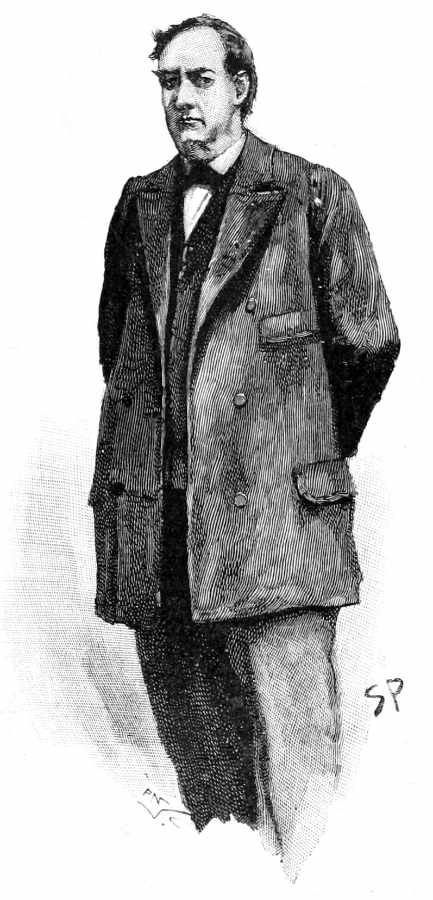
Mycroft Holmes is Sherlock Holmes’s older brother. He mainly appears in two stories by Doyle, “The Adventure of the Greek Interpreter” and “The Adventure of the Bruce-Partington Plans”. He also appears briefly in “The Final Problem”, and is mentioned in “The Adventure of the Empty House”. In “The Greek Interpreter”, he brings Sherlock a case involving one of his neighbours. Sherlock Holmes tells Dr. Watson that Mycroft has powers of observation and deduction superior to his own, but is not energetic or ambitious. He also comments that some of his most interesting cases have come to him through Mycroft. In the story, Sherlock Holmes and Dr. Watson visit Mycroft at the Diogenes Club, which Mycroft co-founded. Also, Mycroft visits 221B Baker Street. Mycroft makes a brief appearance in “The Final Problem”. Sherlock Holmes gives Dr. Watson instructions to take a certain route to leave London to avoid Moriarty’s gang, and part of this plan involves a ride in a brougham driven by a cloaked driver. Watson sees the coachman and does not recognise him. Sherlock later tells Watson that the driver was Mycroft. Near the end of the story after Sherlock’s supposed death, Watson reads a letter left by Sherlock, which includes the statement, “I made every disposition of my property before leaving England, and handed it to my brother Mycroft.” In “The Empty House”, it is revealed that Sherlock Holmes faked his death in “The Final Problem” and subsequently went abroad. His only confidant during this time was Mycroft, who provided him with the money he needed. When Sherlock returned to London, he found that Mycroft had preserved his Baker Street rooms and his papers “exactly as they had always been”. In “The Bruce-Partington Plans”, Mycroft goes to Baker Street to speak with his brother about recovering missing submarine plans for the government. Sherlock Holmes says in this story that Mycroft only visited 221B Baker Street once before. Though Sherlock initially told Watson in “The Greek Interpreter” that Mycroft audits books for the British government, he reveals to Watson in “The Bruce-Partington Plans” that Mycroft’s true role is more substantial: “You are right in thinking that he is under the British government. You would also be right in a sense if you said that occasionally he is the British government.” Mycroft has a unique position in the government, which is not named in the stories. Sherlock comments regarding Mycroft’s role that there “has never been anything like it before, nor will be again” and that Mycroft “has the tidiest and most orderly brain, with the greatest capacity for storing facts, of any man living”.
First Appearance “The Adventure of the Greek Interpreter” in The Strand Magazine (UK) and Harper’s Weekly (US) (September 1893)
First Publisher George Newnes, Ltd.
Appearance List The Adventure of the Greek Interpreter (1893) — Mycroft’s first appearance; “The Final Problem” (1893) by Arthur Conan Doyle — brief role as the brougham driver); “The Adventure of the Empty House” (1903) — mentioned; “The Adventure of the Bruce-Partington Plans” (1908) — second major appearance. Film: The Greek Interpreter (1922, silent short); The Bruce-Partington Plans (1922, silent short); A Study in Terror (1965, feature film); The Private Life of Sherlock Holmes (1970, feature film) — dir. Billy Wilder, Mycroft played by Christopher Lee. TV: “The Bruce-Partington Plans” (BBC TV, 1965) — teleplay by Giles Cooper; “The Greek Interpreter” (BBC TV, 1968) — teleplay by Giles Cooper.
Sample Read The Memoirs of Sherlock Holmes (1894) [Internet Archive]
Description Mycroft Holmes is Sherlock Holmes’s older brother. He mainly appears in two stories by Doyle, “The Adventure of the Greek Interpreter” and “The Adventure of the Bruce-Partington Plans”. He also appears briefly in “The Final Problem”, and is mentioned in “The Adventure of the Empty House”. In “The Greek Interpreter”, he brings Sherlock a case involving one of his neighbours. Sherlock Holmes tells Dr. Watson that Mycroft has powers of observation and deduction superior to his own, but is not energetic or ambitious. He also comments that some of his most interesting cases have come to him through Mycroft. In the story, Sherlock Holmes and Dr. Watson visit Mycroft at the Diogenes Club, which Mycroft co-founded. Also, Mycroft visits 221B Baker Street. Mycroft makes a brief appearance in “The Final Problem”. Sherlock Holmes gives Dr. Watson instructions to take a certain route to leave London to avoid Moriarty’s gang, and part of this plan involves a ride in a brougham driven by a cloaked driver. Watson sees the coachman and does not recognise him. Sherlock later tells Watson that the driver was Mycroft. Near the end of the story after Sherlock’s supposed death, Watson reads a letter left by Sherlock, which includes the statement, “I made every disposition of my property before leaving England, and handed it to my brother Mycroft.” In “The Empty House”, it is revealed that Sherlock Holmes faked his death in “The Final Problem” and subsequently went abroad. His only confidant during this time was Mycroft, who provided him with the money he needed. When Sherlock returned to London, he found that Mycroft had preserved his Baker Street rooms and his papers “exactly as they had always been”. In “The Bruce-Partington Plans”, Mycroft goes to Baker Street to speak with his brother about recovering missing submarine plans for the government. Sherlock Holmes says in this story that Mycroft only visited 221B Baker Street once before. Though Sherlock initially told Watson in “The Greek Interpreter” that Mycroft audits books for the British government, he reveals to Watson in “The Bruce-Partington Plans” that Mycroft’s true role is more substantial: “You are right in thinking that he is under the British government. You would also be right in a sense if you said that occasionally he is the British government.” Mycroft has a unique position in the government, which is not named in the stories. Sherlock comments regarding Mycroft’s role that there “has never been anything like it before, nor will be again” and that Mycroft “has the tidiest and most orderly brain, with the greatest capacity for storing facts, of any man living”.