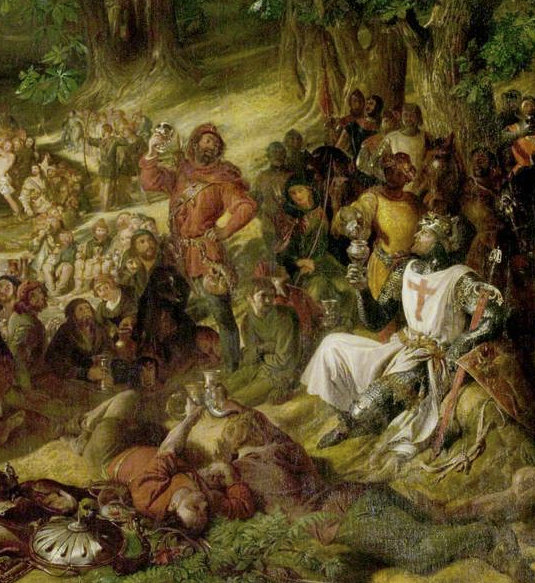
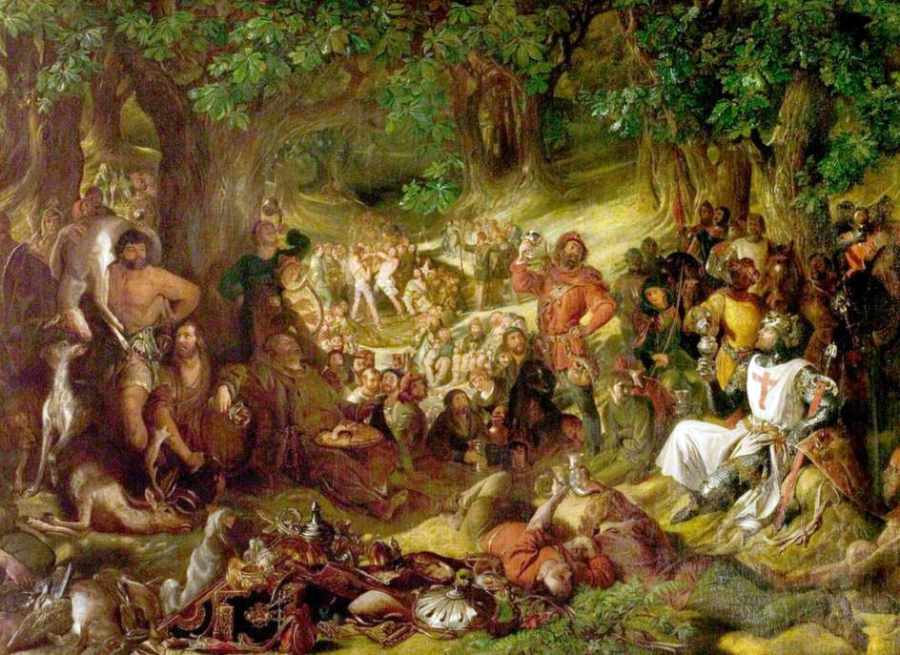
The Merry Men are the group of outlaws who follow Robin Hood in English literature and folklore. The group appears in the earliest ballads about Robin Hood and remains popular in modern adaptations. The Merry Men work to rob from the rich and give to the poor. They have antagonized the tyrannical rule of Prince John while King Richard is fighting in the Crusades. This also puts them into conflict with Prince John’s minions, Guy of Gisbourne and the Sheriff of Nottingham. The early ballads give specific names to only three companions: Little John, Much the Miller’s Son, and William Scarlock or Scathelock, the Will Scarlet of later traditions. Joining them are between 20 and “seven score” (140) outlawed yeomen. The most prominent of the Merry Men is Robin’s second-in-command, Little John. He appears in the earliest ballads, and is mentioned in even earlier sources, such as Andrew of Wyntoun’s Orygynale Chronicle of around 1420 and Walter Bower’s expansion of the Scotichronicon, completed around 1440. Later ballads name additional Merry Men, some of whom appear in only one or two ballads, while others, like the minstrel Alan-a-Dale and the jovial Friar Tuck, became fully attached to the legend. Several of the Robin Hood ballads tell the story of how individual Merry Men join the group; this is frequently accomplished by defeating Robin in a duel. The phrase “merry man” was originally a generic term for any follower or companion of an outlaw, knight, or similar leader. Robin’s band are called “mery men” in the oldest known Robin Hood ballad, “Robin Hood and the Monk”, which survives in a manuscript completed after 1450. Known members include Little John, Much, the Miller’s Son, Will Scarlet, Arthur a Bland, David of Doncaster, Will Stutely, Friar Tuck, Alan-a-Dale, Gilbert Whitehand (or Gilbert with the White Hand), Reynold Greenleaf, Maid Marian, The Tinker, The Cook, The Ranger, The Pinder, The Scotchman, and The Three Yeomen.
Alias Merry Men
Real Names/Alt Names Little John, Much, the Miller’s Son, Will Scarlet, Arthur a Bland, David of Doncaster, Will Stutely, Friar Tuck, Alan-a-Dale, Gilbert Whitehand (or Gilbert with the White Hand), Reynold Greenleaf, Maid Marian, The Tinker, The Cook, The Ranger, The Pinder, The Scotchman, and The Three Yeomen
Appearance List Short list of general Robin Hood media includes Ballads: A Gest of Robyn Hode; Robin Hood and the Monk; Robin Hood and the Curtal Friar; Robin Hood and Allin a Dalem; Robin Hood and Queen Catherin; Robin Hood and the Golden Arrow; Robin Hood and the Tanner of Blyth. Literature: The Merry Adventures of Robin Hood by Howard Pyle (1883) [PG]; Robin Hood by Anonymous [PG]; Bold Robin Hood And His Outlaw Band by Louis Rhead (1912) [Internet Archive]; Robin Hood by Paul Creswick, illustrated by N. C. Wyeth (David McRay Publishers, 1917) [Internet Archive]; Robin Hood and the Men of the Greenwood (1920) [Internet Archive]; Robin Hood: His Deeds and Adventures as Recounted in the Old English Ballads (1923) [Internet Archive]. Comics: Arrow #2; Green Hornet Comics #7-10; Hit Comics #26, 51; Kid Eternity #2; Smash Comics #27; Jumbo Comics #67; Cat-Man Comics #26; Young Heroes #35-37; Treasure Chest of Fun & Facts vol. 3 #14-17; Boy Comics #3-32; Buster Brown #3, 9; Thriller Comics Library #4, 27, 29, 80, 91, 106, 114, 118, 122, 126, 130, 134, 138, 142, 154, 162, 186, 202, 214, 218; Robin Hood Tales #1-6 (Quality) [CB+]; Robin Hood and Company Comics vol. 3 #31-34 (Anglo-American) [CB+]; Robin Hood and His Merry Men #28-38 (Charlton) [CB+]; The Adventures of Robin Hood #1-8 (reprint) (Brown Shoe Co.) [CB+]; Robin Hood (Dell One-Shot) [CB+]; Robin Hood #1-8 (Magazine Enterprises) [CB+]; Robin Hood #1-2, 9-10, 15 (reprint) (I. W. Publishing / Super Comics) [CB+]. Film: At least five silent shorts from 1908-1913, Robin Hood (1922), The Adventures of Robin Hood (1938), The Bandit of Sherwood Forest (1946), The Prince of Thieves (1948), Rogues of Sherwood Forest (1950), Tales of Robin Hood (1951), et. al. TV: The Adventures of Robin Hood (1956, 143 episodes).
Sample Read The Merry Adventures of Robin Hood [PG]
Description The Merry Men are the group of outlaws who follow Robin Hood in English literature and folklore. The group appears in the earliest ballads about Robin Hood and remains popular in modern adaptations. The Merry Men work to rob from the rich and give to the poor. They have antagonized the tyrannical rule of Prince John while King Richard is fighting in the Crusades. This also puts them into conflict with Prince John’s minions, Guy of Gisbourne and the Sheriff of Nottingham. The early ballads give specific names to only three companions: Little John, Much the Miller’s Son, and William Scarlock or Scathelock, the Will Scarlet of later traditions. Joining them are between 20 and “seven score” (140) outlawed yeomen. The most prominent of the Merry Men is Robin’s second-in-command, Little John. He appears in the earliest ballads, and is mentioned in even earlier sources, such as Andrew of Wyntoun’s Orygynale Chronicle of around 1420 and Walter Bower’s expansion of the Scotichronicon, completed around 1440. Later ballads name additional Merry Men, some of whom appear in only one or two ballads, while others, like the minstrel Alan-a-Dale and the jovial Friar Tuck, became fully attached to the legend. Several of the Robin Hood ballads tell the story of how individual Merry Men join the group; this is frequently accomplished by defeating Robin in a duel. The phrase “merry man” was originally a generic term for any follower or companion of an outlaw, knight, or similar leader. Robin’s band are called “mery men” in the oldest known Robin Hood ballad, “Robin Hood and the Monk”, which survives in a manuscript completed after 1450. Known members include Little John, Much, the Miller’s Son, Will Scarlet, Arthur a Bland, David of Doncaster, Will Stutely, Friar Tuck, Alan-a-Dale, Gilbert Whitehand (or Gilbert with the White Hand), Reynold Greenleaf, Maid Marian, The Tinker, The Cook, The Ranger, The Pinder, The Scotchman, and The Three Yeomen.