Mary Celeste (often erroneously referred to as Marie Celeste) was an American-registered merchant brigantine, best known for being discovered adrift and deserted in the Atlantic Ocean off the Azores Islands on December 4, 1872. The Canadian brigantine Dei Gratia found her in a dishevelled but seaworthy condition under partial sail and with her lifeboat missing. The last entry in her log was dated ten days earlier. She had left New York City for Genoa on November 7 and was still amply provisioned when found. Her cargo of alcohol was intact, and the captain’s and crew’s personal belongings were undisturbed. None of those who had been on board were ever seen or heard from again. At the salvage hearings in Gibraltar following her recovery, the court’s officers considered various possibilities of foul play, including mutiny by Mary Celeste’s crew, piracy by the Dei Gratia crew or others, and conspiracy to carry out insurance or salvage fraud. No convincing evidence supported these theories, but unresolved suspicions led to a relatively low salvage award. The inconclusive nature of the hearings fostered continued speculation as to the nature of the mystery, and the story has repeatedly been complicated by false detail and fantasy. Hypotheses that have been advanced include the effects on the crew of alcohol fumes rising from the cargo, submarine earthquakes, waterspouts, attack by a giant squid, and paranormal intervention. Fact and fiction became intertwined in the decades that followed. The Los Angeles Times retold the Mary Celeste story in June 1883 with invented detail. “Every sail was set, the tiller was lashed fast, not a rope was out of place. … The fire was burning in the galley. The dinner was standing untasted and scarcely cold … the log written up to the hour of her discovery.” In 1884, Arthur Conan Doyle wrote “J. Habakuk Jephson’s Statement”, a short story based on the mystery, but spelled the vessel’s name as Marie Celeste. The story’s popularity led to the spelling becoming more common than the original in everyday use.
Appearance List Article: “Mysterious Occurrence at Sea” in The Manchester Guardian (February 13, 1873), “A Brig’s Officers Believed to be Murdered at Sea” in The Boston Post (February 24, 1873), “A Mystery of the Sea: Fate of the Captain, his Wife, the Mate and Crew of the Mary Celeste” in The New York Times (March 25, 1873), “A Mystery of the Sea: Who Can Explain Why and How the Mary Celeste was Abandoned?” in The Los Angeles Times (June 9 1883), “Tales of the Sea II: The Mystery of the Mary Celeste” in Overland Monthly and Out West (November 1906), “Ship’s Disappearance Without Trace” in The Times (October 25, 1955). Fiction: “J. Habakuk Jephson’s Statement” by Arthur Conan Doyle in The Cornhill Magazine (January 1884) [Internet Archive], The Dealings of Captain Sharkey, and Other Tales of Pirates by Arthur Conan Doyle (1905) [PG]. Radio Play: “Mary Celeste: Last Night’s Broadcast of Radio Play” in The Manchester Guardian (May 9, 1931). Film: The Mystery of the Mary Celeste (1935; Phantom Ship in the U.S.), featuring Bela Lugosi. Video: Ghost Ship Mary Celeste – The 150 Year Mystery | Part-Time Explorer [YT]. Podcast: Astonishing Legends: Episode 42-44 The Mary Celeste.
Sample Read Astonishing Legends: Episode 042 The Mary Celeste Part 1 [YT]
Description Mary Celeste (often erroneously referred to as Marie Celeste) was an American-registered merchant brigantine, best known for being discovered adrift and deserted in the Atlantic Ocean off the Azores Islands on December 4, 1872. The Canadian brigantine Dei Gratia found her in a dishevelled but seaworthy condition under partial sail and with her lifeboat missing. The last entry in her log was dated ten days earlier. She had left New York City for Genoa on November 7 and was still amply provisioned when found. Her cargo of alcohol was intact, and the captain’s and crew’s personal belongings were undisturbed. None of those who had been on board were ever seen or heard from again. At the salvage hearings in Gibraltar following her recovery, the court’s officers considered various possibilities of foul play, including mutiny by Mary Celeste’s crew, piracy by the Dei Gratia crew or others, and conspiracy to carry out insurance or salvage fraud. No convincing evidence supported these theories, but unresolved suspicions led to a relatively low salvage award. The inconclusive nature of the hearings fostered continued speculation as to the nature of the mystery, and the story has repeatedly been complicated by false detail and fantasy. Hypotheses that have been advanced include the effects on the crew of alcohol fumes rising from the cargo, submarine earthquakes, waterspouts, attack by a giant squid, and paranormal intervention. Fact and fiction became intertwined in the decades that followed. The Los Angeles Times retold the Mary Celeste story in June 1883 with invented detail. “Every sail was set, the tiller was lashed fast, not a rope was out of place. … The fire was burning in the galley. The dinner was standing untasted and scarcely cold … the log written up to the hour of her discovery.” In 1884, Arthur Conan Doyle wrote “J. Habakuk Jephson’s Statement”, a short story based on the mystery, but spelled the vessel’s name as Marie Celeste. The story’s popularity led to the spelling becoming more common than the original in everyday use.
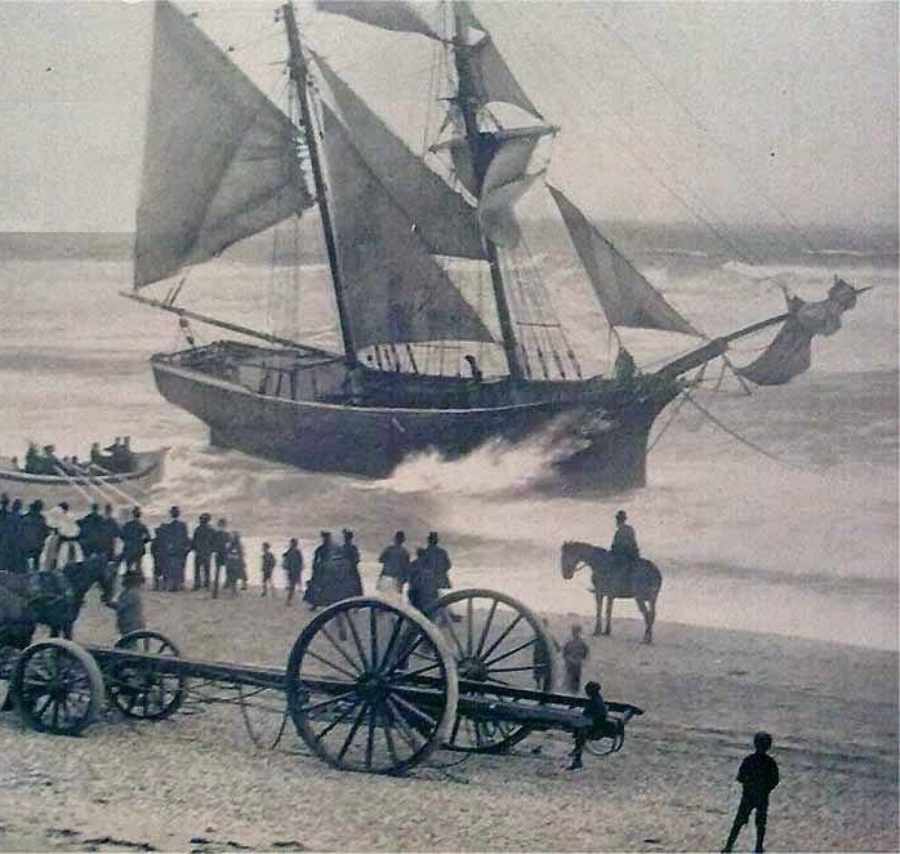
Photo commonly titled “The Flag of Distress” of the Mary and Agnes of Scarborough as she was driven ashore on Whitby beach during the storm of 24 Oct 1885, published in the Illustrated Catalogue of the Royal Photographic Society’s International Exhibition at the Crystal Palace (1898). Note: Not a photo of the Mary Celeste née Amazon of Nova Scotia/Boston/New York. | Photographer: Frank Meadow Sutcliffe