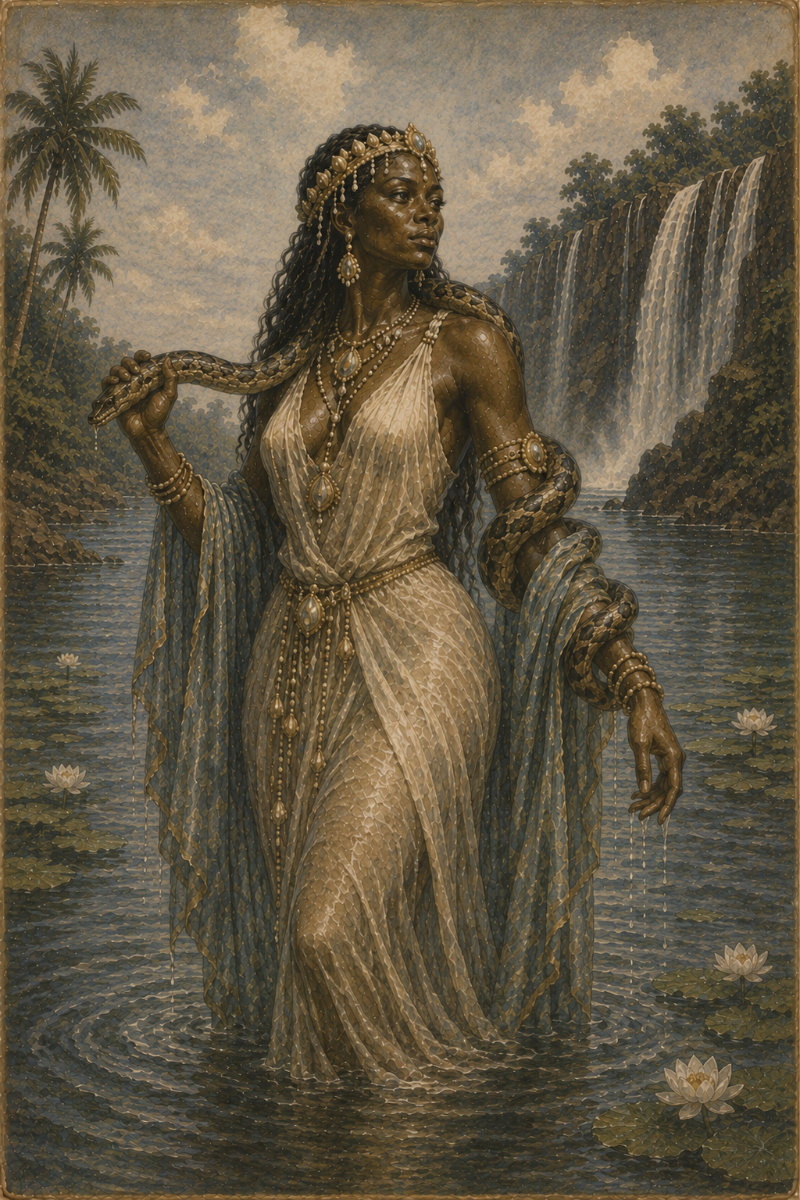
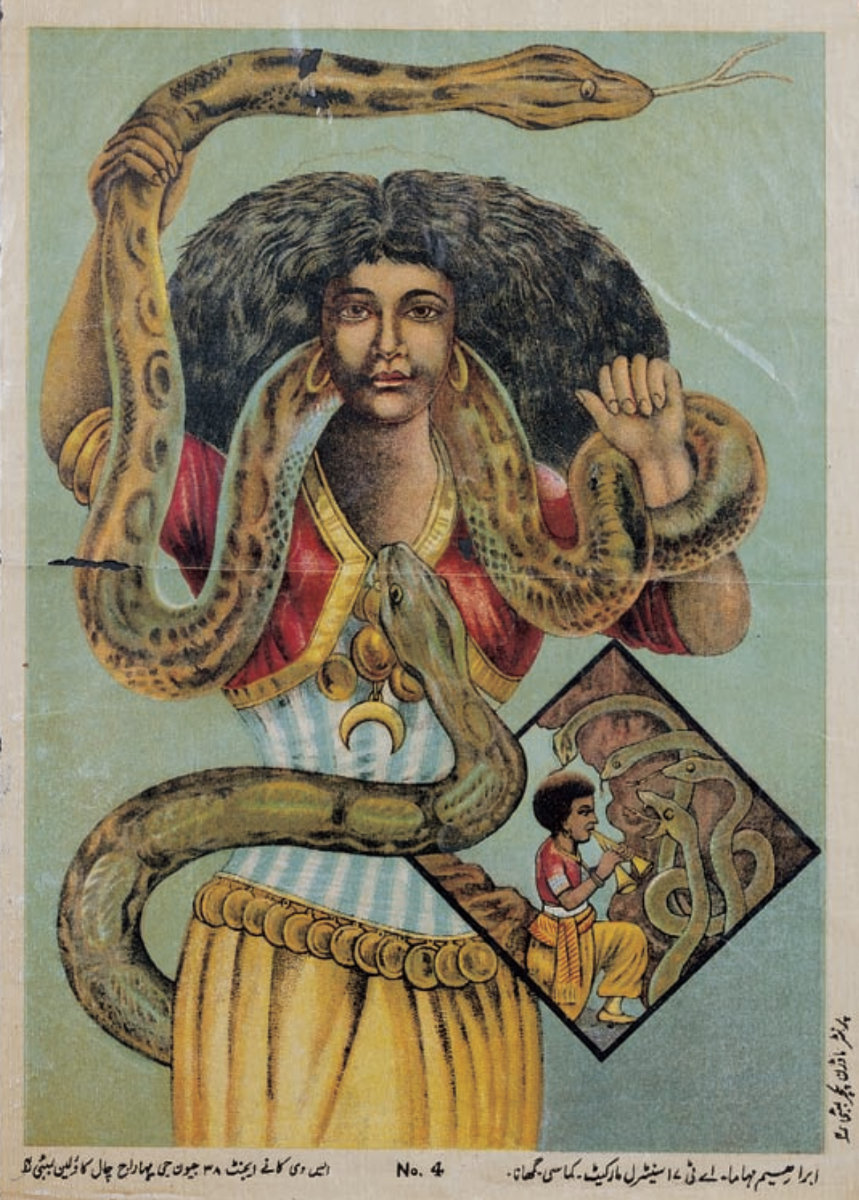
Mami Wata or similar is a mermaid, water spirit, and/or goddess in the folklore of parts of Western Africa, Central Africa, Eastern Africa, and Southern Africa. Historically, scholars trace her origins to early encounters between Europeans and West Africans in the 15th century, where Mami Wata developed from depictions of European mermaids. Mami Wata subsequently joined native pantheons of deities and spirits in parts of Africa. Historically, Mami Wata is conceived of as an exotic female entity from Europe or elsewhere, often depicted as a fair-skinned woman with long, flowing hair and a particular interest in objects foreign to West Africans that her adherents place at her shrines. In the mid-19th century, Mami Wata’s iconography became particularly influenced by an image of snake charmer Nala Damajanti spreading from Europe. This snake charmer print soon overtook Mami Wata’s earlier mermaid iconography in popularity in some parts of Africa. Mami is a goddess of wealth, fertility, healing, wisdom, and profound beauty. She holds the power to manipulate the oceans and rivers, and possesses the ability to transform in order to seduce and mesmerize humans with her alluring beauty… Mami Wata is especially venerated in parts of Africa and in the Atlantic diaspora and has also been demonized in some African Christian and Islamic communities in the region…
Alias Mami Wata
Real Names/Alt Names Mammy Water, Mami Muntu (Bantu), Mamba Muntu
Appearance List Mammy Water: Folk Beliefs and Psychotic Elaborations in Liberia in The Canadian Journal of Psychiatry (April 1970) by Ronald M. Wintrob [Sage Journals]; “Exhibition Preview — Mami Wata: Arts for Water Spirits in Africa and Its Diasporas” by Henry John Drewal with contributions by Marilyn Houlberg, Bogumil Jewsiewicki, John W. Nunley, and Jill Salmons [UWash]; Mammywater (1979) by Flora Nwapa, illus. Obiora Udechukwu – children’s-book. Film: Mammy Water (1954) by Jean Rouch – ethnographic film on Ghanaian sea-spirit cults.
Sample Read Mami Wata: Arts for Water Spirits in Africa and Its Diasporas [UWash]
Description Mami Wata or similar is a mermaid, water spirit, and/or goddess in the folklore of parts of Western Africa, Central Africa, Eastern Africa, and Southern Africa. Historically, scholars trace her origins to early encounters between Europeans and West Africans in the 15th century, where Mami Wata developed from depictions of European mermaids. Mami Wata subsequently joined native pantheons of deities and spirits in parts of Africa. Historically, Mami Wata is conceived of as an exotic female entity from Europe or elsewhere, often depicted as a fair-skinned woman with long, flowing hair and a particular interest in objects foreign to West Africans that her adherents place at her shrines. In the mid-19th century, Mami Wata’s iconography became particularly influenced by an image of snake charmer Nala Damajanti spreading from Europe. This snake charmer print soon overtook Mami Wata’s earlier mermaid iconography in popularity in some parts of Africa. Mami is a goddess of wealth, fertility, healing, wisdom, and profound beauty. She holds the power to manipulate the oceans and rivers, and possesses the ability to transform in order to seduce and mesmerize humans with her alluring beauty… Mami Wata is especially venerated in parts of Africa and in the Atlantic diaspora and has also been demonized in some African Christian and Islamic communities in the region…