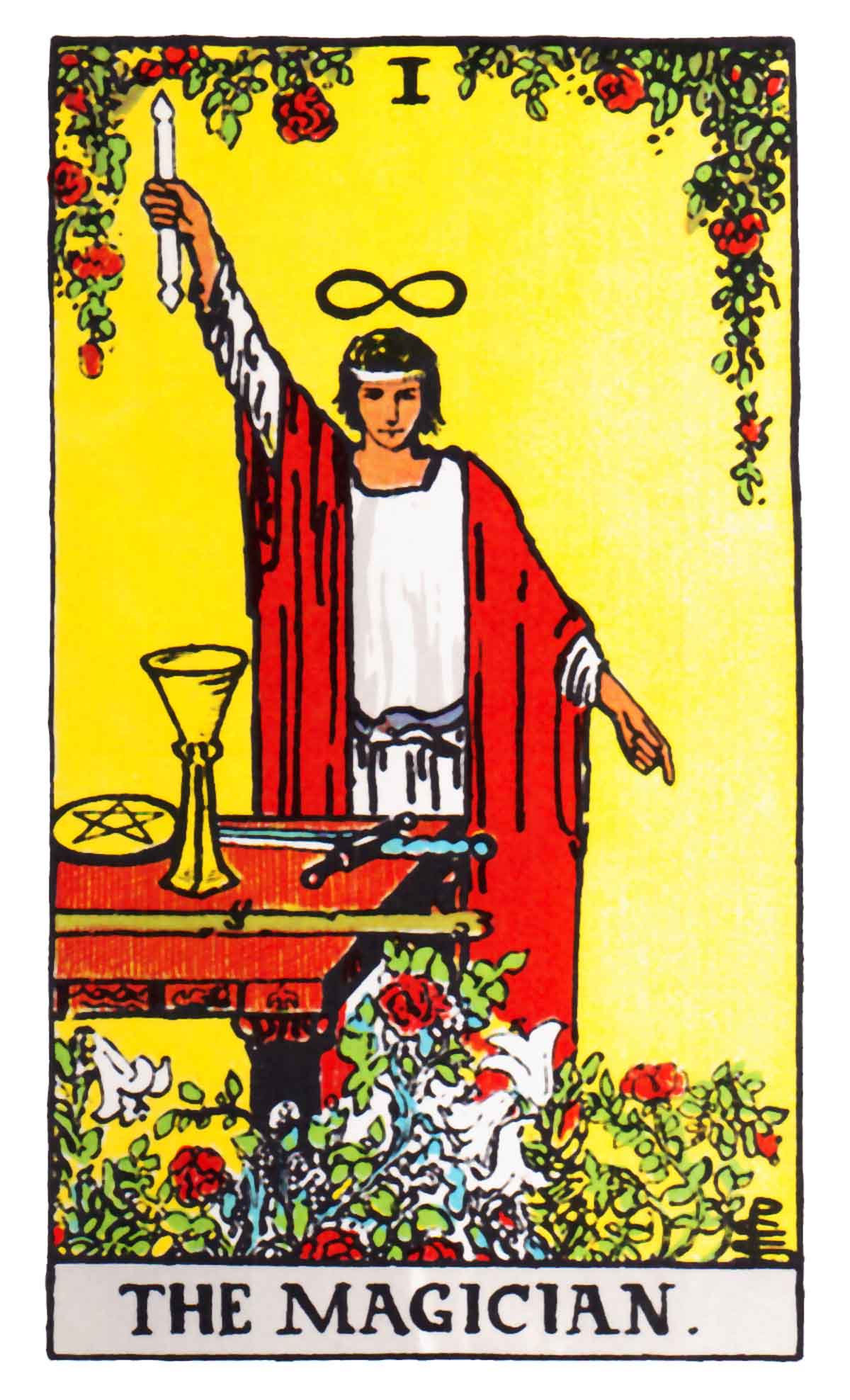
Among devoted Tarot users, the Magician is often the favorite card. That’s because already using the Tarot is a kind of magic — opening the door to a reality yet to be explained in scientific terms, if that’s ever going to be possible. The Tarot Magician seems to have everything in control, like a master of fate, but that might just as well be an illusion. In our days, most magicians are illusionists, but the one of the Tarot Magician card is the first to fall for the illusion. That’s particularly true for those who favor the Magician card. They want the illusion. In the picture of this Tarot card, the Magician has gathered the symbols of all four suits on his table, as if the whole Tarot and thereby everything in the world is at his disposal. Hardly. If the Tarot Magician believes it, he’s more of a fool than the card with that name — because the real Tarot Fool knows he’s a fool. That makes all the difference in the world, and it’s precisely the weakness of the Tarot Magician. The Tarot Magician card indicates things being solved as if by magic. It can be a person making big problems disappear or splendid solutions appear as if out of nowhere. But life doesn’t work like that. If it’s too good to be true, it probably isn’t. The Magician’s solutions will by time prove to be somewhat lacking. Either they don’t last or they don’t solve everything, so new problems will emerge — this time more difficult to handle. That’s not necessarily a bad thing, since the initial solution was probably urgent and beneficial. Without it, who knows what would have happened? It’s just important to understand that the Magician’s solution is rarely the final one. The problem is not really dealt with, but just made to disappear for a while. Still, that can be a blessing. The Magician’s weakness is to be overly confident. Just look at the sign for eternity like a halo above his head. So, we tend to be overly confident about solutions of that kind. When this Tarot card appears in your reading, expect a fantastic turn of events, but also watch out for what remains to be done — that which is at first invisible in the dazzle. But who doesn’t want to be dazzled, now and then?
First Appearance Ducal courts of northern Italy (c. 1440)
First Publisher ○
Appearance List Sola Busca (1490s) — earliest surviving deck [Open Culture] [WaiteSmith.org]; Monde primitif… (Vol. 8: “Du Jeu des Tarots”) (1781) by Antoine Court de Gébelin; Manière de se récréer avec le jeu de cartes nommées Tarots (1783–1785) by Etteilla (Jean-Baptiste Alliette); Dogme et rituel de la haute magie (1856) by Éliphas Lévi; The Tarot: Its Occult Signification, Use in Fortune-Telling, and Method of Play (1888) by S. L. MacGregor Mathers; Le Tarot des Bohémiens (1889) by Papus (Gérard Encausse); Rider Waite Tarot (1909) by A. E. Waite and Pamela Colman Smith [WaiteSmith.org]; The Tarot of the Bohemians (1910) by A. P Morton [Internet Archive]; The Pictorial Key to the Tarot (1911, 1959) by A. E. Waite and Pamela Colman Smith; Le tarot des imagiers du moyen âge (1926) by Oswald Wirth; The Book of Thoth: A Short Essay on the Tarot of the Egyptians (1944) by Aleister Crowley; Le Tarot de Marseille (1949) by Paul Marteau; The Tarot Revealed (1960) by Eden Gray; Tarot Cards for Fun and Fortune Telling (1970) by Stuart R. Kaplan; The Encyclopedia of Tarot (Vol. 1) (1978) by Stuart R. Kaplan.
Sample Read The Pictorial Key to the Tarot (1911, 1959) by A. E. Waite and Pamela Colman Smith [Internet Archive]
Description Among devoted Tarot users, the Magician is often the favorite card. That’s because already using the Tarot is a kind of magic — opening the door to a reality yet to be explained in scientific terms, if that’s ever going to be possible. The Tarot Magician seems to have everything in control, like a master of fate, but that might just as well be an illusion. In our days, most magicians are illusionists, but the one of the Tarot Magician card is the first to fall for the illusion. That’s particularly true for those who favor the Magician card. They want the illusion. In the picture of this Tarot card, the Magician has gathered the symbols of all four suits on his table, as if the whole Tarot and thereby everything in the world is at his disposal. Hardly. If the Tarot Magician believes it, he’s more of a fool than the card with that name — because the real Tarot Fool knows he’s a fool. That makes all the difference in the world, and it’s precisely the weakness of the Tarot Magician. The Tarot Magician card indicates things being solved as if by magic. It can be a person making big problems disappear or splendid solutions appear as if out of nowhere. But life doesn’t work like that. If it’s too good to be true, it probably isn’t. The Magician’s solutions will by time prove to be somewhat lacking. Either they don’t last or they don’t solve everything, so new problems will emerge — this time more difficult to handle. That’s not necessarily a bad thing, since the initial solution was probably urgent and beneficial. Without it, who knows what would have happened? It’s just important to understand that the Magician’s solution is rarely the final one. The problem is not really dealt with, but just made to disappear for a while. Still, that can be a blessing. The Magician’s weakness is to be overly confident. Just look at the sign for eternity like a halo above his head. So, we tend to be overly confident about solutions of that kind. When this Tarot card appears in your reading, expect a fantastic turn of events, but also watch out for what remains to be done — that which is at first invisible in the dazzle. But who doesn’t want to be dazzled, now and then?