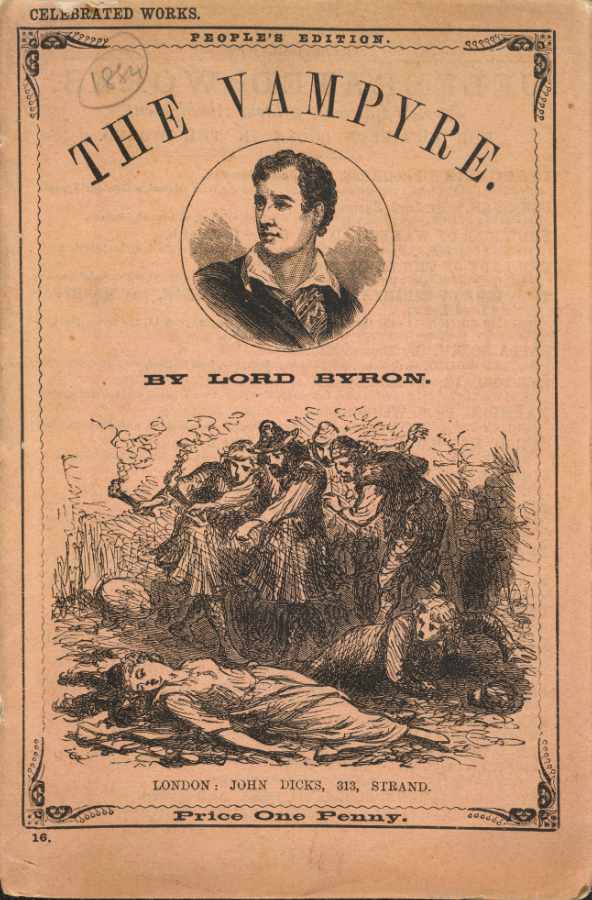
Lord Ruthven appeared as the title character in the 1819 short story “The Vampyre”, written in 1816 by Dr. John William Polidori, the traveling doctor of Lord Byron. It was published in the April 1, 1819 edition of The New Monthly Magazine. The publishers falsely attributed the authorship to Byron. Both Byron and Polidori disputed this attribution. In the following issue, dated May 1, 1819, Polidori wrote a letter to the editor explaining “that though the groundwork is certainly Lord Byron’s, its development is mine.” In the story, Aubrey meets the mysterious Lord Ruthven at a social event when he comes to London. After briefly getting to know Ruthven, Aubrey agrees to go travelling around Europe with him, but leaves him shortly after they reach Rome when he learns that Ruthven seduced the daughter of a mutual acquaintance. Alone, he travels to Greece where he falls in love with an innkeeper’s daughter, Ianthe. She tells him about the legends of the vampire, which are very popular in the area. However, the romance is short lived as she is unfortunately killed, found with her throat torn open. The whole town believes it to be the work of the evil vampire. Aubrey does not make the connection that this coincidentally happens shortly after Lord Ruthven comes to the area. Aubrey makes up with him and rejoins him in his travels, which becomes his undoing. The pair are attacked by bandits on the road and Ruthven is mortally wounded. On his death bed, Ruthven makes Aubrey swear an oath that he will not speak of Ruthven or his death for a year and a day, and once Aubrey agrees, Lord Ruthven literally dies laughing. Aubrey returns to London and is amazed when Ruthven appears shortly thereafter, alive and well and living under a new identity. Ruthven reminds Aubrey of his oath and then begins to seduce Aubrey’s sister. Helpless to protect his sister, Aubrey has a nervous breakdown. Upon recovering, Aubrey learns that Ruthven is engaged to his sister, and they are due to be married on the day his oath will end. He writes a letter to his sister explaining everything in case something happens to him before he can warn her in person. Aubrey does in fact die, and his letter is destroyed by his physician, thinking it the ravings of a mad man. Ruthven marries Aubrey’s sister, and kills her on their wedding night, found drained of blood with Ruthven long gone into the night. His character is one typical of the gothic genre and vampires in general. His vampire character is alluring and sexual, but is also linked with horror and supernatural terror.
Creators/Key Contributors Dr. John William Polidori
First Appearance “The Vampyre; A Tale” in The New Monthly Magazine (April 1, 1819)
First Publisher Henry Colburn
Appearance List “The Vampyre; A Tale” in The New Monthly Magazine (April 1, 1819) by John William Polidori, initially credited “by Lord Byron”; The Vampyre; A Tale (First book ed., 1819); Lord Ruthwen ou Les Vampires (Novel, 1820) by Cyprien Bérard; Le Vampire: mélodrame en trois actes, avec un prologue (1820) by Charles Nodier, Pierre-François-Jean-Baptiste Carmouche & Achille de Jouffroy d’Abbans; The Vampire; or, The Bride of the Isles (1820) by James Robinson Planché — English stage adaptation; Der Vampir oder die Todtenbraut (1821/1822) by Heinrich Ludwig Ritter — German stage adaptation; Der Vampyr (1828) by Heinrich Marschner (opera; libretto by W. A. Wohlbrück after Ritter/Polidori) — premiere Leipzig, 29 Mar 1828; The Vampyre (People’s Edition, London ca. 1884).
Description Lord Ruthven appeared as the title character in the 1819 short story “The Vampyre”, written in 1816 by Dr. John William Polidori, the traveling doctor of Lord Byron. It was published in the April 1, 1819 edition of The New Monthly Magazine. The publishers falsely attributed the authorship to Byron. Both Byron and Polidori disputed this attribution. In the following issue, dated May 1, 1819, Polidori wrote a letter to the editor explaining “that though the groundwork is certainly Lord Byron’s, its development is mine.” In the story, Aubrey meets the mysterious Lord Ruthven at a social event when he comes to London. After briefly getting to know Ruthven, Aubrey agrees to go travelling around Europe with him, but leaves him shortly after they reach Rome when he learns that Ruthven seduced the daughter of a mutual acquaintance. Alone, he travels to Greece where he falls in love with an innkeeper’s daughter, Ianthe. She tells him about the legends of the vampire, which are very popular in the area. However, the romance is short lived as she is unfortunately killed, found with her throat torn open. The whole town believes it to be the work of the evil vampire. Aubrey does not make the connection that this coincidentally happens shortly after Lord Ruthven comes to the area. Aubrey makes up with him and rejoins him in his travels, which becomes his undoing. The pair are attacked by bandits on the road and Ruthven is mortally wounded. On his death bed, Ruthven makes Aubrey swear an oath that he will not speak of Ruthven or his death for a year and a day, and once Aubrey agrees, Lord Ruthven literally dies laughing. Aubrey returns to London and is amazed when Ruthven appears shortly thereafter, alive and well and living under a new identity. Ruthven reminds Aubrey of his oath and then begins to seduce Aubrey’s sister. Helpless to protect his sister, Aubrey has a nervous breakdown. Upon recovering, Aubrey learns that Ruthven is engaged to his sister, and they are due to be married on the day his oath will end. He writes a letter to his sister explaining everything in case something happens to him before he can warn her in person. Aubrey does in fact die, and his letter is destroyed by his physician, thinking it the ravings of a mad man. Ruthven marries Aubrey’s sister, and kills her on their wedding night, found drained of blood with Ruthven long gone into the night. His character is one typical of the gothic genre and vampires in general. His vampire character is alluring and sexual, but is also linked with horror and supernatural terror.