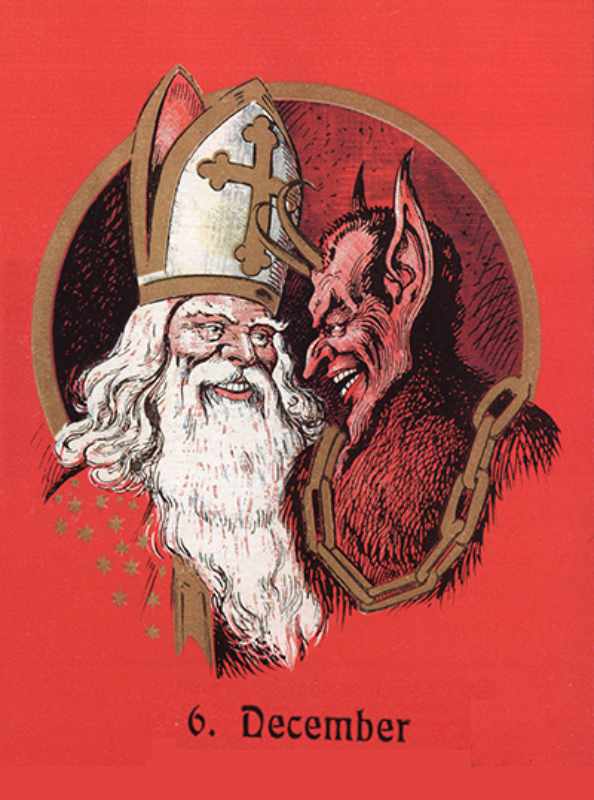
The Krampus is a horned, anthropomorphic figure in Central and Eastern Alpine folklore who, during the Christmas season, scares children who have misbehaved. Assisting Saint Nicholas, the pair visit children on the night of 5 December, with Saint Nicholas rewarding the well-behaved children with modest gifts such as oranges, dried fruit, walnuts and chocolate, while the badly behaved ones only receive punishment from Krampus with birch rods. The origin of the figure is unclear; some folklorists and anthropologists have postulated it as having pre-Christian origins. In traditional parades and in such events as the Krampuslauf (English: Krampus run), young men participate dressed as Krampus and attempt to scare the audience with their antics. Such events occur annually in most Alpine towns. Krampus is featured on holiday greeting cards called Krampuskarten.
Appearance List Tirolische National-Brauchtümer (1858) by Johann Nepomuk von Alpenburg – Early folkloric description of Krampus in Tyrolean customs; Das österreichische Volksleben (1867) by Anton Ritter von Perger – Survey of Austrian folk traditions, mentions Krampus figures; Krampus Lithographs (late 1800s, c. 1890s) by Various Artists – Popular illustrated postcards (Krampuskarten) showing horned Krampus punishing or abducting children; Krampus Parade Photographs (1950s onward) by Regional Photographers – Documenting revived Krampuslauf festivals in Austria and Bavaria.
Sample Read Astonishing Legends: Episode 007 A Krampus Christmas [YT]
Description The Krampus is a horned, anthropomorphic figure in Central and Eastern Alpine folklore who, during the Christmas season, scares children who have misbehaved. Assisting Saint Nicholas, the pair visit children on the night of 5 December, with Saint Nicholas rewarding the well-behaved children with modest gifts such as oranges, dried fruit, walnuts and chocolate, while the badly behaved ones only receive punishment from Krampus with birch rods. The origin of the figure is unclear; some folklorists and anthropologists have postulated it as having pre-Christian origins. In traditional parades and in such events as the Krampuslauf (English: Krampus run), young men participate dressed as Krampus and attempt to scare the audience with their antics. Such events occur annually in most Alpine towns. Krampus is featured on holiday greeting cards called Krampuskarten.