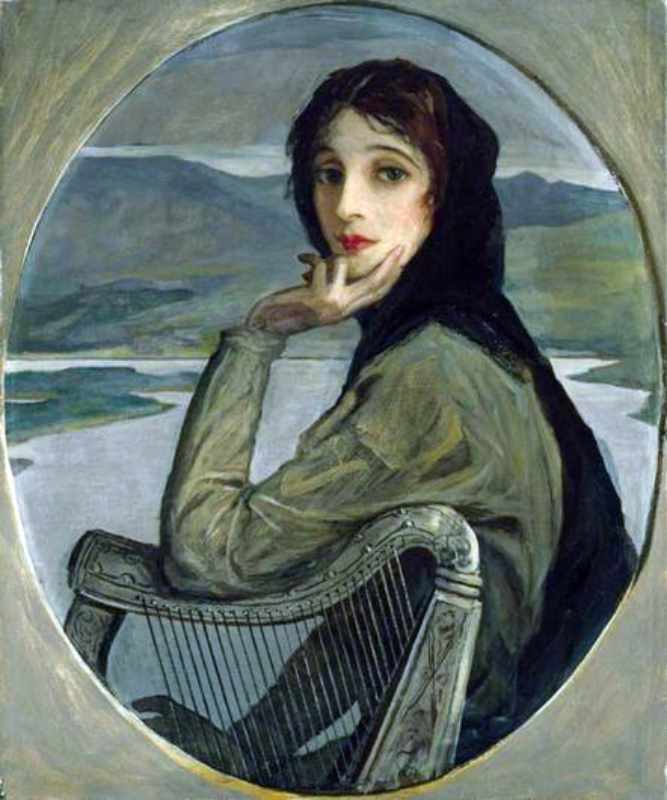
Kathleen Ni Houlihan (Irish: Caitlín Ní Uallacháin, literally, “Kathleen, daughter of Houlihan”) is a mythical symbol and emblem of Irish nationalism found in literature and art, sometimes representing Ireland as a personified woman. The figure of Kathleen Ni Houlihan has also been invoked in nationalist Irish politics. The figure is also sometimes referred to as the Sean-Bhean Bhocht, the Poor Old Woman, and similar appellations. Kathleen Ni Houlihan is generally depicted as an old woman without a home who needs the help of young Irish men willing to fight and die to free Ireland from colonial rule. Frequently it is hinted that this is because she has been dispossessed of her home which comprised a farmhouse and “four green fields” (symbolizing the four provinces of Ireland). After the Anglo-Irish War, Kathleen Ni Houlihan became associated with the Irish Republican Army in Northern Ireland, especially during the Troubles. As a literary figure, Kathleen Ni Houlihan was featured by William Butler Yeats and Lady Augusta Gregory in their play Cathleen Ní Houlihan. Other authors that have used Kathleen Ni Houlihan in some way include Seán O’Casey (especially in The Shadow of the Gunman) and James Joyce who introduces characters named Kathleen and Mr Holohan in his story “A Mother” (in Dubliners) to illustrate the ideological shallowness of an Irish revival festival. The Kathleen Ni Houlihan myth may represent the view that the blood sacrifice of heroes is needed to free and redeem Ireland. At the same time, these heroic sacrificial martyrs are rewarded by being “remembered for ever”. This nationalist sacrificial mythology can be tied to pagan concepts of “seasonal rejuvenation” and the sacrificial aspects of Christianity in the Crucifixion and tradition of martyrdom. This use of sacrificial martyrdom can also be seen in various hunger strikes started by Irish Republican Army prisoners in the 1980s and other periods.
First Appearance Cathleen Ní Houlihan (1902) by W. B. Yeats and Lady Augusta Gregory
First Publisher ○
Appearance List The Countess Cathleen (1892) by W. B. Yeats – precursor play with similar “old woman/young woman” allegory, Cathleen Ní Houlihan (1902) by W. B. Yeats and Lady Augusta Gregory, Cathleen Ní Houlihan (1905) by W. B. Yeats – revised edition of the 1902 play, Mythologies (1959) by W. B. Yeats, Yeats and the Idea of a Theatre (1971) by James W. Flannery – academic study of Yeats’s plays including Cathleen Ní Houlihan.
Description Kathleen Ni Houlihan (Irish: Caitlín Ní Uallacháin, literally, “Kathleen, daughter of Houlihan”) is a mythical symbol and emblem of Irish nationalism found in literature and art, sometimes representing Ireland as a personified woman. The figure of Kathleen Ni Houlihan has also been invoked in nationalist Irish politics. The figure is also sometimes referred to as the Sean-Bhean Bhocht, the Poor Old Woman, and similar appellations. Kathleen Ni Houlihan is generally depicted as an old woman without a home who needs the help of young Irish men willing to fight and die to free Ireland from colonial rule. Frequently it is hinted that this is because she has been dispossessed of her home which comprised a farmhouse and “four green fields” (symbolizing the four provinces of Ireland). After the Anglo-Irish War, Kathleen Ni Houlihan became associated with the Irish Republican Army in Northern Ireland, especially during the Troubles. As a literary figure, Kathleen Ni Houlihan was featured by William Butler Yeats and Lady Augusta Gregory in their play Cathleen Ní Houlihan. Other authors that have used Kathleen Ni Houlihan in some way include Seán O’Casey (especially in The Shadow of the Gunman) and James Joyce who introduces characters named Kathleen and Mr Holohan in his story “A Mother” (in Dubliners) to illustrate the ideological shallowness of an Irish revival festival. The Kathleen Ni Houlihan myth may represent the view that the blood sacrifice of heroes is needed to free and redeem Ireland. At the same time, these heroic sacrificial martyrs are rewarded by being “remembered for ever”. This nationalist sacrificial mythology can be tied to pagan concepts of “seasonal rejuvenation” and the sacrificial aspects of Christianity in the Crucifixion and tradition of martyrdom. This use of sacrificial martyrdom can also be seen in various hunger strikes started by Irish Republican Army prisoners in the 1980s and other periods.