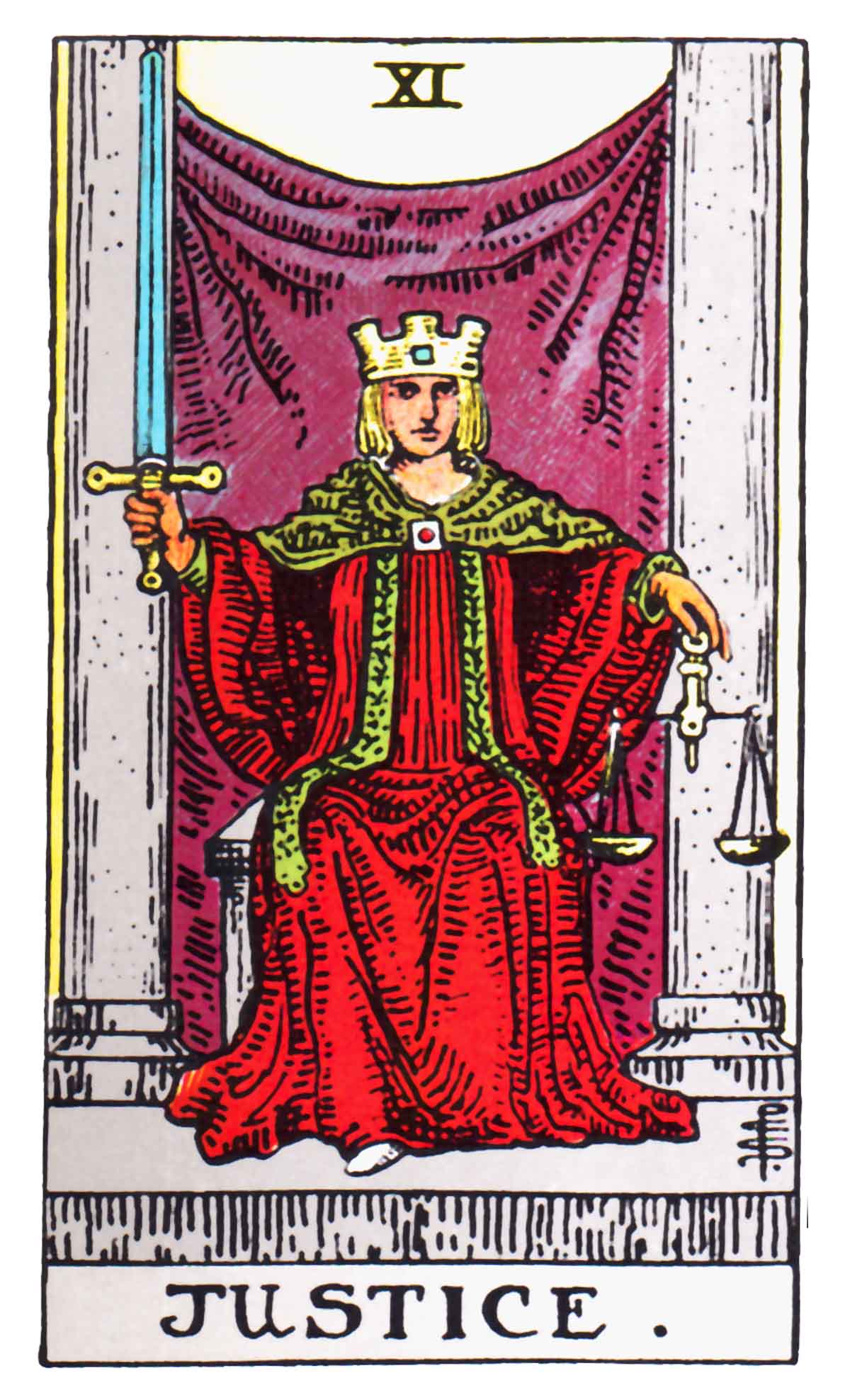
The Justice of the Tarot is not blind. There’s the sword representing the sharp firmness of the law, and the scales by which to judge the actions of men, as carried by every image of Justitia. But the Tarot Justice has no blindfold, the guarantee that all people are treated as equals before the law. Unfortunately, that has often proven to be closer to the truth about justice… So, the Tarot Justice card indicates that the system of justice is hazardous even to the innocent. You need not only to obey the law, but give the impression of doing so. That’s not always easy. How can you prove that you are a law-abiding citizen? A basic principle of justice is that we are innocent until proven guilty, but in reality it has happened far too often through history that we’ve been regarded as guilty until we were able to prove our innocence — beyond any reasonable doubt. The Tarot Justice card, then, refers to the judgmental attitude — the one expecting and seeing faults in others and not in a hurry to reconsider or forgive. But if you stand the test, you are acquitted, most definitely, and everything will be fine. You may even receive respect. Notice also that on the Tarot Justice card image, the sword is held high, as if to strike, whereas the scales are held low. That’s an indication of values between them in the mind of this figure of justice: Fairness in trial is of less importance than the order imposed by the might of the law. So, beware of justice in the shape suggested by this Tarot card… The other great uncertainty with justice, implied by the Tarot Justice card, is the elusive nature of truth. As Pontius Pilate asked rhetorically: What is truth? We are rarely sure of having found it, extremely rarely all of it and nothing but it. So, who can judge, really? Still, Justice on the picture of this Tarot card shows no hint of humility or hesitation. Not much benefit of a doubt is to be expected. A person with this characteristic needs to learn moderation and consideration. We all err. That goes for judges, too…
First Appearance Ducal courts of northern Italy (c. 1440)
First Publisher ○
Appearance List Sola Busca (1490s) — earliest surviving deck [Open Culture] [WaiteSmith.org]; Monde primitif… (Vol. 8: “Du Jeu des Tarots”) (1781) by Antoine Court de Gébelin; Manière de se récréer avec le jeu de cartes nommées Tarots (1783–1785) by Etteilla (Jean-Baptiste Alliette); Dogme et rituel de la haute magie (1856) by Éliphas Lévi; The Tarot: Its Occult Signification, Use in Fortune-Telling, and Method of Play (1888) by S. L. MacGregor Mathers; Le Tarot des Bohémiens (1889) by Papus (Gérard Encausse); Rider Waite Tarot (1909) by A. E. Waite and Pamela Colman Smith [WaiteSmith.org]; The Tarot of the Bohemians (1910) by A. P Morton [Internet Archive]; The Pictorial Key to the Tarot (1911, 1959) by A. E. Waite and Pamela Colman Smith; Le tarot des imagiers du moyen âge (1926) by Oswald Wirth; The Book of Thoth: A Short Essay on the Tarot of the Egyptians (1944) by Aleister Crowley; Le Tarot de Marseille (1949) by Paul Marteau; The Tarot Revealed (1960) by Eden Gray; Tarot Cards for Fun and Fortune Telling (1970) by Stuart R. Kaplan; The Encyclopedia of Tarot (Vol. 1) (1978) by Stuart R. Kaplan.
Sample Read The Pictorial Key to the Tarot (1911, 1959) by A. E. Waite and Pamela Colman Smith [Internet Archive]
Description The Justice of the Tarot is not blind. There’s the sword representing the sharp firmness of the law, and the scales by which to judge the actions of men, as carried by every image of Justitia. But the Tarot Justice has no blindfold, the guarantee that all people are treated as equals before the law. Unfortunately, that has often proven to be closer to the truth about justice… So, the Tarot Justice card indicates that the system of justice is hazardous even to the innocent. You need not only to obey the law, but give the impression of doing so. That’s not always easy. How can you prove that you are a law-abiding citizen? A basic principle of justice is that we are innocent until proven guilty, but in reality it has happened far too often through history that we’ve been regarded as guilty until we were able to prove our innocence — beyond any reasonable doubt. The Tarot Justice card, then, refers to the judgmental attitude — the one expecting and seeing faults in others and not in a hurry to reconsider or forgive. But if you stand the test, you are acquitted, most definitely, and everything will be fine. You may even receive respect. Notice also that on the Tarot Justice card image, the sword is held high, as if to strike, whereas the scales are held low. That’s an indication of values between them in the mind of this figure of justice: Fairness in trial is of less importance than the order imposed by the might of the law. So, beware of justice in the shape suggested by this Tarot card… The other great uncertainty with justice, implied by the Tarot Justice card, is the elusive nature of truth. As Pontius Pilate asked rhetorically: What is truth? We are rarely sure of having found it, extremely rarely all of it and nothing but it. So, who can judge, really? Still, Justice on the picture of this Tarot card shows no hint of humility or hesitation. Not much benefit of a doubt is to be expected. A person with this characteristic needs to learn moderation and consideration. We all err. That goes for judges, too…