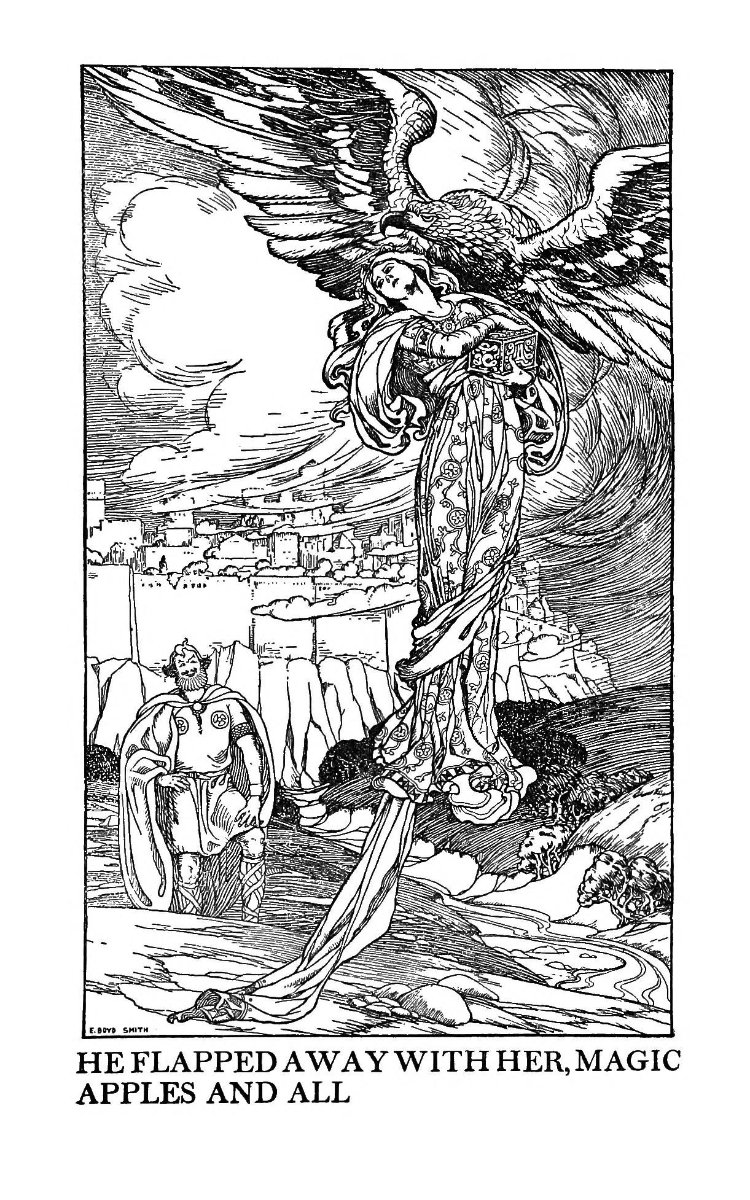
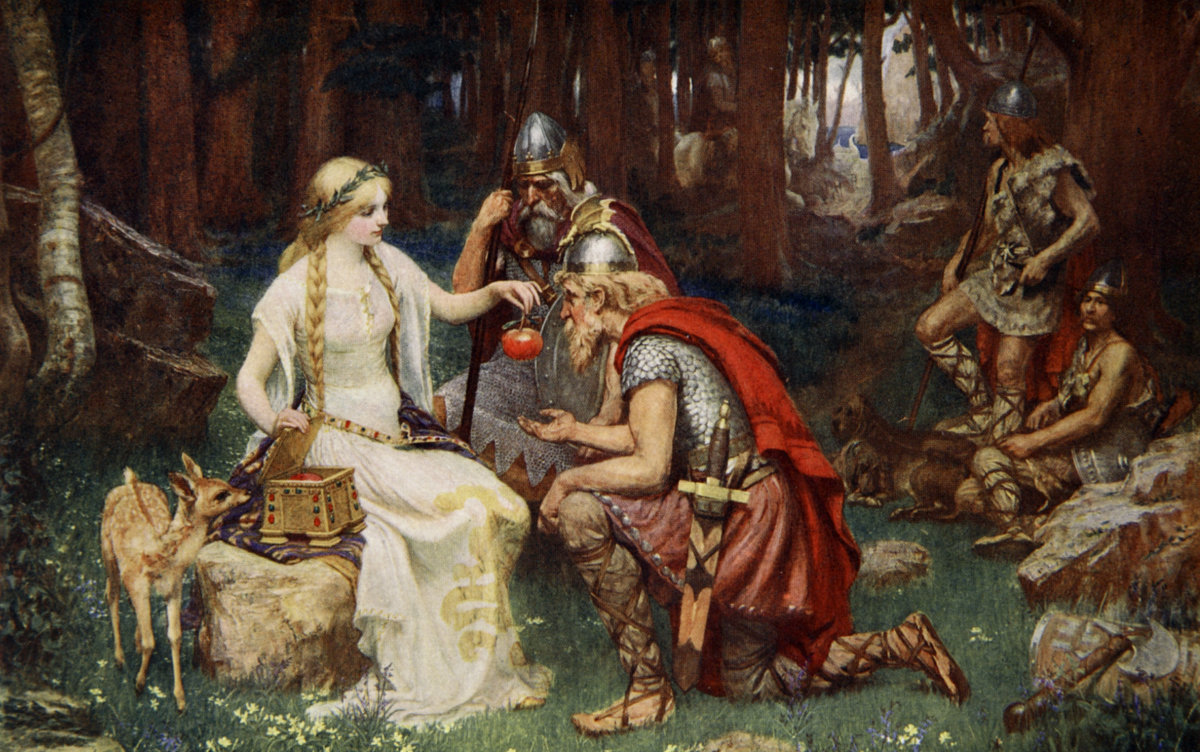
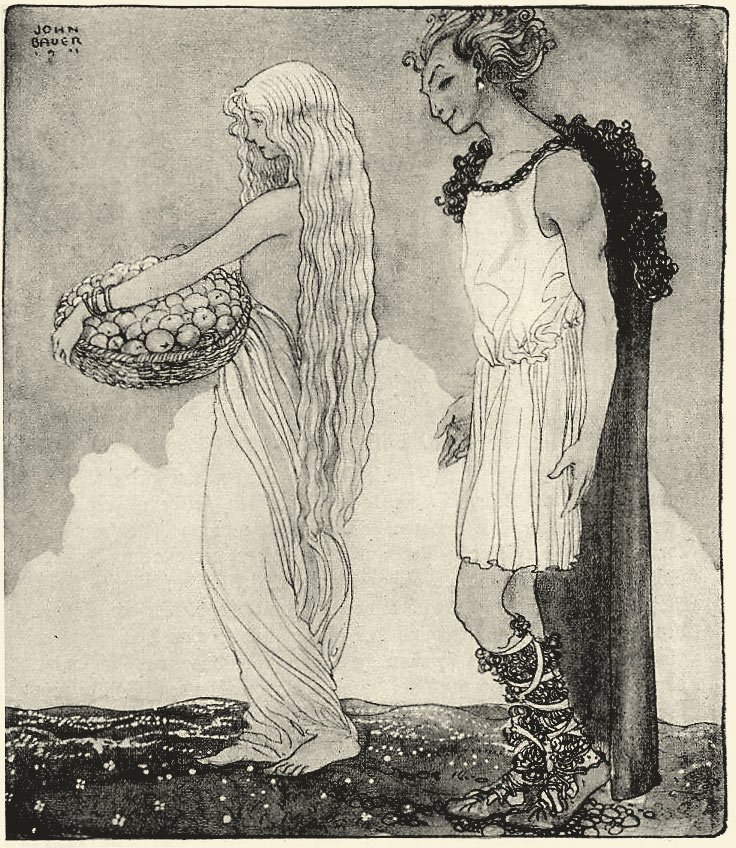
In Norse mythology, Iðunn is a goddess associated with apples and youth. Iðunn is attested in the Poetic Edda, compiled in the 13th century from earlier traditional sources, and the Prose Edda, written in the 13th century by Snorri Sturluson. In both sources, she is described as the wife of the skaldic god Bragi, and in the Prose Edda, also as a keeper of apples and granter of eternal youthfulness. The Prose Edda relates how Loki was once forced by the jötunn Þjazi to lure Iðunn out of Asgard and into a wood with the promise of apples even fairer than her own. Þjazi, in the form of an eagle, abducts Iðunn from the wood, bearing her off to his home. Iðunn’s absence causes the gods to grow old and grey, and they realize that Loki is responsible for her disappearance. Under duress, Loki promises to bring her back and, setting out in the form of a falcon, eventually finds her alone at Þjazi’s home. He turns her into a nut and flies back toward Asgard. When Þjazi returns to find Iðunn gone, he assumes his eagle form once more and flies off in hot pursuit of Loki and his precious burden. The gods build a pyre in the courtyard of Asgard and, just as Loki has stopped short of it, kindle it. Unable to halt his frenzied onrush, Þjazi plunges headlong through the fire, falling to the ground with his feathers aflame, whereupon the gods attack and kill him. A number of theories surround Iðunn, including potential links to fertility, and her potential origin in Proto-Indo-European religion. Long the subject of artworks, Iðunn is sometimes referenced in modern popular culture. The name Iðunn has been variously explained as meaning ‘ever young’, ‘rejuvenator’, or ‘the rejuvenating one’. As the modern English alphabet lacks the eth (ð) character, Iðunn is sometimes anglicized as Idhunn, Idunn, Idun, or Ithun. An -a suffix is sometimes appended to denote femininity, resulting in forms such as Iduna and Idunna.
Appearance List Literary: Prose Edda (c. 1220 CE) by Snorri Sturluson; Poetic Edda (c. 1270 CE); Northern Mythology (1851–1852) by Benjamin Thorpe [Internet Archive]; Asgard Stories: Tales from Norse Mythology (1901) by Mary H. Foster and Mabel H. Cummings [Internet Archive]; In the Days of Giants: A Book of Norse Tales by Abbie Farwell Brown (1902) [Internet Archive]; The Elder or Poetic Edda (1908) [Internet Archive]; The Heroes of Asgard: Tales from Scandinavian Mythology by Keary and Keary (1909) [Internet Archive]; Teutonic Myths and Legends (1912) by Donald A. Mackenzie [Internet Archive]; The Children of Odin (1920) by Padraic Colum [Internet Archive].
Sample Read The Heroes of Asgard: Tales from Scandinavian Mythology [Internet Archive]
Description In Norse mythology, Iðunn is a goddess associated with apples and youth. Iðunn is attested in the Poetic Edda, compiled in the 13th century from earlier traditional sources, and the Prose Edda, written in the 13th century by Snorri Sturluson. In both sources, she is described as the wife of the skaldic god Bragi, and in the Prose Edda, also as a keeper of apples and granter of eternal youthfulness. The Prose Edda relates how Loki was once forced by the jötunn Þjazi to lure Iðunn out of Asgard and into a wood with the promise of apples even fairer than her own. Þjazi, in the form of an eagle, abducts Iðunn from the wood, bearing her off to his home. Iðunn’s absence causes the gods to grow old and grey, and they realize that Loki is responsible for her disappearance. Under duress, Loki promises to bring her back and, setting out in the form of a falcon, eventually finds her alone at Þjazi’s home. He turns her into a nut and flies back toward Asgard. When Þjazi returns to find Iðunn gone, he assumes his eagle form once more and flies off in hot pursuit of Loki and his precious burden. The gods build a pyre in the courtyard of Asgard and, just as Loki has stopped short of it, kindle it. Unable to halt his frenzied onrush, Þjazi plunges headlong through the fire, falling to the ground with his feathers aflame, whereupon the gods attack and kill him. A number of theories surround Iðunn, including potential links to fertility, and her potential origin in Proto-Indo-European religion. Long the subject of artworks, Iðunn is sometimes referenced in modern popular culture. The name Iðunn has been variously explained as meaning ‘ever young’, ‘rejuvenator’, or ‘the rejuvenating one’. As the modern English alphabet lacks the eth (ð) character, Iðunn is sometimes anglicized as Idhunn, Idunn, Idun, or Ithun. An -a suffix is sometimes appended to denote femininity, resulting in forms such as Iduna and Idunna.

 ,
,  ,
,  ,
,