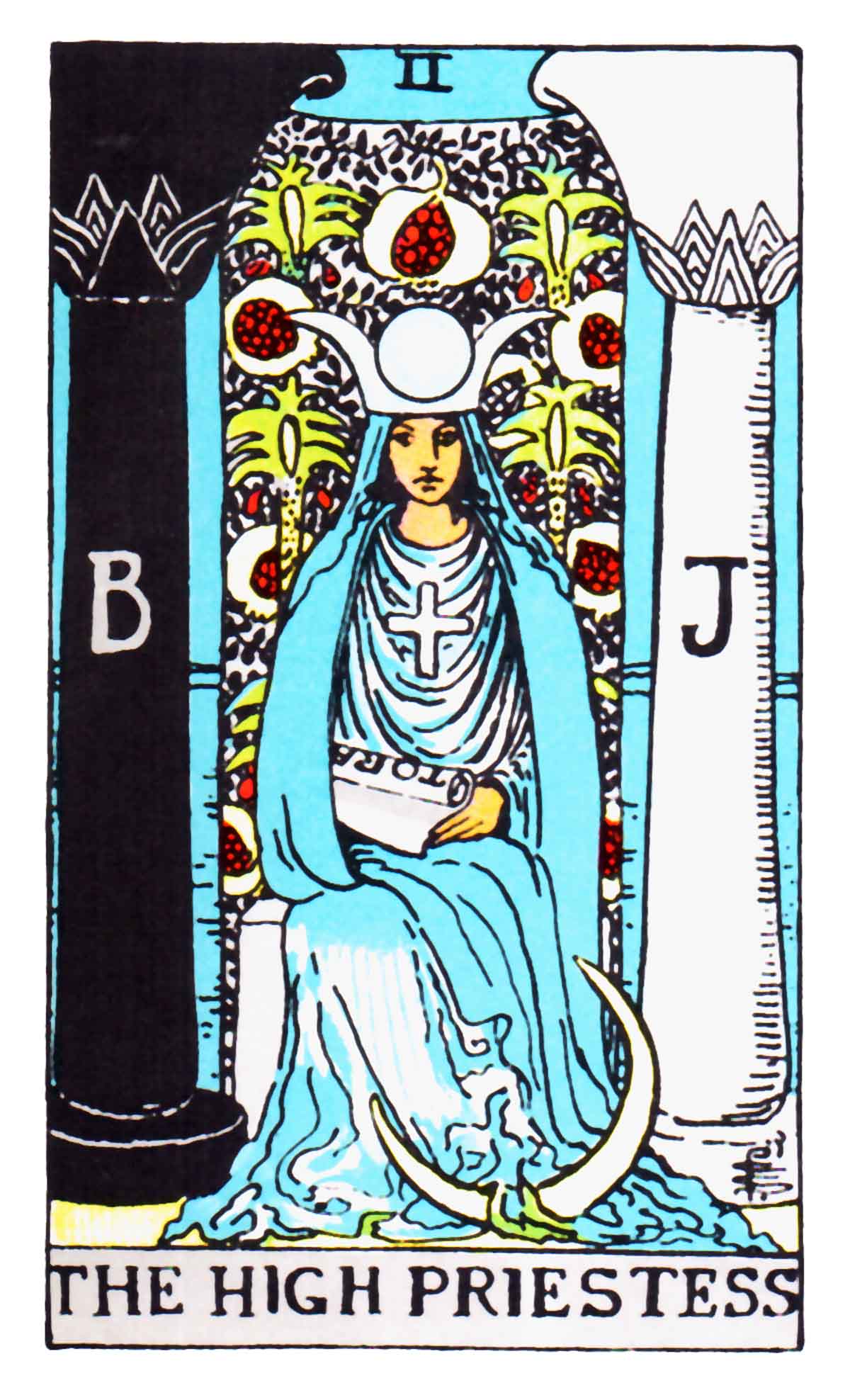
The Tarot High Priestess is the ruler of what’s hidden and secret, the essence behind the scenes. She knows what really goes on. The High Priestess is not that eager to reveal it, though, at least not to those who are fooled by the superficial. You have to deserve the revelations to which she holds the keys. The Tarot High Priestess card has a counterpart in that of the Hierophant, the pompous pope who is indeed powerful, but mainly carries the treasured symbols, having less to do with actual rulership. The High Priestess is the opposite — much more modest in appearance and rare in making public appearances, but still running the show. She can be compared to a grey eminence, someone in charge although not carrying the office. The Tarot High Priestess guards the secrets and ensures the master plan. In doing so, she knows to act with caution, very discreetly, and paying attention to details that are believe to be insignificant. But it’s in the shadows and the periphery that the future of the world is forged. The microcosm rules the macrocosm. The High Priestess is a master of the microcosm…
First Appearance Ducal courts of northern Italy (c. 1440)
First Publisher ○
Appearance List Sola Busca (1490s) — earliest surviving deck [Open Culture] [WaiteSmith.org]; Monde primitif… (Vol. 8: “Du Jeu des Tarots”) (1781) by Antoine Court de Gébelin; Manière de se récréer avec le jeu de cartes nommées Tarots (1783–1785) by Etteilla (Jean-Baptiste Alliette); Dogme et rituel de la haute magie (1856) by Éliphas Lévi; The Tarot: Its Occult Signification, Use in Fortune-Telling, and Method of Play (1888) by S. L. MacGregor Mathers; Le Tarot des Bohémiens (1889) by Papus (Gérard Encausse); Rider Waite Tarot (1909) by A. E. Waite and Pamela Colman Smith [WaiteSmith.org]; The Tarot of the Bohemians (1910) by A. P Morton [Internet Archive]; The Pictorial Key to the Tarot (1911, 1959) by A. E. Waite and Pamela Colman Smith; Le tarot des imagiers du moyen âge (1926) by Oswald Wirth; The Book of Thoth: A Short Essay on the Tarot of the Egyptians (1944) by Aleister Crowley; Le Tarot de Marseille (1949) by Paul Marteau; The Tarot Revealed (1960) by Eden Gray; Tarot Cards for Fun and Fortune Telling (1970) by Stuart R. Kaplan; The Encyclopedia of Tarot (Vol. 1) (1978) by Stuart R. Kaplan.
Sample Read The Pictorial Key to the Tarot (1911, 1959) by A. E. Waite and Pamela Colman Smith [Internet Archive]
Description The Tarot High Priestess is the ruler of what’s hidden and secret, the essence behind the scenes. She knows what really goes on. The High Priestess is not that eager to reveal it, though, at least not to those who are fooled by the superficial. You have to deserve the revelations to which she holds the keys. The Tarot High Priestess card has a counterpart in that of the Hierophant, the pompous pope who is indeed powerful, but mainly carries the treasured symbols, having less to do with actual rulership. The High Priestess is the opposite — much more modest in appearance and rare in making public appearances, but still running the show. She can be compared to a grey eminence, someone in charge although not carrying the office. The Tarot High Priestess guards the secrets and ensures the master plan. In doing so, she knows to act with caution, very discreetly, and paying attention to details that are believe to be insignificant. But it’s in the shadows and the periphery that the future of the world is forged. The microcosm rules the macrocosm. The High Priestess is a master of the microcosm…