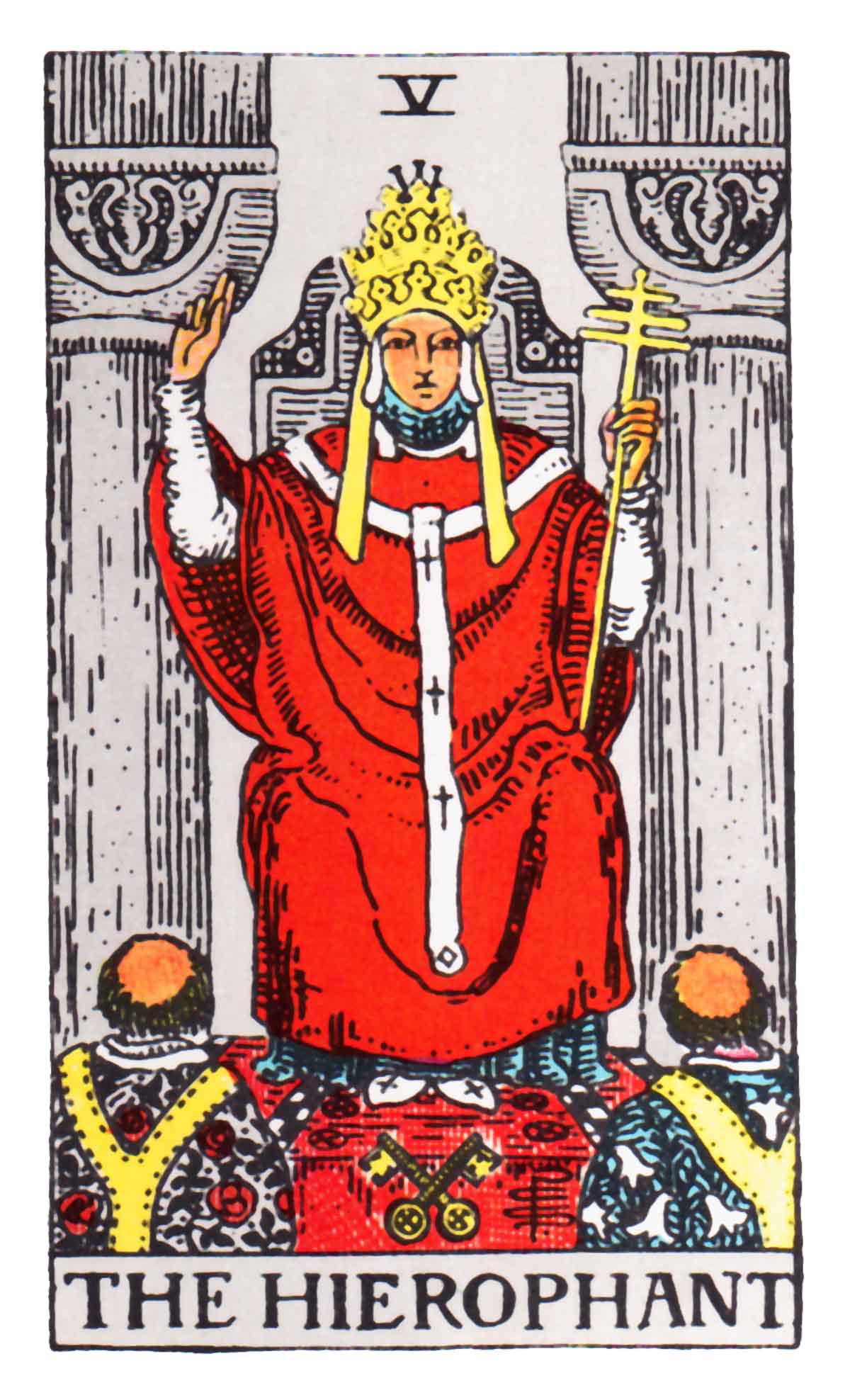
There’s no doubt that the elevated figure on the Tarot Hierophant card is the pope. The word hierophant is Greek, meaning someone who shows the holy. The card is sometimes called The High Priest, which is just about the same: the one claiming to be closest to what’s holy, thereby kind of holy himself, too. But that’s far from certain. The pope and other kinds of hierophants are heads of something symbolic, which is not the same as calling them symbolic heads. Usually, they have tremendous power and final say when it comes to what the divine may want. So, the divine seems mostly to want precisely what the hierophants want. Temples are lavishly decorated, since they are to be the domains of gods. For the same reason, hierophants are lavishly dressed. Their appearances represent the splendor of what’s holy, since they are supposed to be the closest links to it. That’s why they can carry all that gold and jewels, without embarrassment. Some seem to indulge in it more than others, though. In the Tarot deck, the Hierophant card is one that signals tremendous significance, but not necessarily as much substance. Whatever the hierophant might claim, we’re all just as bewildered before god. The divine has no definite location, so there’s no way anybody could be nearer to it than others. The Tarot Hierophant is the head of rituals, but the essence of any spiritual path is what each of us makes of it inside ourselves. That’s a temple no hierophant can make his abode. If the Tarot Hierophant card refers to a person, which is most often the case, it’s someone very pompous indeed, whom it’s of vital importance to treat with respect — whatever you might feel about it. You need that person’s approval. At least, you can’t afford offending him or her. Watch out, because the Tarot Hierophant is a person that is much more important to the final outcome than you might expect — definitely more than what seems reasonable. If the Tarot Hierophant card refers to an event, it’s a moment of great symbolic significance, which can lead to triumph or to debasement. The importance of it must be respected, or things are unlikely to go your way. Still, your own influence is minimal. Things beyond your reach and ability are involved. There’s not much more to do than hope for the best — and make sure not to offend anyone. If the Tarot Hierophant card has a position in the divination spread which refers to you, then you are in a position that others can’t ignore. It is not exactly one of power to decide or spring into action. It’s just that you can’t be opposed and your preferences can’t be ignored. You don’t have to be modest about this strong influence, but you should. Tomorrow, in another situation, things may be very different. And people remember. To be respected is far from the same as being liked, or even admired…
First Appearance Ducal courts of northern Italy (c. 1440)
First Publisher ○
Appearance List Sola Busca (1490s) — earliest surviving deck [Open Culture] [WaiteSmith.org]; Monde primitif… (Vol. 8: “Du Jeu des Tarots”) (1781) by Antoine Court de Gébelin; Manière de se récréer avec le jeu de cartes nommées Tarots (1783–1785) by Etteilla (Jean-Baptiste Alliette); Dogme et rituel de la haute magie (1856) by Éliphas Lévi; The Tarot: Its Occult Signification, Use in Fortune-Telling, and Method of Play (1888) by S. L. MacGregor Mathers; Le Tarot des Bohémiens (1889) by Papus (Gérard Encausse); Rider Waite Tarot (1909) by A. E. Waite and Pamela Colman Smith [WaiteSmith.org]; The Tarot of the Bohemians (1910) by A. P Morton [Internet Archive]; The Pictorial Key to the Tarot (1911, 1959) by A. E. Waite and Pamela Colman Smith; Le tarot des imagiers du moyen âge (1926) by Oswald Wirth; The Book of Thoth: A Short Essay on the Tarot of the Egyptians (1944) by Aleister Crowley; Le Tarot de Marseille (1949) by Paul Marteau; The Tarot Revealed (1960) by Eden Gray; Tarot Cards for Fun and Fortune Telling (1970) by Stuart R. Kaplan; The Encyclopedia of Tarot (Vol. 1) (1978) by Stuart R. Kaplan.
Sample Read The Pictorial Key to the Tarot (1911, 1959) by A. E. Waite and Pamela Colman Smith [Internet Archive]
Description There’s no doubt that the elevated figure on the Tarot Hierophant card is the pope. The word hierophant is Greek, meaning someone who shows the holy. The card is sometimes called The High Priest, which is just about the same: the one claiming to be closest to what’s holy, thereby kind of holy himself, too. But that’s far from certain. The pope and other kinds of hierophants are heads of something symbolic, which is not the same as calling them symbolic heads. Usually, they have tremendous power and final say when it comes to what the divine may want. So, the divine seems mostly to want precisely what the hierophants want. Temples are lavishly decorated, since they are to be the domains of gods. For the same reason, hierophants are lavishly dressed. Their appearances represent the splendor of what’s holy, since they are supposed to be the closest links to it. That’s why they can carry all that gold and jewels, without embarrassment. Some seem to indulge in it more than others, though. In the Tarot deck, the Hierophant card is one that signals tremendous significance, but not necessarily as much substance. Whatever the hierophant might claim, we’re all just as bewildered before god. The divine has no definite location, so there’s no way anybody could be nearer to it than others. The Tarot Hierophant is the head of rituals, but the essence of any spiritual path is what each of us makes of it inside ourselves. That’s a temple no hierophant can make his abode. If the Tarot Hierophant card refers to a person, which is most often the case, it’s someone very pompous indeed, whom it’s of vital importance to treat with respect — whatever you might feel about it. You need that person’s approval. At least, you can’t afford offending him or her. Watch out, because the Tarot Hierophant is a person that is much more important to the final outcome than you might expect — definitely more than what seems reasonable. If the Tarot Hierophant card refers to an event, it’s a moment of great symbolic significance, which can lead to triumph or to debasement. The importance of it must be respected, or things are unlikely to go your way. Still, your own influence is minimal. Things beyond your reach and ability are involved. There’s not much more to do than hope for the best — and make sure not to offend anyone. If the Tarot Hierophant card has a position in the divination spread which refers to you, then you are in a position that others can’t ignore. It is not exactly one of power to decide or spring into action. It’s just that you can’t be opposed and your preferences can’t be ignored. You don’t have to be modest about this strong influence, but you should. Tomorrow, in another situation, things may be very different. And people remember. To be respected is far from the same as being liked, or even admired…