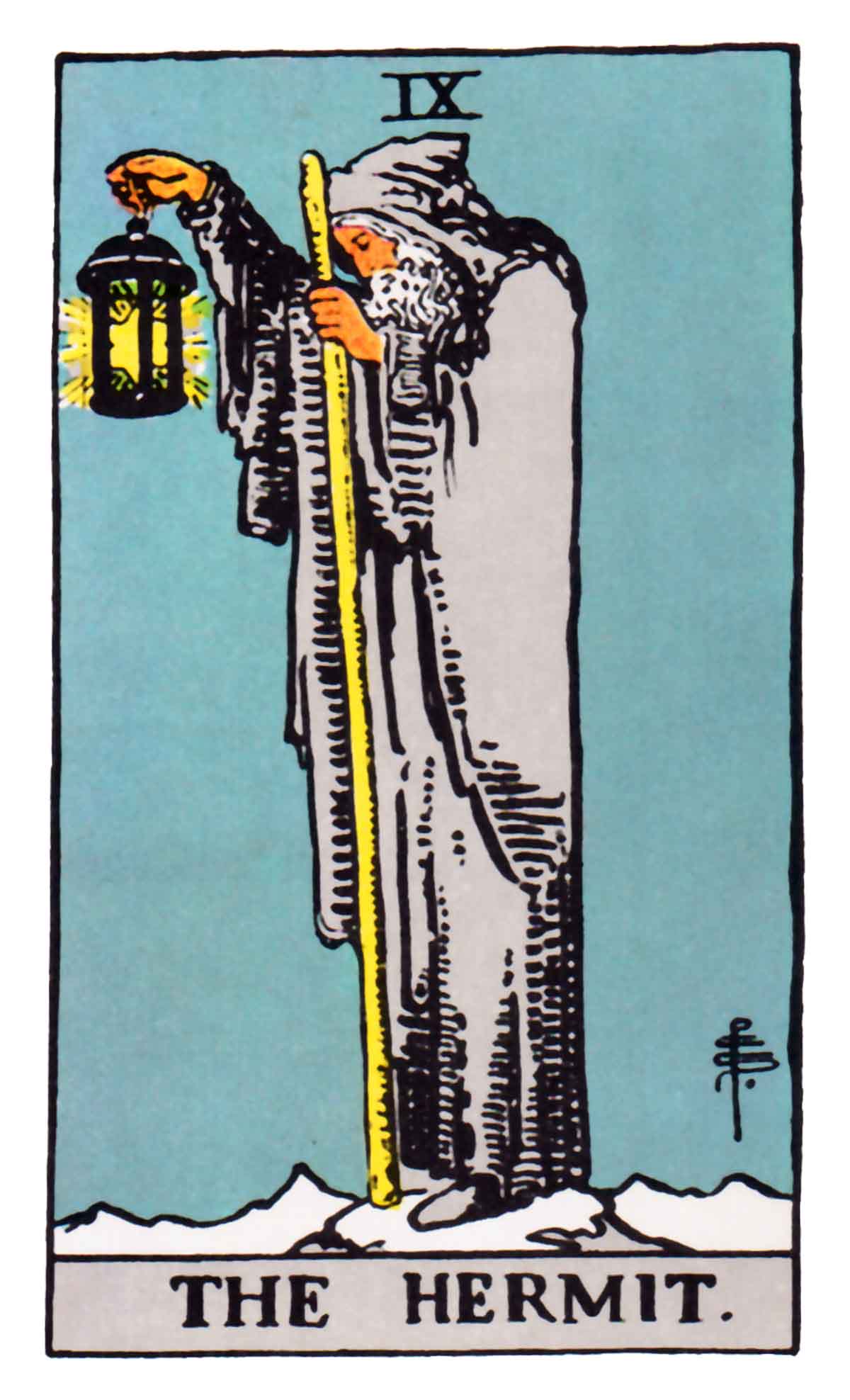
The Tarot card picture of the Hermit is a gloomy one. That’s because of the solitude the card represents. Although it’s voluntary in the case of a hermit, solitude is still somewhat sad. It’s not chosen as a wish of separating oneself from fellow human beings, but for a certain purpose where being alone is instrumental. Usually, it involves an effort to get to know oneself at depth. That’s why the Tarot Hermit is often linked to wisdom. That can be discussed. The hermit might find out plenty about himself and what goes on in his own mind, when avoiding the company of others. But that’s in his mind, the ultimately secluded place where no one else can go. It rarely applies to the outside world, so the scope of any wisdom reached is limited, indeed. You go inwards to learn about yourself, but you have to go outside to learn anything about the world and your place in it. On the Tarot card, the lantern in the hand of the Hermit and the dim blue background suggest night. The stillness and closed eyes of the Tarot Hermit suggest repose, even sleep. Indeed, the self-discovery one does on one’s own is like a dream, fading away quickly when one opens one’s eyes. It’s said that we’re always alone at heart, in our souls. “I believe in the lust of the body and the incurable loneliness of the soul,” said the Swedish author Hjalmar Söderberg. That’s true, in a sense, but it’s also true that we never are completely alone. We have so much in common that wherever we go, even inside our minds, others have done the same and discovered the same. We are alike. Therefore, the experience of one person, no matter how internal, has some relevance to all others. In that way, the Hermit of this Tarot card can become wise. But the wisdom reached by the Hermit has no substance before it’s shared. What we discover in our loneliness becomes real when we share it with others and thereby discover that there’s so much we have in common. In this manner, loneliness can be the way out of it. It’s not sure that the Tarot Hermit will come to that revelation. He seems committed to stay on his own, as if renouncing the world altogether. That leads nowhere. He must snap out of it, lift his head and open his eyes. Until then he’s in sort of a coma. Still, occasionally in life we all need the recluse of the Tarot Hermit. To contemplate what we have been through and what we can expect in the future, to heal from emotional wounds, or simply to get some rest. It’s a healing process, but it’s not a final destination…
First Appearance Ducal courts of northern Italy (c. 1440)
First Publisher ○
Appearance List Sola Busca (1490s) — earliest surviving deck [Open Culture] [WaiteSmith.org]; Monde primitif… (Vol. 8: “Du Jeu des Tarots”) (1781) by Antoine Court de Gébelin; Manière de se récréer avec le jeu de cartes nommées Tarots (1783–1785) by Etteilla (Jean-Baptiste Alliette); Dogme et rituel de la haute magie (1856) by Éliphas Lévi; The Tarot: Its Occult Signification, Use in Fortune-Telling, and Method of Play (1888) by S. L. MacGregor Mathers; Le Tarot des Bohémiens (1889) by Papus (Gérard Encausse); Rider Waite Tarot (1909) by A. E. Waite and Pamela Colman Smith [WaiteSmith.org]; The Tarot of the Bohemians (1910) by A. P Morton [Internet Archive]; The Pictorial Key to the Tarot (1911, 1959) by A. E. Waite and Pamela Colman Smith; Le tarot des imagiers du moyen âge (1926) by Oswald Wirth; The Book of Thoth: A Short Essay on the Tarot of the Egyptians (1944) by Aleister Crowley; Le Tarot de Marseille (1949) by Paul Marteau; The Tarot Revealed (1960) by Eden Gray; Tarot Cards for Fun and Fortune Telling (1970) by Stuart R. Kaplan; The Encyclopedia of Tarot (Vol. 1) (1978) by Stuart R. Kaplan.
Sample Read The Pictorial Key to the Tarot (1911, 1959) by A. E. Waite and Pamela Colman Smith [Internet Archive]
Description The Tarot card picture of the Hermit is a gloomy one. That’s because of the solitude the card represents. Although it’s voluntary in the case of a hermit, solitude is still somewhat sad. It’s not chosen as a wish of separating oneself from fellow human beings, but for a certain purpose where being alone is instrumental. Usually, it involves an effort to get to know oneself at depth. That’s why the Tarot Hermit is often linked to wisdom. That can be discussed. The hermit might find out plenty about himself and what goes on in his own mind, when avoiding the company of others. But that’s in his mind, the ultimately secluded place where no one else can go. It rarely applies to the outside world, so the scope of any wisdom reached is limited, indeed. You go inwards to learn about yourself, but you have to go outside to learn anything about the world and your place in it. On the Tarot card, the lantern in the hand of the Hermit and the dim blue background suggest night. The stillness and closed eyes of the Tarot Hermit suggest repose, even sleep. Indeed, the self-discovery one does on one’s own is like a dream, fading away quickly when one opens one’s eyes. It’s said that we’re always alone at heart, in our souls. “I believe in the lust of the body and the incurable loneliness of the soul,” said the Swedish author Hjalmar Söderberg. That’s true, in a sense, but it’s also true that we never are completely alone. We have so much in common that wherever we go, even inside our minds, others have done the same and discovered the same. We are alike. Therefore, the experience of one person, no matter how internal, has some relevance to all others. In that way, the Hermit of this Tarot card can become wise. But the wisdom reached by the Hermit has no substance before it’s shared. What we discover in our loneliness becomes real when we share it with others and thereby discover that there’s so much we have in common. In this manner, loneliness can be the way out of it. It’s not sure that the Tarot Hermit will come to that revelation. He seems committed to stay on his own, as if renouncing the world altogether. That leads nowhere. He must snap out of it, lift his head and open his eyes. Until then he’s in sort of a coma. Still, occasionally in life we all need the recluse of the Tarot Hermit. To contemplate what we have been through and what we can expect in the future, to heal from emotional wounds, or simply to get some rest. It’s a healing process, but it’s not a final destination…