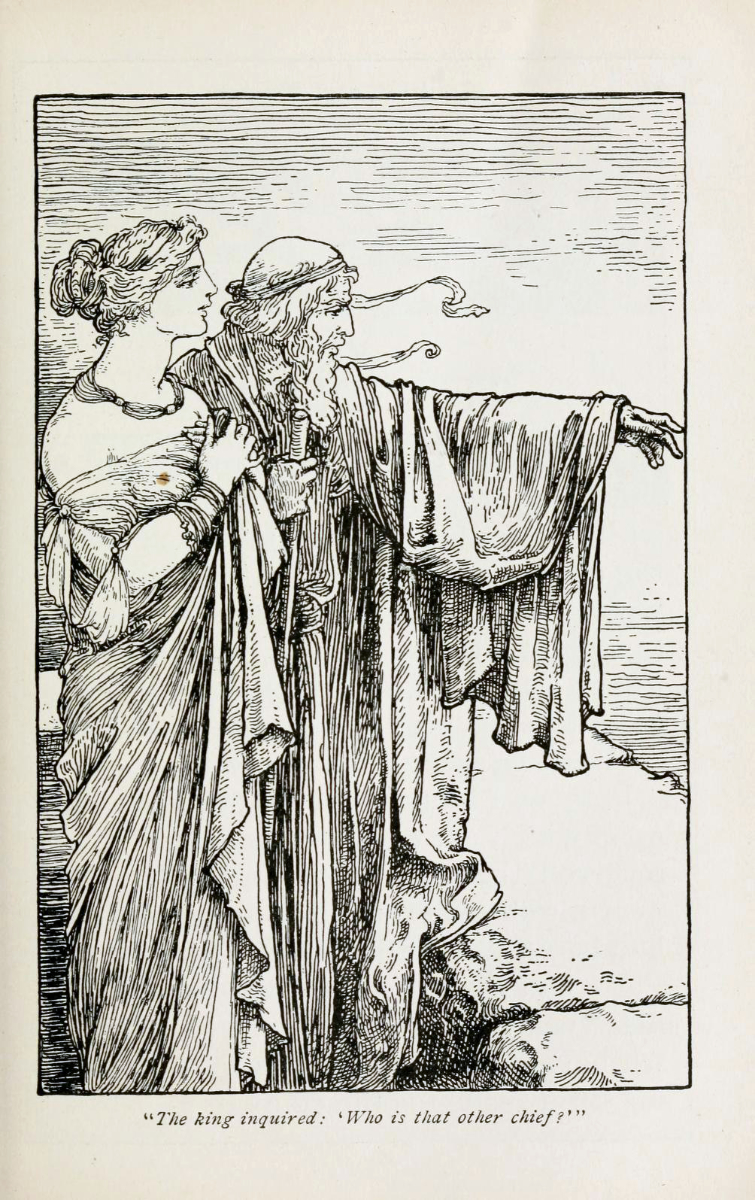
Helen, also known as Helen of Troy, or Helen of Sparta, and in Latin as Helena, was a figure in Greek mythology said to have been the most beautiful woman in the world. She was believed to have been the daughter of Zeus by Leda or Nemesis, and the sister of Clytemnestra, Castor, Pollux, Philonoe, Phoebe and Timandra. She was first married to King Menelaus of Sparta “who became by her the father of Hermione, and, according to others, of Nicostratus also.” Her subsequent marriage to Paris of Troy was the most immediate cause of the Trojan War. Elements of her putative biography come from ancient Greek and Roman authors such as Homer, Hesiod, Euripides, Virgil and Ovid. In her youth, she was abducted by Theseus. A competition between her suitors for her hand in marriage saw Menelaus emerge victorious. All of her suitors were required to swear an oath (known as the Oath of Tyndareus) promising to provide military assistance to the winning suitor, if Helen were ever stolen from him. The obligations of the oath precipitated the Trojan War. When she married Menelaus she was still very young. In most accounts, including Homer’s, Helen ultimately fell in love with Paris and willingly went to Troy with him, though there are also stories in which she was abducted. The legends of Helen during her time in Troy are contradictory. Homer depicts her ambivalently, both regretful of her choice and sly in her attempts to redeem her public image… Stories of her beauty have inspired artists and writers to represent her as the personification of ideal human beauty. Images of Helen started appearing in the 7th century BC. In Classical Greece, her elopement—or abduction—was a popular motif. In medieval illustrations, this event was frequently portrayed as a seduction, whereas in Renaissance paintings it was usually depicted as a “rape” (i. e., a forced abduction) by Paris. Christopher Marlowe’s lines from his tragedy Doctor Faustus (1604) are frequently cited: “Was this the face that launched a thousand ships / And burnt the topless towers of Ilium?”
Appearance List Iliad (c. 8th century BCE) by Homer; Odyssey (c. 8th century BCE) by Homer; Cypria (archaic, fragments); Little Iliad (archaic, fragments); Helen (4th c. BCE) by Isocrates — Defense and reinterpretation of Helen’s role; Helen (5th c. BCE) by Gorgias; Helen (412 BCE) by Euripides — Radical variant; Iphigenia at Aulis (late 5th c. BCE); Orestes (408 BCE); Heroides (c. 1st century BCE) by Ovid; Aeneid (c. 29–19 BCE) by Virgil — retrospective Roman framing of Trojan War, Helen appears in Book II; Bibliotheca (1st–2nd c. CE) — prose account of Helen, Menelaus, and Trojan War cycle; Description of Greece (2nd c. CE); Dante Alighieri’s Divine Comedy (1308–1320); Recueil des histoires de Troie (c. 1464); Shakespeare’s Troilus and Cressida (1602); The Story of Greece: Told to Boys and Girls by Mary Macgregor (c. 1910s) [Internet Archive]; The Age of Fable (1855; many later eds.) by Thomas Bulfinch; Myths of the Greeks and Romans (1893) by H. A. Guerber; The Myths of Greece and Rome (1942) by Edith Hamilton; The Greek Myths (1955) by Robert Graves. Film: Helen of Troy (1956) dir. Robert Wise.
Sample Read Bulfinch’s Mythology by Thomas Bulfinch [Internet Archive]
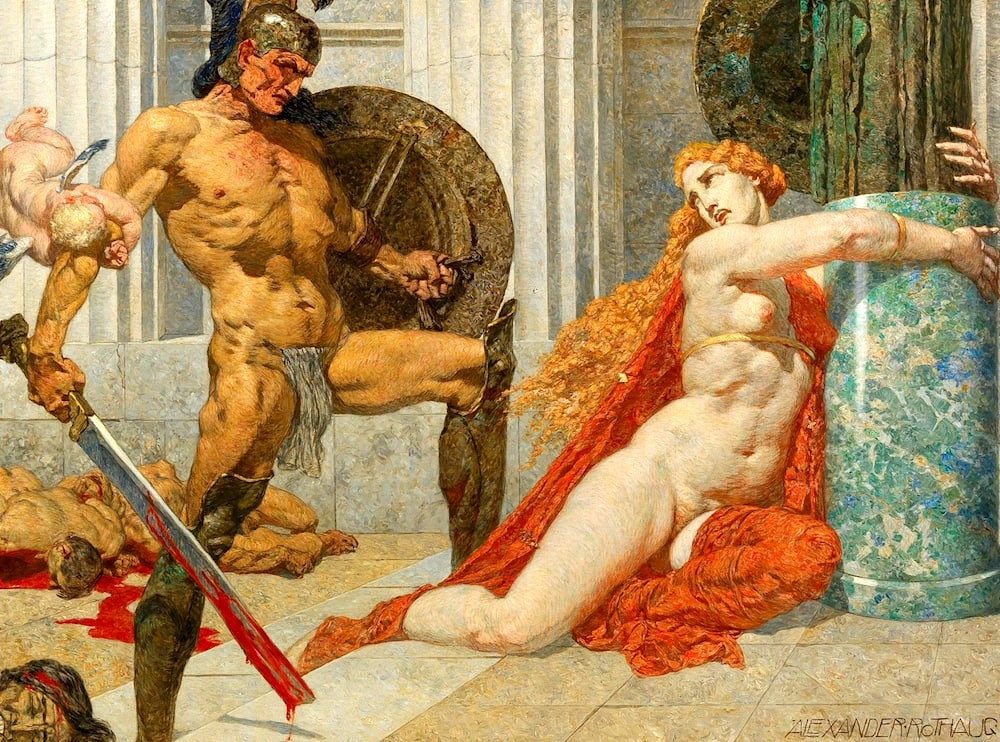
Description Helen, also known as Helen of Troy, or Helen of Sparta, and in Latin as Helena, was a figure in Greek mythology said to have been the most beautiful woman in the world. She was believed to have been the daughter of Zeus by Leda or Nemesis, and the sister of Clytemnestra, Castor, Pollux, Philonoe, Phoebe and Timandra. She was first married to King Menelaus of Sparta “who became by her the father of Hermione, and, according to others, of Nicostratus also.” Her subsequent marriage to Paris of Troy was the most immediate cause of the Trojan War. Elements of her putative biography come from ancient Greek and Roman authors such as Homer, Hesiod, Euripides, Virgil and Ovid. In her youth, she was abducted by Theseus. A competition between her suitors for her hand in marriage saw Menelaus emerge victorious. All of her suitors were required to swear an oath (known as the Oath of Tyndareus) promising to provide military assistance to the winning suitor, if Helen were ever stolen from him. The obligations of the oath precipitated the Trojan War. When she married Menelaus she was still very young. In most accounts, including Homer’s, Helen ultimately fell in love with Paris and willingly went to Troy with him, though there are also stories in which she was abducted. The legends of Helen during her time in Troy are contradictory. Homer depicts her ambivalently, both regretful of her choice and sly in her attempts to redeem her public image… Stories of her beauty have inspired artists and writers to represent her as the personification of ideal human beauty. Images of Helen started appearing in the 7th century BC. In Classical Greece, her elopement—or abduction—was a popular motif. In medieval illustrations, this event was frequently portrayed as a seduction, whereas in Renaissance paintings it was usually depicted as a “rape” (i. e., a forced abduction) by Paris. Christopher Marlowe’s lines from his tragedy Doctor Faustus (1604) are frequently cited: “Was this the face that launched a thousand ships / And burnt the topless towers of Ilium?”


 ,
,  ,
,