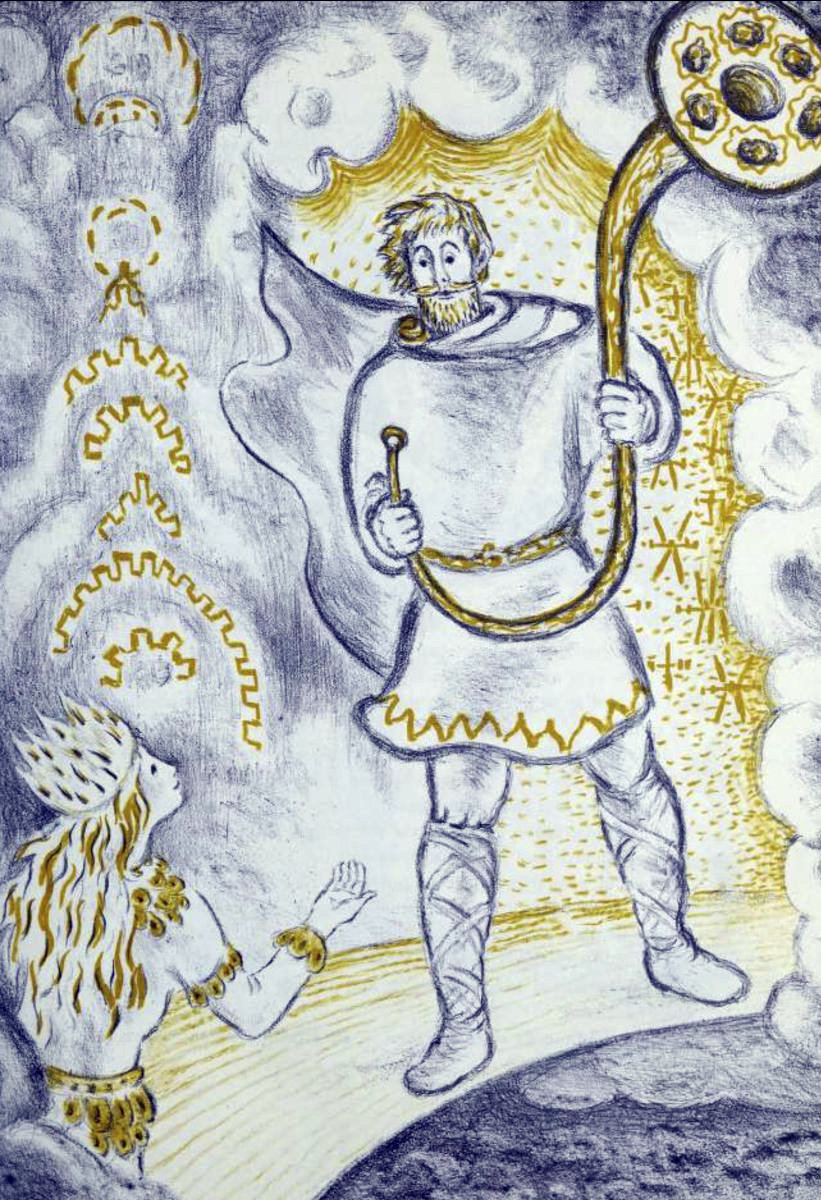
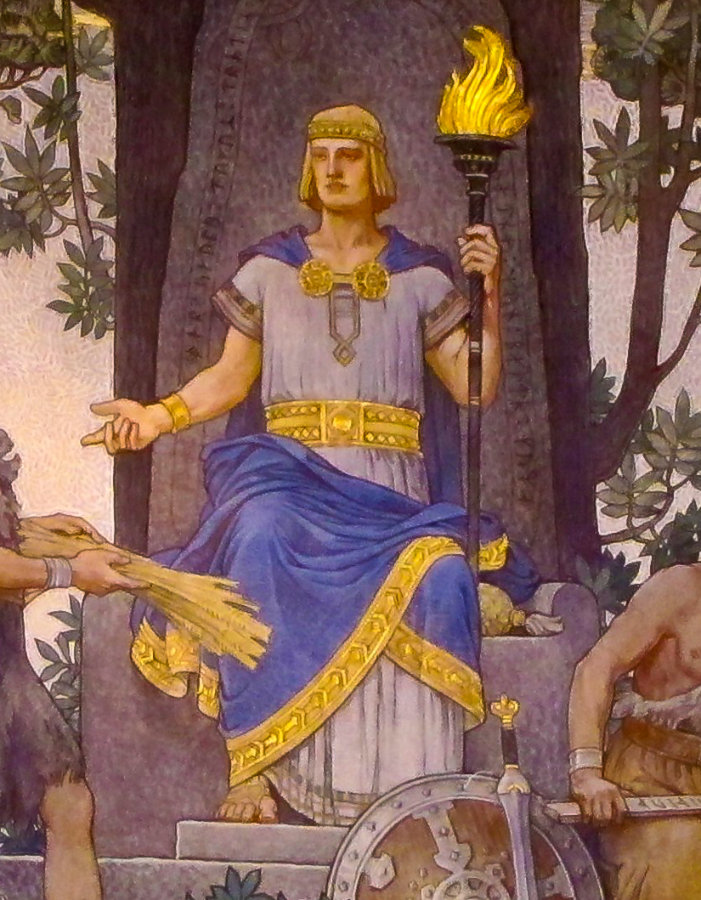
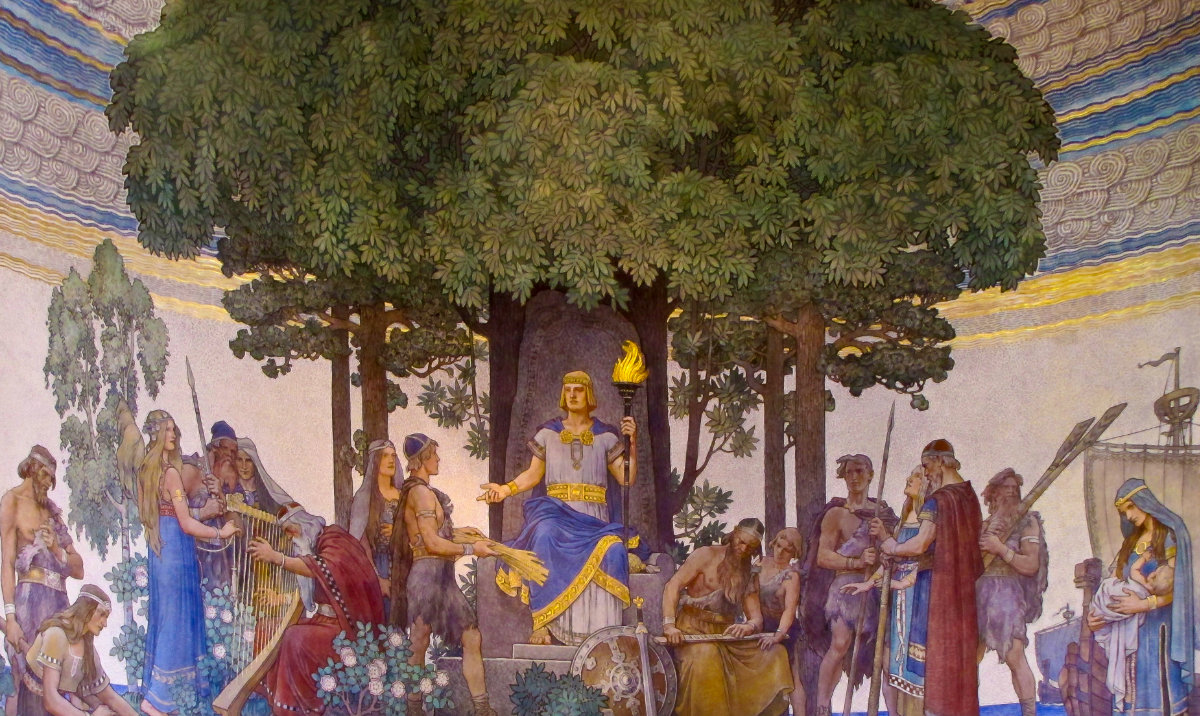
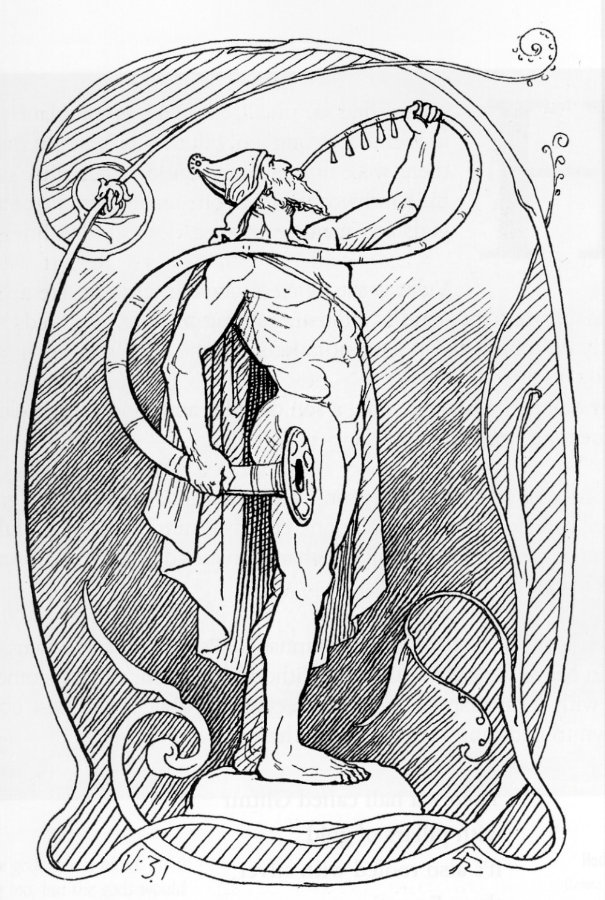
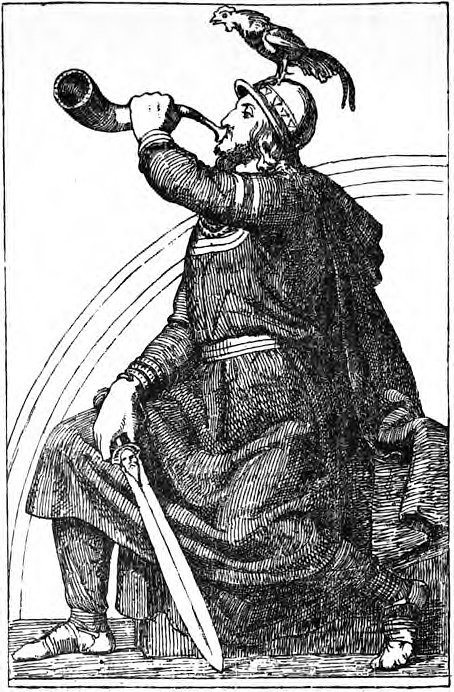
In Norse mythology, Heimdall is a god. He is the son of Odin and nine sisters. Heimdall keeps watch for invaders and the onset of Ragnarök from his dwelling Himinbjörg, where the burning rainbow bridge Bifröst meets the sky. He is attested as possessing foreknowledge and keen senses, particularly eyesight and hearing. The god and his possessions are described in enigmatic manners. For example, Heimdall is golden-toothed, “the head is called his sword”, and he is “the whitest of the gods.” Heimdall possesses the resounding horn Gjallarhorn and the golden-maned horse Gulltoppr, along with a store of mead at his dwelling. He is the son of nine mothers, and he is said to be the originator of social classes among humanity. Other notable stories include the recovery of Freyja’s treasured possession Brísingamen while doing battle in the shape of a seal with Loki. The antagonistic relationship between Heimdall and Loki is notable, as they are foretold to kill one another during the events of Ragnarök. Heimdallr is also known as Rig, Hallinskiði, Gullintanni, and Vindlér or Vindhlér. Heimdall is attested in the Poetic Edda, compiled in the 13th century from earlier traditional material; in the Prose Edda and Heimskringla, both written in the 13th century; in the poetry of skalds; and likely in a runic inscription on the Saltfleetby spindle-whorl found in England. Two lines of an otherwise lost poem about the god, Heimdalargaldr, survive. Due to the enigmatic nature of these attestations, scholars have produced various theories about the nature of the god, including his relation to sheep, borders, and waves.
Alias Heimdall
Real Names/Alt Names Heimdall, Heimdallr, Heimdallur
Appearance List Literary: Prose Edda (c. 1220 CE) by Snorri Sturluson; Poetic Edda (c. 1270 CE); Northern Mythology (1851–1852) by Benjamin Thorpe [Internet Archive]; Asgard Stories: Tales from Norse Mythology (1901) by Mary H. Foster and Mabel H. Cummings [Internet Archive]; In the Days of Giants: A Book of Norse Tales by Abbie Farwell Brown (1902) [Internet Archive]; The Elder or Poetic Edda (1908) [Internet Archive]; The Heroes of Asgard: Tales from Scandinavian Mythology by Keary and Keary (1909) [Internet Archive]; Teutonic Myths and Legends (1912) by Donald A. Mackenzie [Internet Archive]; The Children of Odin (1920) by Padraic Colum [Internet Archive].
Sample Read The Heroes of Asgard: Tales from Scandinavian Mythology [Internet Archive]
Description In Norse mythology, Heimdall is a god. He is the son of Odin and nine sisters. Heimdall keeps watch for invaders and the onset of Ragnarök from his dwelling Himinbjörg, where the burning rainbow bridge Bifröst meets the sky. He is attested as possessing foreknowledge and keen senses, particularly eyesight and hearing. The god and his possessions are described in enigmatic manners. For example, Heimdall is golden-toothed, “the head is called his sword”, and he is “the whitest of the gods.” Heimdall possesses the resounding horn Gjallarhorn and the golden-maned horse Gulltoppr, along with a store of mead at his dwelling. He is the son of nine mothers, and he is said to be the originator of social classes among humanity. Other notable stories include the recovery of Freyja’s treasured possession Brísingamen while doing battle in the shape of a seal with Loki. The antagonistic relationship between Heimdall and Loki is notable, as they are foretold to kill one another during the events of Ragnarök. Heimdallr is also known as Rig, Hallinskiði, Gullintanni, and Vindlér or Vindhlér. Heimdall is attested in the Poetic Edda, compiled in the 13th century from earlier traditional material; in the Prose Edda and Heimskringla, both written in the 13th century; in the poetry of skalds; and likely in a runic inscription on the Saltfleetby spindle-whorl found in England. Two lines of an otherwise lost poem about the god, Heimdalargaldr, survive. Due to the enigmatic nature of these attestations, scholars have produced various theories about the nature of the god, including his relation to sheep, borders, and waves.

 ,
,  ,
,  ,
,  ,
,  ,
,  ,
,