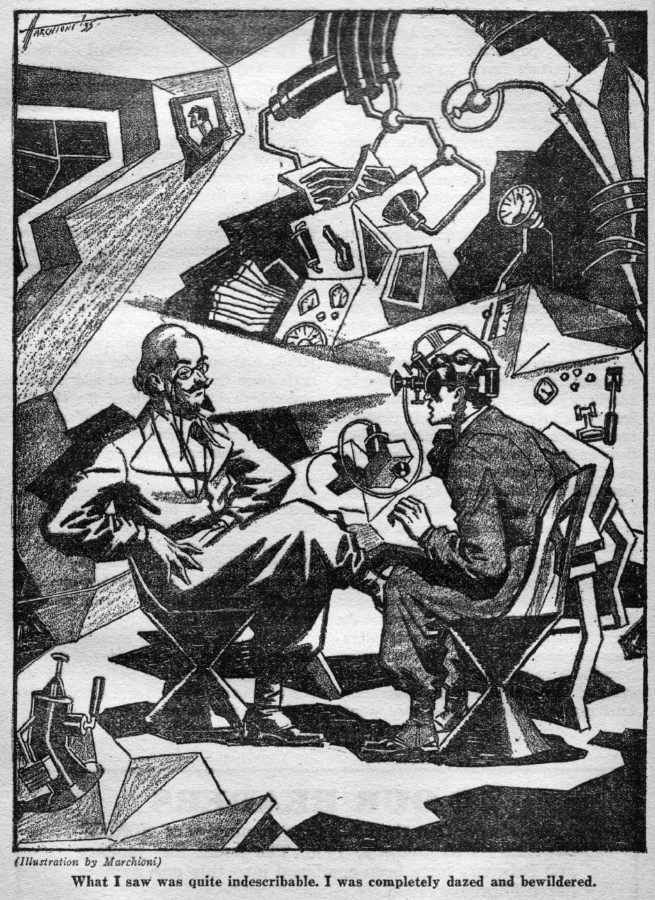
According to the protagonist and narrator, Dixon Wells, Prof. Haskel van Manderpootz is one of the greatest scientific minds of his time. According to van Manderpootz himself, he is the greatest. He is a scientific genius and head of the Department of Newer Physics (i.e. Relativity) at New York University. He inhabits a futuristic 21st century (one of the stories explicitly taking place in 2015) and is mostly well known for being eccentric, easily irritable, and supremely immodest, often comparing himself to the great geniuses of the past, and claiming his intellect to be equal or superior to the likes of Roger Bacon, William de Sitter, and Albert Einstein. For his contemporaries, he has nothing but contempt. His physical appearance hasn’t been described in detail. It’s known that he has “stubby whiskers” and blue eyes. He has been described as having a “broad red face,” and Wells once noted that he was always so red it was impossible to notice if he was blushing. Van Manderpootz’s opinion of himself is quite flattering. He once commissioned a bust of himself from a sculptor named Gogli and intended to donate it either to the city or to the university. He’s quite impulsive, often giving up projects in the midst of them to work on some new idea, and casually dismantling old inventions to make room for new ones. He usually speaks in the third person and doesn’t allow interruptions. In spite of this, he does have a warm heart, and cares a great deal for his ex-student, Dixon Wells, despite considering him something of an imbecile at times. This impression might even be justified to some degree, as despite Wells being smart and competent, he doesn’t come across as particularly responsible, being infamously “always late” and also something of a playboy who loves golf and chorus girls. Van Manderpootz’s inventions include most notably: The subjunctivisor, which allows one to see “what could have been” scenarios (basically parallel worlds, but limited to the possibilities contained within the user’s life experience; i.e. one wouldn’t be able to see a world where they’ve never been born or where the divergence from our timeline had nothing to do with the user’s own life and choices). The idealizator, which allows one to see the most “ideal form” of something to them, for instance, in Wells’ case, his “ideal woman”. The attitudinizor, which allows one to see the world from the point of view of another individual. Each of these machines has been tested by van Manderpootz’s friend and former student Dixon Wells, and in each case the experience ended badly for Dixon, falling in love with a woman who was completely inaccessible to him for one reason or another. Van Manderpootz also designed a “predatory machine”: a huge robot which would act as a predator, attacking cars and sucking out their gasoline to power itself. That machine was never constructed, except for a tiny prototype. Van Manderpootz considered giving the robot intelligence, but ultimately concluded that the idea would be superfluous, as the world wouldn’t need an artificial brain when it already has a brain like van Manderpootz’s. Van Manderpootz’s scientific discoveries are indeed quite revolutionary. He has proven that, just like matter and energy are composed of indivisible units, so are time, space, and thought. He has named the fundamental time particle the “chronon,” and the fundamental space particle the “spation”. Both of these exist immersed in an even more fundamental matrix made of what he named “cosmons”. Finally, but not least important, he has discovered the fundamental particles of thought, these being named “psychons”. According to Van Manderpootz, this theory should allow the construction of machines that could convert anything into anything else: matter into time, energy into space, space into thought, etc. It is based on these principles that his idealizator is built, which converts psychons to light, allowing thoughts to be shown in their ideal form. The attitudinizor, meanwhile, works the other way around, by converting light to psychons. For his contributions to science, van Manderpootz has won the Morell physics award at least six times, the last of which was for the discovery of the psychon. He considers the concept of a “time machine” an impossibility, because it would require an impractical amount of energy to travel even a few seconds to the future, and an infinite amount to travel to the past.
First Appearance “The Worlds of If” in Wonder Stories (Aug 1935)
First Publisher Better / Nedor / Standard / Pines [CB+] [DCM] [GCD]
Appearance List The Worlds of If in Wonder Stories (Aug 1935), “The Ideal” in Wonder Stories (Sep 1935), “The Point of View” in Wonder Stories (Feb 1936)
Description According to the protagonist and narrator, Dixon Wells, Prof. Haskel van Manderpootz is one of the greatest scientific minds of his time. According to van Manderpootz himself, he is the greatest. He is a scientific genius and head of the Department of Newer Physics (i.e. Relativity) at New York University. He inhabits a futuristic 21st century (one of the stories explicitly taking place in 2015) and is mostly well known for being eccentric, easily irritable, and supremely immodest, often comparing himself to the great geniuses of the past, and claiming his intellect to be equal or superior to the likes of Roger Bacon, William de Sitter, and Albert Einstein. For his contemporaries, he has nothing but contempt. His physical appearance hasn’t been described in detail. It’s known that he has “stubby whiskers” and blue eyes. He has been described as having a “broad red face,” and Wells once noted that he was always so red it was impossible to notice if he was blushing. Van Manderpootz’s opinion of himself is quite flattering. He once commissioned a bust of himself from a sculptor named Gogli and intended to donate it either to the city or to the university. He’s quite impulsive, often giving up projects in the midst of them to work on some new idea, and casually dismantling old inventions to make room for new ones. He usually speaks in the third person and doesn’t allow interruptions. In spite of this, he does have a warm heart, and cares a great deal for his ex-student, Dixon Wells, despite considering him something of an imbecile at times. This impression might even be justified to some degree, as despite Wells being smart and competent, he doesn’t come across as particularly responsible, being infamously “always late” and also something of a playboy who loves golf and chorus girls. Van Manderpootz’s inventions include most notably: The subjunctivisor, which allows one to see “what could have been” scenarios (basically parallel worlds, but limited to the possibilities contained within the user’s life experience; i.e. one wouldn’t be able to see a world where they’ve never been born or where the divergence from our timeline had nothing to do with the user’s own life and choices). The idealizator, which allows one to see the most “ideal form” of something to them, for instance, in Wells’ case, his “ideal woman”. The attitudinizor, which allows one to see the world from the point of view of another individual. Each of these machines has been tested by van Manderpootz’s friend and former student Dixon Wells, and in each case the experience ended badly for Dixon, falling in love with a woman who was completely inaccessible to him for one reason or another. Van Manderpootz also designed a “predatory machine”: a huge robot which would act as a predator, attacking cars and sucking out their gasoline to power itself. That machine was never constructed, except for a tiny prototype. Van Manderpootz considered giving the robot intelligence, but ultimately concluded that the idea would be superfluous, as the world wouldn’t need an artificial brain when it already has a brain like van Manderpootz’s. Van Manderpootz’s scientific discoveries are indeed quite revolutionary. He has proven that, just like matter and energy are composed of indivisible units, so are time, space, and thought. He has named the fundamental time particle the “chronon,” and the fundamental space particle the “spation”. Both of these exist immersed in an even more fundamental matrix made of what he named “cosmons”. Finally, but not least important, he has discovered the fundamental particles of thought, these being named “psychons”. According to Van Manderpootz, this theory should allow the construction of machines that could convert anything into anything else: matter into time, energy into space, space into thought, etc. It is based on these principles that his idealizator is built, which converts psychons to light, allowing thoughts to be shown in their ideal form. The attitudinizor, meanwhile, works the other way around, by converting light to psychons. For his contributions to science, van Manderpootz has won the Morell physics award at least six times, the last of which was for the discovery of the psychon. He considers the concept of a “time machine” an impossibility, because it would require an impractical amount of energy to travel even a few seconds to the future, and an infinite amount to travel to the past.